Kinetic-inductance traveling-wave parametric amplifiers (KI-TWPAs) represent a significant advance in amplifying weak signals across a broad range of frequencies, and a team led by Lucas M. Janssen from the University of Cologne, alongside Farzad Faramarzi, Henry G. LeDuc, Sahil Patel, and Peter K. Day from the California Institute of Technology, and Gianluigi Catelani from Forschungszentrum J ̈ulich, now demonstrates their remarkable resilience to challenging operating conditions. This research establishes that KI-TWPAs maintain substantial signal-to-noise ratio improvement even in the presence of strong magnetic fields, functioning effectively up to 0. 35 Tesla in-plane and 50 milliTesla out-of-plane, exceeding the performance of conventional traveling-wave parametric amplifiers. Importantly, the team also finds that gain remains stable up to 3 Kelvin, opening possibilities for use in experiments requiring relatively higher temperatures, and this combination of high-field and temperature stability unlocks a wide range of applications, from advanced qubit technologies to the sensitive search for dark matter. This work confirms the potential of KI-TWPAs to become a versatile and robust tool for diverse scientific investigations.
Kinetic-inductance traveling-wave parametric amplifiers (KI-TWPAs) offer broadband, near-quantum-limited amplification with high saturation power. Due to the high critical magnetic fields of high-kinetic-inductance materials, KI-TWPAs should exhibit resilience to magnetic fields. This work investigates how magnetic field and temperature affect the performance of a KI-TWPA based on a thin-NbTiN inverse microstrip with a Nb ground plane. The research demonstrates that this KI-TWPA can provide substantial signal-to-noise ratio improvement, even in challenging magnetic environments.
Superconducting Qubit Control and Characterisation
Research in superconducting quantum devices is a rapidly expanding field, focused on building the next generation of computers and sensors. A significant portion of this work centers on superconducting qubits, the fundamental building blocks of these quantum systems. Researchers are actively developing different qubit types, refining fabrication techniques, and creating sophisticated control electronics to manipulate and measure their quantum states. Beyond the qubits themselves, substantial effort goes into building the supporting hardware. This includes maintaining the extremely low temperatures required for superconductivity using cryogenics, designing microwave circuits for precise qubit control and readout, and developing materials with optimal superconducting properties.
Quantum sensors and detectors, leveraging superconducting materials, also represent a strong secondary area of research, offering unprecedented sensitivity for various measurements. This diverse field requires expertise from physics, electrical engineering, materials science, and computer science. Current research focuses on scaling up the number of qubits, improving qubit coherence times by reducing noise, and developing advanced materials with enhanced properties. Sophisticated measurement techniques are crucial for characterizing device performance and optimizing designs. Experiments reveal the device delivers improved performance in in-plane magnetic fields up to 0. 35 Tesla and out-of-plane fields of 50 milliTesla, exceeding the capabilities of traditional Josephson junction-based amplifiers. The team measured a second amplifier noise temperature of 13 Kelvin and a minimum noise floor of 0. 48 Kelvin, establishing a baseline for performance evaluation.
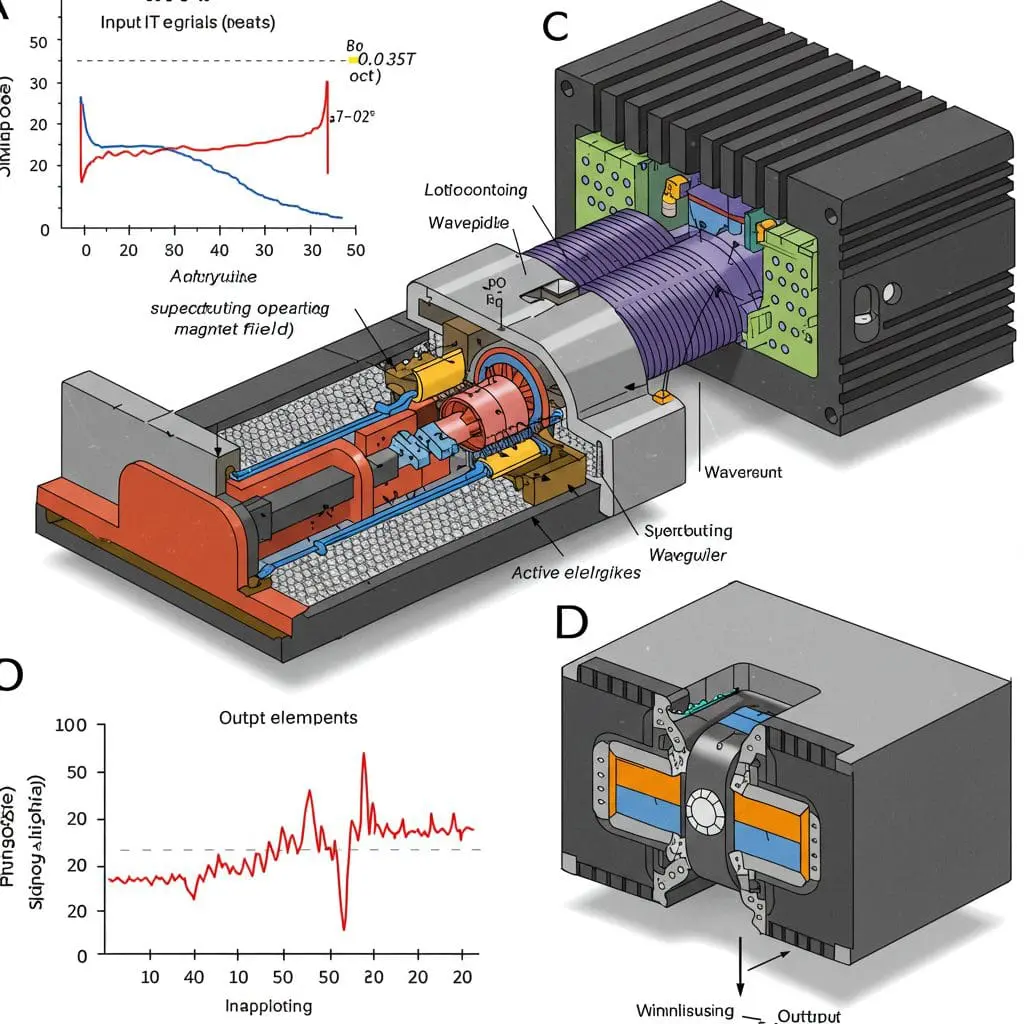
Detailed analysis shows the amplifier’s 3 dB bandwidth initially increases with in-plane field strength, peaking at 0. 2 Tesla, before decreasing, while maintaining similar gain and signal-to-noise ratio. At 0. 3 Tesla, the bandwidth reaches a maximum, demonstrating increased performance despite field-induced losses. The team observed hysteresis in the gain curves, requiring higher pump power at increased fields, consistent with increased insertion loss.
Measurements of out-of-plane magnetic field dependence reveal even more pronounced hysteresis, with the amplifier exhibiting a significant drop in performance at higher fields. The researchers determined that the amplifier maintains stable gain until a clear threshold for field compatibility is reached. Data shows the 3 dB bandwidth initially increases with field strength, peaking at approximately 4GHz, before decreasing, demonstrating a dynamic response to external magnetic forces. 35 Tesla in-plane and 50 milliTesla out-of-plane, representing a significant advance over existing Josephson-junction-based amplifiers. The team achieved this performance using a thin-film niobium-titanium nitride (NbTiN) inverse microstrip design with a niobium ground plane, successfully maintaining high gain and bandwidth under these conditions. Importantly, the amplifier’s performance does not degrade at temperatures up to 3 Kelvin, extending its usability in a wider range of experimental environments.
The study also investigated the effects of magnetic fields on amplifier performance, finding that vortex losses currently limit field compatibility, but can be mitigated through the incorporation of vortex trapping structures or by utilizing alternative ground plane materials. The researchers observed that increased in-plane fields can actually improve bandwidth, likely due to suppression of pump reflections, and that the observed temperature effects align with theoretical expectations. These findings position KI-TWPAs as a promising technology for demanding applications including spin qubits, topological qubits, low-power nuclear magnetic resonance, and the search for axion dark matter. Future work could focus on further enhancing field compatibility and exploring operation at lower temperatures to unlock the full potential of this technology.
🗞 Magnetic-Field and Temperature Limits of a Kinetic-Inductance Traveling-Wave Parametric Amplifier
🧠 ArXiv: https://arxiv.org/abs/2509.15043