

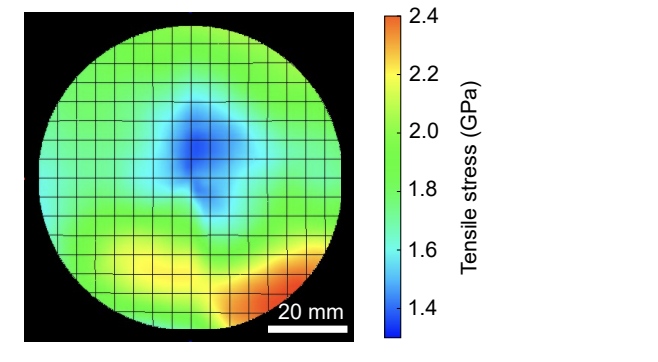
High-quality mechanical resonators are crucial for the precise control of motion at extremely small scales, and researchers continually seek materials offering improved performance. While amorphous silicon nitride has long been a mainstay in these devices, crystalline materials now promise even higher quality factors by combining low energy loss with strong internal stress. Yuki Matsuyama from The University of Tokyo and the RIKEN Center for Quantum Computing, alongside Shotaro Shirai from the RIKEN Center for Quantum Computing and Ippei Nakamura from The University of Tokyo, and colleagues, now demonstrate high-performance membrane resonators fabricated from crystalline titanium nitride. Their devices exhibit exceptional tensile stress exceeding 2. 3 GPa and achieve a quality factor comparable to existing silicon nitride resonators, suggesting crystalline TiN films represent a powerful new platform for building highly sensitive opto- and electromechanical systems.
While amorphous materials like silicon nitride have been widely used, crystalline materials such as titanium nitride are emerging as promising candidates to achieve even higher quality factors by combining low intrinsic loss with high tensile stress. This approach leverages the inherent properties of crystalline structures to minimise energy dissipation, thereby enhancing resonator performance. The pursuit of materials with both low loss and high stress is crucial for advancing the sensitivity and precision of these devices, opening possibilities for more sophisticated quantum technologies.
Silicon Phononic Crystals Fabricated by Deep Etching
The fabrication of these resonators involves a precise microfabrication process starting with a silicon substrate and incorporating a titanium nitride layer. Reactive Ion Etching and chemical etching techniques are used to create suspended TiN membranes. These membranes incorporate phononic crystals, structures designed to enhance the resonator’s quality factor through careful control of sound wave propagation. Finite Element Method simulations are employed to optimise the phononic crystal design, predicting the range of frequencies where the resonator will exhibit peak performance. A sophisticated measurement setup, utilising a Michelson interferometer and heterodyne detection, is used to accurately detect the resonator’s motion and minimise noise.
Analysis of the resonator’s behaviour reveals a complex relationship between temperature, frequency, and external factors. The resonant frequency does not simply decrease with increasing temperature as expected, but exhibits a more complex behaviour, and continues to drift even after temperature stabilisation. Furthermore, the frequency shifts with laser power in an unexpected manner. These shifts are likely caused by the adsorption and desorption of molecules on the membrane surface, rather than changes in tensile stress. This highlights the importance of operating the resonators in a high-vacuum environment and maintaining a clean surface.
TiN Resonators Demonstrate High Quality Factors
Researchers have demonstrated high-performance mechanical resonators fabricated from crystalline titanium nitride (TiN), achieving a quality factor of 8. 0 x 10 6 at 2. 2 Kelvin. These TiN membranes exhibit tensile stress exceeding 2. 3 GPa, a property that holds significant potential for enhancing resonator performance.
Experiments reveal that the intrinsic quality factor of the TiN resonators is comparable to that of silicon nitride resonators, approximately 1. 1 x 10 4 . The team investigated the temperature dependence of both stress and quality factor, finding that while stress remains relatively constant up to 50 Kelvin, the quality factor begins to decrease from 10 Kelvin onwards. Analysis suggests that factors beyond tensile stress contribute to this reduction in quality factor at lower temperatures. By applying a dissipation dilution formula, researchers estimated the intrinsic quality factor and determined that the observed decrease is primarily attributed to a reduction in this intrinsic value.
Comparative analysis with silicon nitride resonators indicates that, under current experimental conditions, TiN does not offer a substantial advantage in achievable quality factor, despite its higher tensile stress. However, simulations demonstrate that implementing a “soft clamping” technique, a design that minimises energy dissipation at the resonator’s supports, could unlock TiN’s full potential. Applying soft clamping to TiN resonators is predicted to achieve a quality factor exceeding 10 9 for a 1 MHz mechanical mode, significantly surpassing the performance of conventional silicon nitride designs. These findings suggest that crystalline TiN, combined with optimized designs, represents a promising material for developing highly sensitive and precise opto- and electromechanical systems. Researchers acknowledge that increasing membrane size and reducing thickness could further enhance the quality factor, and future work will focus on microwave measurements at extremely low temperatures, alongside exploring device designs that fully leverage TiN’s ultra-high stress. These advancements may ultimately contribute to the development of quantum transducers, sensors, and hybrid quantum systems.
🗞 High- membrane resonators using ultra-high-stress crystalline TiN films
🧠 ArXiv: https://arxiv.org/abs/2509.02987


