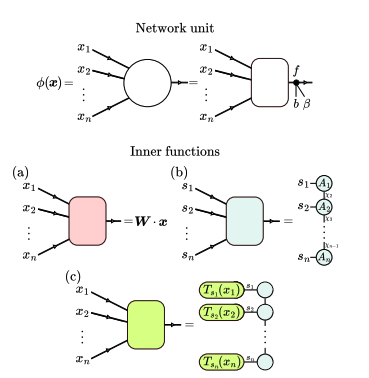
Researchers developed ‘perceptrains’, a novel neural network architecture integrating features of tensor networks to efficiently represent many-body quantum states. Applied to a transverse field Ising model, the method achieved high accuracy—around 0.1% via Variational Monte Carlo and 0.01% via Green Function Monte Carlo—using minimal computational resources and robust optimisation.
The simulation of complex quantum systems presents a significant computational challenge, particularly when dealing with many interacting particles. Researchers continually seek methods to represent these ‘many-body states’ efficiently, balancing accuracy with manageable computational cost. Recent approaches have explored the potential of artificial neural networks, leveraging their representational power, while established techniques like tensor networks offer structured, optimisable solutions, albeit with limitations in higher dimensions. A new study, detailed in ‘Hybrid between biologically inspired and quantum inspired many-body states’ by Miha Srdinšek, Xavier Waintal, and colleagues from Université Grenoble Alpes, CEA, and Grenoble INP, proposes a novel variational ansatz – the ‘perceptrain’ – that combines features of both neural networks and tensor networks. This hybrid approach aims to achieve accurate representations of quantum states with improved optimisation and reduced computational demands, demonstrated here using a transverse field Ising model relevant to Rydberg atom quantum annealing.
Computational Advances in Quantum Material Simulation
Research focuses on the development and application of sophisticated computational techniques to elucidate the behaviour of complex quantum materials. These materials exhibit properties arising from the collective behaviour of many interacting quantum particles, presenting significant challenges for theoretical modelling.
Several established computational methods form the basis of this work. Density Matrix Renormalization Group (DMRG), a variational method, proves particularly effective in simulating one-dimensional strongly correlated systems. It achieves this by iteratively refining an approximation to the ground state wavefunction. Determinantal Quantum Monte Carlo (DQMC) employs stochastic sampling to solve the many-body Schrödinger equation, offering a complementary approach. However, DQMC suffers from the ‘sign problem’ – an exponential increase in computational cost as system size increases, limiting its applicability. Tensor Networks provide a powerful framework for representing and manipulating quantum states, especially in higher dimensions. These methods represent the wavefunction as a network of interconnected tensors, reducing the computational scaling compared to traditional approaches. A prominent example is Projected Entangled Pair States (PEPS), a two-dimensional generalisation of Matrix Product States used in DMRG.
Current research prioritises improving the accuracy and efficiency of these established methods. A central challenge remains the mitigation of the sign problem in Quantum Monte Carlo simulations. This involves developing algorithms and techniques to reduce the fluctuations that cause the exponential scaling of computational cost. Simultaneously, efforts focus on extending the applicability of tensor network methods to larger and more complex systems.
A novel computational approach, termed Perceptrain, is under development. This method combines the strengths of both neural networks and tensor networks. Neural networks excel at learning complex patterns and functions, while tensor networks provide a structured and efficient representation of quantum states. Perceptrain leverages local optimisation strategies, similar to those employed in DMRG, for parameter tuning. This avoids the computationally expensive global optimisation procedures often required in neural network training. Crucially, the architecture incorporates mechanisms for state compression, further reducing computational demands. Initial tests on the transverse field Ising model demonstrate that Perceptrain achieves high accuracy with comparatively modest computational resources, outperforming traditional Matrix Product States in certain regimes.
A key aspect of this research is the validation of theoretical simulations against experimental data. Particular emphasis is placed on connecting with results obtained from Rydberg atom platforms. Rydberg atoms, with their strong interactions and controllable properties, serve as a versatile platform for quantum simulation. By comparing theoretical predictions with experimental observations from these platforms, researchers aim to refine their models and gain deeper insights into the behaviour of real materials. The ultimate goal is to bridge the gap between theory and experiment, providing a predictive understanding of quantum materials and guiding the development of novel quantum technologies.
👉 More information
🗞 Hybrid between biologically inspired and quantum inspired many-body states
🧠 DOI: https://doi.org/10.48550/arXiv.2506.05050