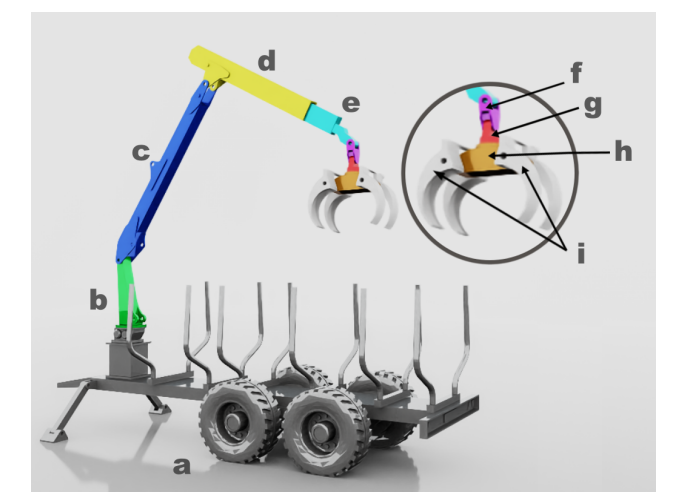
The demanding task of log loading presents a significant challenge in modern forestry, requiring skilled operators to work for extended periods in remote environments. Researchers, including Ilya Kurinov and Miroslav Ivanov from LUT University and Lapland University of Applied Sciences respectively, alongside Grzegorz Orzechowski and Aki Mikkola from LUT University, are addressing this issue by developing automated solutions using artificial intelligence. Their work focuses on applying reinforcement learning to create an agent capable of independently locating, grappling, transporting, and delivering logs to a forestry forwarder, effectively automating the entire loading process. This achievement represents a crucial step towards reducing operator stress and improving efficiency in timber harvesting, with the team’s best-performing agent successfully completing the task with a 94% success rate in a simulated environment.
Autonomous Log Forwarding with Reinforcement Learning
This research details a significant advance in automating forestry operations, specifically controlling a forwarder, a vehicle used to transport logs. Scientists successfully trained a forwarder to autonomously pick up and transport logs within a simulated environment, addressing a challenging task due to complex terrain and the need for precise manipulation of heavy loads. The team employed a curriculum learning approach, starting with simpler tasks and gradually increasing complexity to improve training efficiency and performance. This work leverages the high-performance, GPU-accelerated physics simulation provided by Isaac Gym, enabling realistic training scenarios and focusing on the critical aspects of grasping and manipulating logs.
The results demonstrate the feasibility of using reinforcement learning to develop autonomous control systems for forestry machinery, potentially increasing efficiency, reducing labor costs, and improving safety for human operators. This research paves the way for more sustainable forestry operations by automating tasks and optimizing harvesting practices. Code and a video demonstration are publicly available, allowing other researchers to build upon these findings and accelerate the development of autonomous forestry machines.
Forestry Automation via Reinforcement Learning Curriculum
Scientists have developed a novel reinforcement learning approach to fully automate log handling for forestry forwarders, extending previous work that focused solely on grasping. The study pioneered a simulation environment built within Isaac Gym, modeling a trailer-type forestry forwarder operating in a typical log loading scenario, enabling extensive agent training. Researchers engineered a curriculum learning approach, progressively increasing task complexity to facilitate robust agent development. This method involved training an agent to locate, grapple, transport, and deliver logs to the forwarder bed, automating the entire loading procedure.
The agent learned to grasp logs from random initial positions, utilizing a randomly positioned grapple, and successfully transport them to the forwarder bed with a 94% success rate for the best performing agent. This achievement demonstrates the feasibility of applying reinforcement learning to complex, long-horizon tasks with shifting objectives, such as grabbing, transporting, and loading. To facilitate training and evaluation, scientists created a virtual environment that accurately simulates the dynamics of a forestry forwarder and the surrounding terrain, incorporating realistic physics and sensor models.
Forestry Automation via Reinforcement Learning Agents
This work demonstrates a significant breakthrough in automating log handling for forestry forwarders using reinforcement learning agents. Scientists achieved a 94% success rate for the best performing agent in grasping a log from a random position and transporting it to the forwarder bed. The research team developed a simulation model within Isaac Gym, creating a virtual environment for a typical log loading scenario, and then trained agents using a curriculum learning approach. Experiments reveal that a two-stage curriculum training process is particularly effective, first focusing on core skills like grasping, lifting, and moving logs, and then augmenting the reward function to promote vertical log motion and safe unloading.
Analysis of cumulative rewards demonstrates that agents consistently improve their performance over time, with rapid skill development observed between 60 and 140 training steps. The research confirms the effectiveness of the reward shaping and curriculum learning methods, demonstrating their contribution to policy generalization and stability. This achievement represents a crucial step towards fully automating forestry forwarders and reducing operator stress.
Forestry Automation Via Curriculum Reinforcement Learning
This study demonstrates successful training of an autonomous agent to handle logs within a simulated forestry forwarder environment. The research team achieved a 94% success rate in locating, grasping, transporting, and loading logs, showcasing the potential of reinforcement learning for automating this complex task. A key element of this approach involved curriculum learning and reward shaping, which decomposed the log handling process into manageable subtasks and introduced them progressively to the agent. Experiments confirm that this curriculum-based sequencing improves training stability and final performance, enabling the agent to master each subtask sequentially and accelerating convergence. While the study demonstrates promising results, the authors acknowledge limitations stemming from the use of an older version of the simulation software. Future work may focus on continuing training with a higher fidelity simulator or exploring the use of multiple agents, each dedicated to a specific subtask, to further enhance performance and generalization capabilities.
🗞 Towards Reinforcement Learning Based Log Loading Automation
🧠 ArXiv: https://arxiv.org/abs/2510.26363