

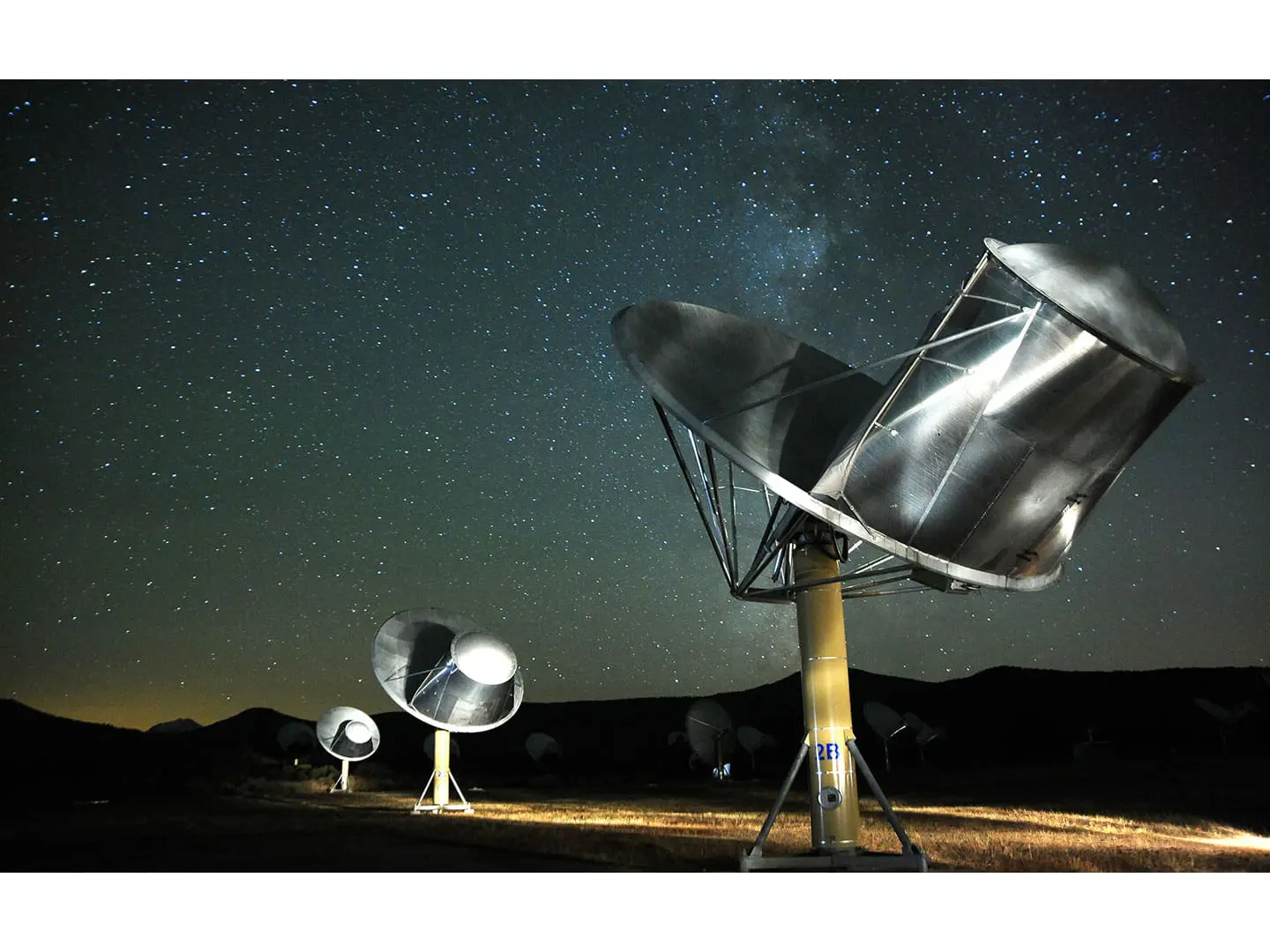
Researchers at the Penn State Extraterrestrial Intelligence Center have been awarded a three-year, $480,000 grant from NASA to search for radio and laser signals from alien civilizations. The project, led by doctoral student Pinchen Fan under the supervision of Professor Jason Wright, aims to develop novel technosignature detection techniques using the Habitable Zone Planet Finder and the Allen Telescope Array.
This initiative marks a resurgence in NASA’s support for the search for extraterrestrial intelligence, with Wright noting that the field has been historically underfunded but is now gaining traction. The team will analyze patterns of deep-space radio transmissions and use infrared spectroscopic measurements to detect potential communicative laser transmissions from planets outside the solar system. Key individuals involved include Pinchen Fan, Jason Wright, and Suvrath Mahadevan, with technologies such as the Habitable Zone Planet Finder and the Allen Telescope Array playing a crucial role in the research.
Introduction to the Search for Extraterrestrial Intelligence
The search for extraterrestrial intelligence (SETI) has been a topic of interest and debate within the scientific community for decades. Recently, researchers at the Penn State Extraterrestrial Intelligence Center have been awarded a three-year, $480,000 grant under the NASA Exoplanets Research Program to search for radio and laser signals from alien civilizations. This project is led by Pinchen Fan, a doctoral student in astronomy, astrophysics, and astrobiology, under her adviser, Jason Wright, professor of astronomy and astrophysics and director of the PSETI Center. The grant marks a significant milestone for both Penn State and the broader field of SETI research, which has been historically underfunded by NASA but is now seeing a resurgence in attention and support.
The PSETI Center was founded in 2020 to establish Penn State as an academic leader in technosignature research. Through initiatives like this NASA-funded project, the center provides a platform for researchers to explore sophisticated technosignature detection methods and more. The renewed interest from NASA is a game-changer for SETI research, providing researchers with the resources and support needed to push the boundaries of their understanding and explore uncharted territories in the search for extraterrestrial intelligence. This funding underscores Penn State’s prominent role in a field that is gaining traction within the scientific community.
The project aims to develop novel laser and radio technosignature detection techniques that will push the boundaries of how researchers can detect technosignatures from planets outside the solar system. Technosignatures are defined as any detectable sign that would indicate the presence of intelligent civilizations elsewhere in the universe. The researchers will analyze the patterns of humanity’s most powerful deep-space radio transmissions as a baseline for understanding the patterns of a civilization’s transmissions to its own interplanetary probes. They will use these patterns as a guide to how they might eavesdrop on radio transmissions from other spacefaring civilizations that are not specifically intended for Earth.
The researchers will also use the tens of thousands of infrared spectroscopic measurements taken by the Habitable Zone Planet Finder (HPF) built at Penn State to detect planets orbiting other stars and see if there are any communicative laser transmissions coming from them. The HPF is an astronomical spectrograph installed on the 10-meter Hobby-Eberly Telescope at the McDonald Observatory in Texas. This approach is a novel search for laser transmissions, as humanity has been moving towards laser communications for interplanetary communications for a while now, and it makes sense that other species might do the same.
The Role of the Habitable Zone Planet Finder
The Habitable Zone Planet Finder (HPF) plays a crucial role in the search for extraterrestrial intelligence. The HPF is an astronomical spectrograph installed on the 10-meter Hobby-Eberly Telescope at the McDonald Observatory in Texas. It has taken tens of thousands of infrared spectroscopic measurements to detect planets orbiting other stars. By using these measurements, the researchers can search for communicative laser transmissions coming from these planets. This approach is a novel search for laser transmissions, as it utilizes the HPF’s capabilities to detect planets in the habitable zones of their respective stars.
The use of the HPF in the search for extraterrestrial intelligence highlights the importance of interdisciplinary research and collaboration. The HPF was built at Penn State, and its principal investigator, Suvrath Mahadevan, is a professor of astronomy and astrophysics. The collaboration between the PSETI Center and the HPF team demonstrates the value of combining expertise from different fields to advance our understanding of the universe. By leveraging the capabilities of the HPF, the researchers can explore new avenues in the search for extraterrestrial intelligence.
The Significance of NASA’s Support
NASA’s support for the technosignature research reflects both the growing scientific credibility and public interest in SETI. The funding underscores Penn State’s prominent role in a field that is gaining traction within the scientific community. The 2018 workshop, along with a series of SETI Symposia hosted by the PSETI Center on Penn State’s University Park campus, played a pivotal role in renewing NASA’s focus on SETI research. The grant from NASA highlights a pivotal moment in the advancement of SETI as a scientific discipline and the pioneering work being done at Penn State.
The support from NASA is crucial for the advancement of SETI research, as it provides the necessary resources and funding to explore new avenues in the search for extraterrestrial intelligence. The funding will enable researchers to develop new techniques, collaborate with other experts, and push the boundaries of their understanding. With renewed support, innovative ideas, and a team of dedicated researchers, Penn State is well-positioned to lead in the quest to uncover evidence of intelligent life beyond Earth.
The Future of SETI Research
The search for extraterrestrial intelligence is an ongoing effort that requires continuous innovation and collaboration. The PSETI Center is building an interdisciplinary academic SETI community, developing a SETI curriculum at the undergraduate and graduate levels, and training new SETI researchers. The center provides a platform for researchers to explore sophisticated technosignature detection methods and more. By combining expertise from different fields, the researchers can advance our understanding of the universe and potentially answer the age-old question: “Are we alone?”
The future of SETI research holds much promise, as new technologies and techniques are being developed to aid in the search for extraterrestrial intelligence. The use of artificial intelligence, machine learning, and other advanced computational methods will enable researchers to analyze large datasets and identify patterns that may indicate the presence of intelligent life. The collaboration between scientists, engineers, and theorists will be crucial in advancing our understanding of the universe and potentially uncovering evidence of extraterrestrial intelligence.
Conclusion
The search for extraterrestrial intelligence is a complex and ongoing effort that requires continuous innovation and collaboration. The recent grant from NASA to the PSETI Center highlights the growing scientific credibility and public interest in SETI research. The use of novel techniques, such as the analysis of radio transmissions and laser communications, demonstrates the importance of interdisciplinary research and collaboration. With renewed support, innovative ideas, and a team of dedicated researchers, Penn State is well-positioned to lead in the quest to uncover evidence of intelligent life beyond Earth. As we continue to explore the universe and push the boundaries of our understanding, we may eventually answer the age-old question: “Are we alone?”
External Link: Click Here For More


