

Understanding the behaviour of electrons within materials is fundamental to developing new technologies, and angle-resolved photoemission spectroscopy, or ARPES, offers a powerful way to investigate these electronic properties. Phil D. C. King, along with colleagues at the University of St Andrews, now presents a new Python package, named ‘peaks’, designed to streamline the complex analysis of ARPES data. This software addresses the growing need for tools capable of handling the increasingly large and multi-dimensional datasets generated by modern ARPES experiments, offering fast visualisation and parallel processing capabilities. By simplifying the analysis process, ‘peaks’ promises to accelerate research into a wide range of materials, including those crucial for next-generation electronics and energy technologies.
Angle-resolved photoemission spectroscopy (ARPES) directly probes the electronic band structures of materials and is widely used to study functional, quantum, and two-dimensional materials. The software package, peaks, provides a Python-based solution for advanced ARPES data analysis, handling the complex data hierarchies typical of these experiments. It efficiently visualises and analyses multi-dimensional datasets, accommodating the ever-increasing data volumes now routinely acquired in ARPES studies, through lazy loading and parallel processing.
ARPES Data Analysis with Interactive Notebooks
The package offers a comprehensive toolkit for angle-resolved photoemission spectroscopy (ARPES) and related spectroscopic data analysis, employing a modular approach that supports researchers from initial data acquisition through advanced analysis. It is designed for use within interactive notebooks, with extensive graphical user interface support for data visualisation. Recent advances have transformed ARPES into a multidimensional spectroscopy, with measurements now routinely incorporating energy, three momentum directions, temperature, spin, spatial resolution, and temporal dependence. This generates complex, high-dimensional datasets, necessitating efficient handling and analysis techniques, particularly during intensive experimental campaigns at international light sources.
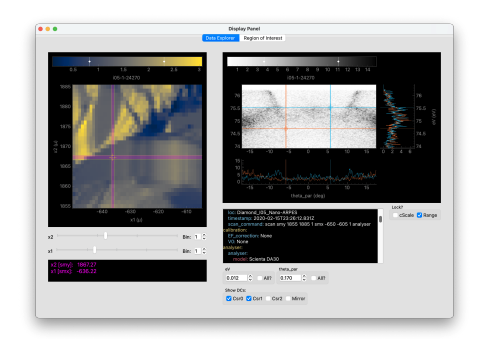
There is increasing demand for incorporating machine learning methods into the analysis pipeline, and ensuring transparency and reproducibility through FAIR data principles. The package utilises N-dimensional labelled arrays and datasets in Python, enabling dynamic task scheduling and facilitating analysis even of very large datasets. It supports a range of functionalities, including interactive tools for exploring four-dimensional datasets and region of interest analysis, as well as fitting procedures applicable to individual or large sets of data, such as those acquired in spatially-resolved measurements. The framework is available as an open-source package, designed to be extensible and adaptable to various ARPES experimental configurations.
Peaks Package Streamlines ARPES Data Analysis
The electronic properties of materials are fundamentally determined by how electrons move within them, and angle-resolved photoemission spectroscopy (ARPES) is a crucial technique for directly observing this electron behaviour. Researchers have developed a new Python package, peaks, designed to streamline and enhance ARPES data analysis, addressing limitations in existing software and accommodating the increasing complexity of modern experiments. This package provides a comprehensive toolkit, supporting researchers from the initial stages of data acquisition through advanced analysis and visualisation. peaks distinguishes itself through its ability to handle exceptionally large datasets, a growing necessity in the field, by utilising efficient data loading and processing techniques.
It leverages the power of ‘xarray’ and ‘dask’ packages, allowing researchers to analyse datasets that exceed available memory and to perform calculations in parallel, significantly reducing processing time. The package’s modular design and class-based structure also make it easily extensible, allowing users to adapt it to new experimental setups and data formats with relative ease. A key feature of peaks is its focus on data provenance and collaborative work. The package meticulously records each processing step, creating a detailed analysis history that enhances transparency and reproducibility.
This, combined with its compatibility with interactive notebooks, facilitates effective collaboration among researchers. Furthermore, peaks offers extensive visualisation capabilities, including tools for two-dimensional, three-dimensional, and four-dimensional datasets, and aids in sample alignment, a critical step in ARPES measurements. Beyond basic data handling and visualisation, peaks incorporates specific tools tailored to ARPES analysis, such as momentum and energy distribution curve extraction, data normalisation, and fitting routines. It also includes initial functionality for analysing spatially-resolved ARPES data using machine learning techniques, opening avenues for more sophisticated data exploration. The package’s developers envision future enhancements including support for spin-resolved ARPES data and the integration of additional machine learning approaches, solidifying its position as a versatile and powerful tool for the ARPES community.
Peaks streamlines ARPES data analysis and sharing
The development of the Python package, peaks, addresses the growing need for advanced data analysis tools in angle-resolved photoemission spectroscopy (ARPES). This software facilitates the visualisation and analysis of the increasingly complex, multi-dimensional datasets now common in ARPES experiments, while also supporting efficient data handling through lazy loading and parallel processing. peaks is designed for interactive use, offering extensive graphical user interface support for data exploration and manipulation. By providing a flexible and open-source platform, peaks aims to improve transparency and reproducibility in ARPES data analysis, particularly as researchers increasingly incorporate machine learning techniques and collaborate on large-scale experiments at international facilities.
🗞 peaks: a Python package for analysis of angle-resolved photoemission and related spectroscopies
🧠 ArXiv: https://arxiv.org/abs/2508.04803


