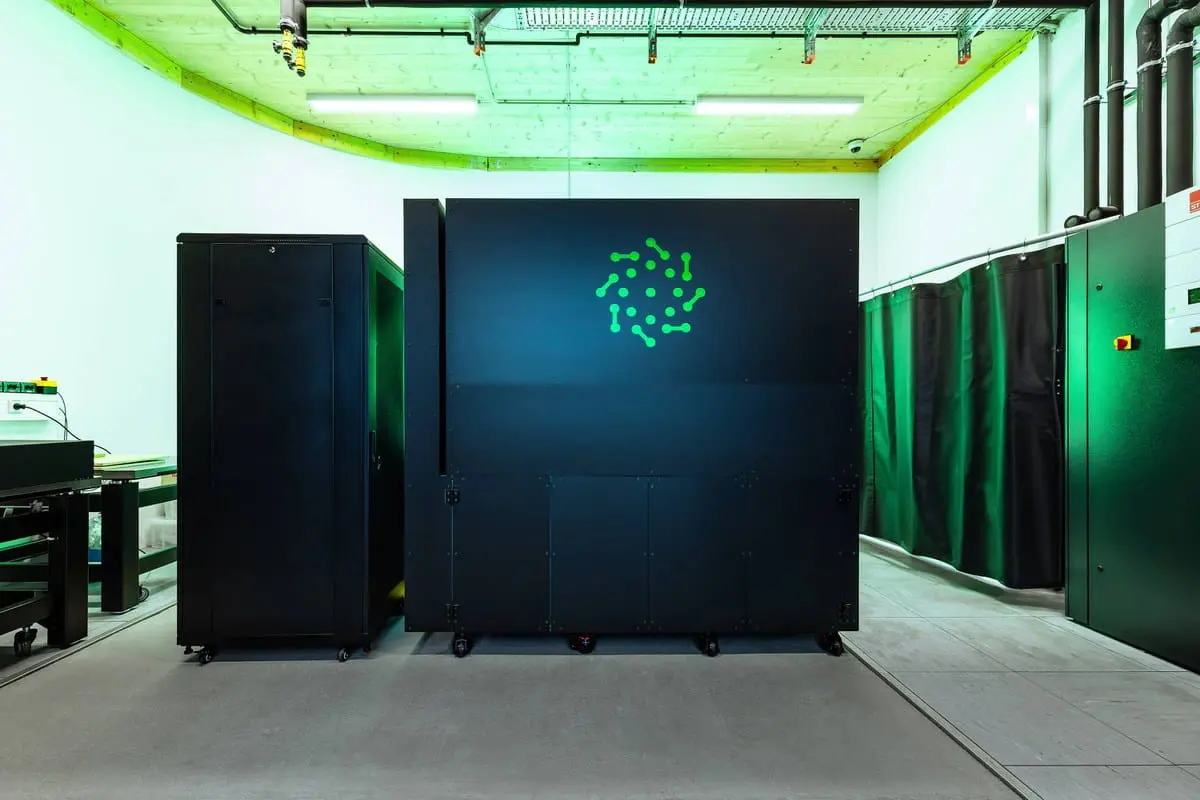
A major milestone in the development of Europe’s hybrid quantum-HPC infrastructure has been reached with the deployment of a new quantum computer at the Jülich Supercomputing Centre in Germany. The quantum computer, developed by French company Pasqal, uses neutral atoms to generate qubits and is expected to be available by June 2025.
This marks a significant step forward in the High Performance Computer and Quantum Simulator hybrid (HPCQS) project, a Europe-wide initiative aimed at advancing the European hybrid quantum-HPC infrastructure. The HPCQS project is led by researchers from Forschungszentrum Jülich, including Professor Dr Alain Aspect, a Nobel Prize winner in Physics. Pasqal’s technology is based on the work of its founders, including Georges-Olivier Reymond and Christophe Jurczak.
The EuroHPC Joint Undertaking, which coordinates European efforts in supercomputing, has procured four quantum computers currently being deployed across Europe, with more to follow in the near future.
The recent announcement by Anders Jensen, Executive Director of the EuroHPC Joint Undertaking (EuroHPC JU), highlights the potential of combining quantum and classical HPC resources to tackle complex scientific challenges.
At the forefront of this innovation is Pasqal‘s quantum computer, which utilizes neutral atoms to generate qubits. This analog computing approach enables the solution of quantum mechanical multi-particle systems, allowing scientists to study complex properties and dynamics in a controlled environment. Using neutral atoms ensures stable quantum calculations, as they interact weakly with electromagnetic fields.
The High Performance Computer and Quantum Simulator hybrid
The High Performance Computer and Quantum Simulator hybrid (HPCQS) project is a Europe-wide initiative to advance the European hybrid quantum-HPC infrastructure. By integrating classical and quantum computing power, researchers will be able to tackle complex scientific challenges that were previously unsolvable.
The HPCQS infrastructure is designed to be open and evolutionary, allowing for the integration of diverse quantum computing platforms at different technology readiness levels. This will enable the expansion of the European Quantum Computing and Simulation Infrastructure (EuroHPC-QCS), as advocated for in the Strategic Research and Industry Agenda 2030 of the European Quantum Flagship.
The deployment of two quantum computers, one in France and another in Jülich, Germany, is expected to be completed by June 2025. These systems will enable the calculation of first use cases, marking a significant milestone in the development of hybrid classical-quantum HPC resources.
The Jülich Supercomputing Centre (JSC) at Forschungszentrum Jülich plays a crucial role in this initiative, providing researchers with access to supercomputers and quantum computing infrastructure. The JSC’s expertise in high-performance computing and artificial intelligence will be essential in developing reliable and transparent AI tools.
Pasqal, a leading company in the field of quantum computing, is at the forefront of this innovation. Founded by renowned experts in the field, including Physics Nobel Prize Winner 2022, Professor Dr Alain Aspect, Pasqal’s technology has the potential to provide a practical quantum advantage for real-world problems.
The EuroHPC JU has been instrumental in enabling
The EuroHPC JU has been instrumental in enabling Europe to become a world leader in supercomputing. By pooling resources and coordinating efforts across European countries, the EuroHPC JU has procured nine supercomputers and four quantum computers, providing access to cutting-edge technologies for scientists and users from the public sector and industry.
As we look ahead to the months and years to come, it’s clear that the combination of classical and quantum HPC resources will revolutionize the way we approach complex scientific challenges. With the deployment of these hybrid systems, Europe is poised to take a significant leap forward in fields such as materials science, chemistry, and climate modeling, among others.
As a science journalist, I’m excited to continue covering this rapidly evolving field and exploring the transformative potential of hybrid classical-quantum HPC resources.
External Link: Click Here For More