Pasqal, a leader in neutral-atom quantum computing, has achieved a significant milestone by successfully loading over 1,000 atoms in a single shot within their quantum computing setup. This advancement demonstrates the feasibility of large-scale neutral atom quantum computing. The atoms are confined and manipulated using electromagnetic fields, serving as the quantum states of the qubits. This achievement is crucial for building scalable quantum processors capable of solving complex problems. Co-CEO of Pasqal, Loic Henriet, emphasized that this milestone illustrates the scalability of Pasqal’s quantum processors and will fuel the design of future hardware products.
Pasqal’s Quantum Computing Advancement: Over 1,000 Atoms Trapped
Pasqal, a company specializing in neutral-atom quantum computing, recently announced a significant technological achievement: the successful loading of over 1,000 atoms in a single shot within their quantum computing setup. This accomplishment is a crucial step in Pasqal’s progress towards quantum advantage and scalable quantum processors.
In a significant development for the quantum computing industry, Pasqal has trapped more than 1,110 atoms within approximately 2,000 traps, demonstrating the feasibility of large-scale neutral atom quantum computing. In Pasqal’s quantum computing architecture, these atoms are confined and manipulated using electromagnetic fields. The internal energy states of these atoms serve as the quantum states of the qubits, which are manipulated to perform quantum operations and execute quantum algorithms.
Innovative Techniques in Quantum Computing: Pasqal’s Approach
Pasqal’s latest achievement in quantum computing involves the successful trapping of single rubidium atoms in large arrays of optical tweezers, comprising up to 2,088 sites, within a cryogenic environment at a temperature of 6 K. This achievement involves innovative optical designs that combine ultra-high-vacuum-compatible microscope objectives at room temperature with windowless thermal shields, ensuring efficient trapping at cryogenic temperatures. In an industry first, Pasqal demonstrated atom-by-atom rearrangement of an 828-atom target array using moving optical tweezers controlled by a field-programmable gate array (FPGA).
The Importance of Large-Scale Atom Trapping in Quantum Computing
The large-scale trapping of atoms is essential for building scalable quantum processors capable of solving complex problems efficiently. As the number of qubits increases, so does the computational power and the range of problems that can be tackled using quantum algorithms. The ability to trap and manipulate over 1,000 atoms represents a significant advancement towards creating quantum processors that can address problems currently beyond the abilities of classical computers.
Loic Henriet, Co-CEO of Pasqal, stated that achieving the 1,000-atom milestone illustrates the scalability of Pasqal’s quantum processors. He added that these innovative results would fuel the design of future hardware products with enhanced computational power.
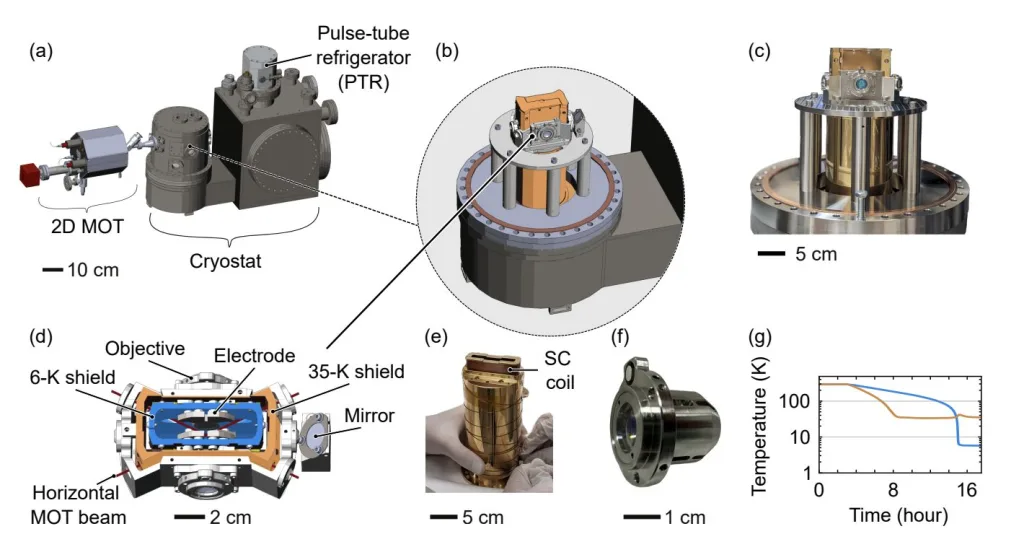
the lower, elongated superconducting (SC) coil for the MOT gradient; it is fixed onto the 6 K shield. (f) Close-up shot of one of the custom, UHV-compatible objectives. (g) Temperature behavior of the first (brown) and second stage (blue) during cool-down
Pasqal’s Strategic Roadmap and Future Plans
This milestone aligns with Pasqal’s strategic roadmap, which emphasizes the development of quantum computers with over 1,000 qubits, progressing towards 10,000 qubits by the 2026-2027 horizon. The roadmap highlights Pasqal’s commitment to advancing hardware capabilities and exploring high-impact business use cases in collaboration with Fortune 500 companies.
Pasqal was founded in 2019, out of the Institut d’Optique, by Georges-Olivier Reymond, Christophe Jurczak, Professor Dr. Alain Aspect, Nobel Prize Laureate Physics, 2022, Dr. Antoine Browaeys, and Dr. Thierry Lahaye. Pasqal has secured more than €140 million in financing to date.
Pasqal is a company that builds quantum processors from ordered neutral atoms in 2D and 3D arrays to bring a practical quantum advantage to its customers and address real-world problems. The company’s mission is to develop quantum processors that can solve complex problems more efficiently than classical computers, and this recent achievement of trapping over 1,000 atoms in a single shot is a significant step towards that goal.
External Link: Click Here For More