

Researchers are investigating the decay of B⁺ mesons into D⁺ mesons and pairs of kaons, a process crucial for refining our understanding of particle physics. Zhi-Tian Zou, Jun-Peng Wang, and Zhou Rui from the Department of Physics at Yantai University, working with Ying Li, present a detailed analysis of this decay using the perturbative QCD approach. Their collaborative work systematically examines contributions from various resonant states, including the ρ(770), ω(782), φ(1020), ρ(1450), and f₂(1270) resonances, to provide the first predictions for the branching fractions of these quasi-two-body decays within this framework. This research is significant because it not only aligns with existing experimental data but also highlights the potential for discovering physics beyond the Standard Model, as any observed CP asymmetry in these decays would indicate new phenomena.
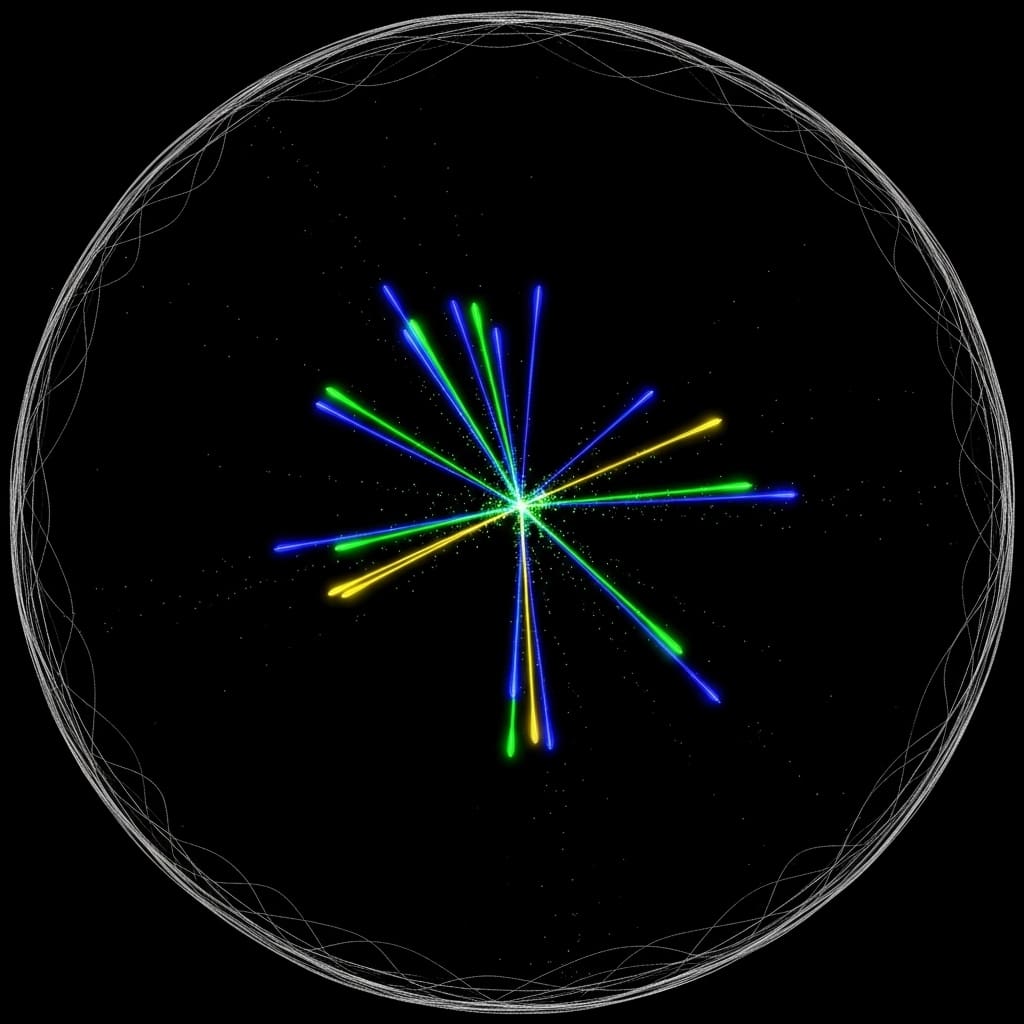
Within the LHCb detector, streams of particles from colliding protons are carefully tracked to reveal fleeting, exotic decays. This analysis focuses on how a B+ meson breaks down into other particles via intermediate resonances, offering a refined understanding of particle interactions. Scientists are increasingly focused on precision measurements of B-meson decays to test the Standard Model of particle physics and search for new phenomena.
These decays, particularly those involving three final-state particles, offer a complex yet sensitive environment for probing subtle effects beyond our current understanding. Recent investigations by the BaBar, Belle, and LHCb collaborations have yielded precise data on branching fractions and CP-violating observables, placing stringent constraints on theoretical models.
Now, researchers have turned their attention to quasi-two-body decays of B mesons, specifically focusing on the B+ → D+s K+K− channel. These decays, where two of the final-state particles combine to form a resonant intermediate state, present a unique challenge for theoretical prediction. A thorough analysis of these processes requires accounting for contributions from various resonances, short-lived particles, including S-wave states like f0, P-wave states such as φ, and D-wave states like f2.
By carefully modelling the interactions within the K+K− subsystem, scientists aim to predict the rates at which these decays occur. Accurately predicting branching fractions demands a detailed understanding of the underlying dynamics. This work employs the perturbative QCD (PQCD) approach, a theoretical framework where interactions are calculated as a series expansion in terms of the strong coupling constant, to analyse these quasi-two-body decays.
By introducing two-meson distribution amplitudes, which describe the internal structure of the K+K− system, the team presents the first PQCD predictions for associated branching fractions. Beyond matching theoretical predictions to experimental measurements, this research explores the potential for discovering new physics. Calculations reveal that direct CP asymmetries should be zero within the Standard Model for these specific decays. Therefore, any observed nonzero CP asymmetry would serve as a clear indication of physics beyond the Standard Model, opening up exciting avenues for future investigation.
Resonance decay modelling utilising perturbative QCD and Gegenbauer polynomial distribution amplitudes
Initially, a perturbative QCD (PQCD) factorization framework underpinned the analysis of resonant contributions to the decay process. This approach provides a systematic way to calculate decay rates by separating short-distance dynamics, calculable via perturbation theory, from long-distance effects, encoded in the two-meson distribution amplitudes. Contributions from several resonances, namely, and, were incorporated into the calculations.
By defining appropriate two-meson distribution amplitudes for each resonance, a detailed perturbative analysis of quasi-two-body decays was undertaken, yielding predictions for associated branching fractions. Accurately modelling the behaviour of these distribution amplitudes demanded careful consideration. The work adopted forms for the scalar resonances, expressed through Gegenbauer polynomials and associated moments, a1S and a3S, with values of −0.8 and 0.2 taken from previous analyses of B →KKK decays.
For the P-wave K−K pair, established two-meson wave functions were employed, retaining only the longitudinal polarization component due to angular momentum conservation, and expanded using twist-2 and twist-3 LCDAs with moments a0P, asP, and atP, determined from prior work with values of −0.89 ±0.18, −0.87 ±0.18, and 0.1 ±0.02 respectively. The D-wave two-kaon wave function mirrored the P-wave approach but utilised a distinct polarization vector, with the parameter aD set to 0.5 ±0.1, consistent with previous B →KKK decay studies. For narrow-width resonances, the relativistic Breit-Wigner (RBW) model was used to describe the time-like form factor, expressed as F L(ω2) = X i cim2 i m2 i −ω2 −imiΓi(ω2), providing a practical way to account for the resonance’s width and pole position.
Branching fraction predictions for B+ to D+s decays via intermediate K+K− resonances
Predictions for branching fractions of the B+ → D+ s R decays, where R represents an intermediate resonance, constitute the primary results of this work. Calculations, performed within the perturbative QCD (PQCD) factorization framework, indicate contributions from the f2 and f2 wave resonances, alongside the f1 resonance and the f0 and f0 resonances.
By employing corresponding two-meson distribution amplitudes for the K+K− system, a complete perturbative analysis of the quasi-two-body decays B+ → D+ s (R →)K+K− was undertaken. Branching fraction predictions were then generated for these quasi-two-body processes, allowing for the extraction of branching fractions for the corresponding two-body decays B+ → D+ s R using the narrow-width approximation.
These calculated values align with existing experimental measurements and prior theoretical investigations, validating the approach. The research establishes that direct CP asymmetries are predicted to vanish for these quasi-two-body decays within the Standard Model. Any observation of a non-zero CP asymmetry would provide compelling evidence for physics beyond the Standard Model.
The calculations treat the decay dynamics near the edges of the Dalitz plot, where two nearly collinear mesons form a clustered system. Here, the intermediate resonances can be described beyond the narrow-width approximation, offering a more precise theoretical description. The framework allows for a clear separation between resonant and nonresonant contributions, essential for reliable theoretical predictions. Nonresonant contributions can dominate in certain three-body B-meson decays, reaching approximately 70%, 90% in B → KKK decays, and are smaller, at about 40% and 14% for B → Kππ and B → πππ channels respectively.
Refining decay predictions narrows the gap between theory and LHCb measurements
Scientists have refined calculations predicting the behaviour of certain particle decays, bringing theoretical predictions closer to experimental observations. For years, a discrepancy existed between predicted branching fractions and LHCb experiment measurements. This work addresses that gap by carefully accounting for the complex contributions from several intermediate particles involved in these decays, utilising a perturbative quantum chromodynamics approach.
Rather than simply confirming existing results, this research provides the first predictions within this framework for associated branching fractions, offering a more detailed understanding of the decay process. The significance extends beyond simply matching numbers. Once a precise theoretical understanding of these decays is established, physicists gain a powerful tool for searching for deviations from the Standard Model of particle physics.
Any unexpected behaviour, such as a non-zero charge-parity (CP) asymmetry, would immediately signal the presence of new physics beyond our current understanding. Limitations remain, as the analysis relies on approximations like the narrow-width approximation and specific models for particle interactions. Accurately modelling each contribution requires sophisticated theoretical techniques and a detailed knowledge of particle properties.
Future work will likely focus on incorporating additional theoretical refinements and exploring the impact of different modelling assumptions. Continued data collection from the LHCb and other experiments will provide more precise measurements, further testing the validity of these predictions and potentially revealing subtle hints of new phenomena. This ongoing interaction between theory and experiment holds the potential for a deeper understanding of the fundamental laws governing our universe.
👉 More information
🗞 Quasi-two-body decays B^+\to D_s^+ (R\to) K^+K^-B^+\to D_s^+ (R\to) K^+K^- in the perturbative QCD approach
🧠 ArXiv: https://arxiv.org/abs/2602.16423

