

The fundamental process of thermalisation, where systems reach equilibrium after disruption, is intimately linked to how information spreads, or ‘scrambles’, within them. Saptarshi Mandal from the International Centre for Theoretical Sciences, Pieter W. Claeys from the Max Planck Institute for the Physics of Complex Systems, and Sthitadhi Roy, also from the International Centre for Theoretical Sciences, investigate this connection by introducing a new framework called the partial projected ensemble. This method allows researchers to study how the spatial and temporal patterns of information scrambling leave their mark on the statistical properties of quantum systems, effectively revealing how information propagates. The team demonstrates that fluctuations within these ensembles accurately trace the boundaries of information spread, and that measurable probabilities associated with the ensemble provide a direct way to observe scrambling dynamics, offering a powerful new tool for understanding thermalisation in both simple and complex quantum systems.
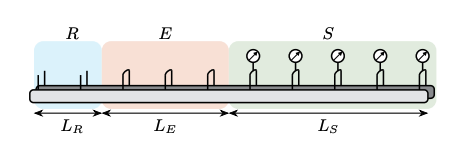
Subsystems dynamically approach thermal density matrices while their entropies track non-local information spreading. Projected ensembles, collections of pure states conditioned on measurement outcomes of complementary subsystems, provide higher-order probes of thermalisation, converging at late times to universal maximum-entropy ensembles constrained by conservation laws. This work introduces the partial projected ensemble (PPE) as a framework to study how the spatiotemporal structure of information scrambling is imprinted on projected ensembles. The PPE consists of an ensemble of mixed states induced on a subsystem by measurements on a spatially separated part of its complement, allowing researchers to investigate the relationship between information dispersal and the underlying spatial arrangement of the system
Thermalization, Localization and Operator Spreading Studies
This is a comprehensive overview of research related to quantum many-body physics, particularly focusing on thermalization, many-body localization (MBL), operator spreading, and the emergence of hydrodynamic behavior in closed quantum systems. The field explores how isolated quantum systems reach equilibrium, the conditions under which they fail to do so, and how information propagates within them. Researchers first established the theoretical foundations for understanding thermalization and ergodicity, investigating how systems evolve towards equilibrium despite being governed by quantum mechanics. A significant portion of the research focuses on many-body localization, a phase where quantum systems fail to thermalize due to strong disorder.
Key studies explore the characteristics of MBL, including the absence of level repulsion and the breakdown of ergodicity. Other investigations focus on operator spreading and entanglement growth, crucial indicators of how information spreads within a many-body system. Recent work demonstrates that even without full thermalization, many-body systems can exhibit emergent hydrodynamic behavior, characterized by diffusive transport of conserved quantities. This behavior arises from the collective motion of quasiparticles and can be described by effective hydrodynamic equations. Researchers leverage tools from random matrix theory to understand the statistical properties of quantum states and operators in disordered systems.
Out-of-Time-Ordered Correlators (OTOCs) are used to probe quantum chaos and the breakdown of classical behavior, while dual-unitary circuits offer a special class of quantum circuits with interesting properties for quantum computation and entanglement generation. Investigations into quantum chaos and ergodicity explore the connection between these concepts and the emergence of ergodic behavior. Researchers also highlight the importance of using quantum simulators to test theoretical predictions and explore complex quantum systems. Studies of logarithmic entanglement growth and entanglement lightcones characterize the spatial extent of entanglement in MBL systems. The role of conservation laws in preventing thermalization and giving rise to MBL is also a key area of research. A major focus is on understanding the dynamics of closed quantum systems, which are not in thermal equilibrium, and numerical simulations play a crucial role in testing theoretical predictions.
Information Spreads Via Statistical Fluctuations
Researchers have developed a new method to investigate how information spreads and thermalizes within complex quantum systems, offering deeper insights into the process of equilibration. This work centres on the ‘partial projected ensemble’ (PPE), a framework for studying how subsystems evolve when part of the surrounding system is measured or lost, effectively creating an ensemble of possible states. The PPE allows scientists to move beyond simply observing the average behaviour of a subsystem and instead examine the full statistical distribution of its possible states, revealing subtle details about the underlying dynamics. The team demonstrates that fluctuations within the PPE faithfully trace the spread of information, mirroring the ‘lightcone’ that defines the limits of causal influence.
This means the statistical properties of the PPE directly reflect how quickly and extensively information is shared throughout the system, providing a powerful tool for mapping the process of scrambling. Importantly, the probabilities associated with different states within the PPE exhibit distinct behaviours, offering an experimentally accessible way to probe this scrambling process and quantify how quickly information is lost when parts of the system are discarded or become inaccessible. Quantitative analysis reveals that the PPE’s fluctuations and probabilities are remarkably sensitive to the size of the discarded region, with correlations degrading exponentially as more information is lost. This exponential sensitivity highlights the fragility of quantum correlations and provides a precise measure of how quickly information is lost due to erasure or environmental noise.
These findings were substantiated through simulations of a complex, non-integrable system, the kicked Ising chain, and extended to scenarios where the system becomes ‘many-body localised’, meaning it fails to thermalize. The researchers found that the PPE dynamics naturally produce lightcones characteristic of both ergodic (thermalizing) and many-body localised systems, with linear lightcones appearing in the former and logarithmic ones in the latter. This establishes the PPE as a versatile tool for probing a wide range of quantum behaviours and understanding the fundamental mechanisms governing thermalisation and information scrambling in complex systems. The method offers a higher-order probe of ergodicity, going beyond simply observing the average behaviour and instead examining the full statistical distribution of possible states
Partial Projected Ensembles Track Information Scrambling
This research introduces the partial projected ensemble (PPE) as a new tool for investigating thermalisation and information scrambling in complex quantum systems. The team demonstrates that the statistical fluctuations within the PPE accurately track the spread of information, revealing how scrambling dynamics are encoded in the structure of the ensemble. Furthermore, the probabilities of bit-string outcomes associated with the PPE exhibit distinct behaviours that provide an experimentally accessible way to probe scrambling processes. The study confirms that the size of a discarded region significantly impacts correlations, leading to exponential degradation, and establishes the PPE as a powerful method for examining both scrambling and deep thermalisation. Researchers validated these findings using the kicked Ising chain model, both in ergodic and many-body localised regimes, and also through analytical results for a simplified model.
🗞 Partial projected ensembles and spatiotemporal structure of information scrambling
🧠 ArXiv: https://arxiv.org/abs/2508.05632


