The challenge of factoring large numbers underpins much of modern cryptography, and researchers continually seek more efficient algorithms to address this problem. Gregory D. Kahanamoku-Meyer from MIT, Seyoon Ragavan from MIT, and Katherine Van Kirk from Harvard, investigate a novel approach to improving Regev’s factoring algorithm by combining techniques from a field known as ‘pebble games’ with the concept of ‘spooky pebbling’. Their work demonstrates that by allowing measurements which introduce temporary errors, and performing operations in parallel, they can dramatically reduce the computational cost of factoring. The team’s optimised methods achieve a multiplication depth of 193 for 4096-bit integers, significantly outperforming previous iterations of Regev’s algorithm and even surpassing the performance of Shor’s algorithm reported by other researchers. This advancement suggests that Regev’s algorithm may become a viable option for future cryptographic applications, and the researchers anticipate that their pebbling techniques will have broader implications for cryptanalysis beyond integer factorisation.
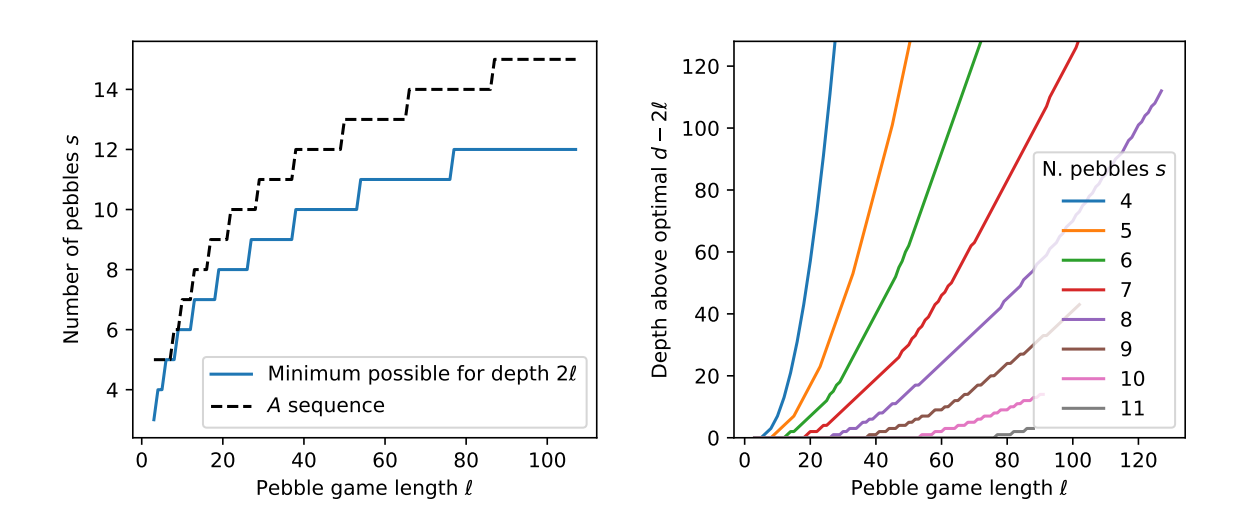
Early pebbling schemes often suffer from errors, but recent work defines and studies parallel spooky pebble games, building on previous research that explored the benefits of parallelism or spookiness individually. The team demonstrates that these resources yield impressive gains when used in combination, constructing a method to pebble a line graph of length l in depth 2l, achieving optimal performance using limited space. To explore even more efficient pebbling schemes, the researchers employed a highly optimised search algorithm.
Lattice Optimizations for Regev and Shor Algorithms
Researchers are continually refining algorithms used in cryptography, particularly those based on lattices, to ensure security in a post-quantum world. This work focuses on optimizing Regev’s algorithm, a public-key encryption scheme, and comparing its performance to Shor’s algorithm, a quantum algorithm for factoring. The goal is to improve the efficiency of these algorithms and understand their strengths and weaknesses. Regev’s algorithm relies on the hardness of the Learning With Errors (LWE) problem, while Shor’s algorithm poses a threat to many current public-key systems. Lattice-based cryptography, which underpins Regev’s algorithm, is considered a promising approach to secure communication in the age of quantum computers.
Key to understanding the optimizations are concepts like lattice reduction, achieved through algorithms like Block Korkine-Zucman (BKZ), and techniques for efficient modular arithmetic. The researchers explored several optimization techniques, including Fibonacci arithmetic, which reduces the computational cost of modular multiplications, and parallel spooky pebbling, a method for speeding up large modular multiplications by enabling parallel computation. Windowing, a technique used in modular exponentiation, was also applied to Shor’s algorithm to improve its efficiency. Careful selection of algorithm parameters is crucial for minimizing computational cost while maintaining security.
The results of experiments evaluating Regev’s algorithm with different optimizations and parameter settings demonstrate the impact of each technique. Parameters like the BKZ-β value and those affecting Fibonacci arithmetic were carefully analyzed. The researchers measured metrics like the number of modular multiplications, the number of qubits required, and the computational depth, which is critical for performance. The data show that spooky pebbling significantly reduces computational depth, especially for larger security parameters. The optimal values for algorithm parameters depend on the desired trade-off between computational cost and security. These results are important for the development of practical lattice-based cryptography and for understanding the security of these systems against potential attacks. The work highlights the importance of optimization techniques and provides insights into the computational cost of attacking lattice-based cryptosystems.
Pebbling and Spookiness Boost Factoring Efficiency
Researchers have achieved significant advancements in quantum computation by exploring a technique called “pebble games,” an abstraction from classical reversible computing, and its application to factoring algorithms. The work focuses on optimizing the space and time complexity of inherently sequential computations on quantum computers, addressing a challenge where quantum systems don’t inherently offer advantages in running such algorithms. The team demonstrated that combining parallelism with a technique called “spookiness”, allowing measurements that introduce temporary phase errors, yields substantial gains in computational efficiency. They constructed a line graph of length l that can be “pebbled” in depth l, achieving optimal performance using a limited amount of space.
Further optimization, implemented through a highly optimized search algorithm, revealed even more efficient pebbling schemes. Applying these techniques to Regev’s factoring algorithm, the researchers achieved a breakthrough in reducing the computational cost for factoring large integers. Specifically, they found that factoring 4096-bit integers requires a multiplication depth of 193, a significant improvement over previous variants of Regev’s algorithm and even surpassing the performance of Shor’s algorithm in certain scenarios. This result suggests that Regev’s algorithm, while currently outperformed by space-optimized implementations of Shor’s algorithm for initial factorization, holds promise for future applications, particularly with further optimization. The team’s work not only advances the efficiency of factoring algorithms but also establishes a foundation for applying these pebbling techniques to other areas of quantum cryptanalysis beyond integer factorization, opening new avenues for research in secure computation.
Pebbling and Spookiness Improve Factoring Efficiency
Researchers have demonstrated that combining parallelism with a technique called “spookiness” within the framework of pebble games significantly improves computational efficiency, particularly when applied to complex problems like integer factorization. They successfully constructed a pebbling scheme for a line graph that achieves optimal depth using a limited amount of space, and further refined this approach with a highly optimized search algorithm. The team applied these techniques to Regev’s factoring algorithm, revealing a considerable reduction in computational cost. Specifically, they found that factoring 4096-bit integers requires a multiplication depth of 193, outperforming previous variants of Regev and even surpassing the performance of Shor’s algorithm in certain scenarios.
While acknowledging that space-optimized implementations of Shor’s algorithm currently remain the leading approach for large integer factorization, the researchers highlight the potential for Regev’s algorithm to become increasingly relevant with further optimization. The authors note a limitation in their analysis, stemming from assumptions made regarding lattice reduction costs, and suggest that future work could focus on refining these estimates. They also anticipate that the pebbling techniques developed in this study will have broader applications in quantum cryptanalysis beyond integer factorization, opening new avenues for research in this critical field.
🗞 Parallel Spooky Pebbling Makes Regev Factoring More Practical
🧠 ArXiv: https://arxiv.org/abs/2510.08432