

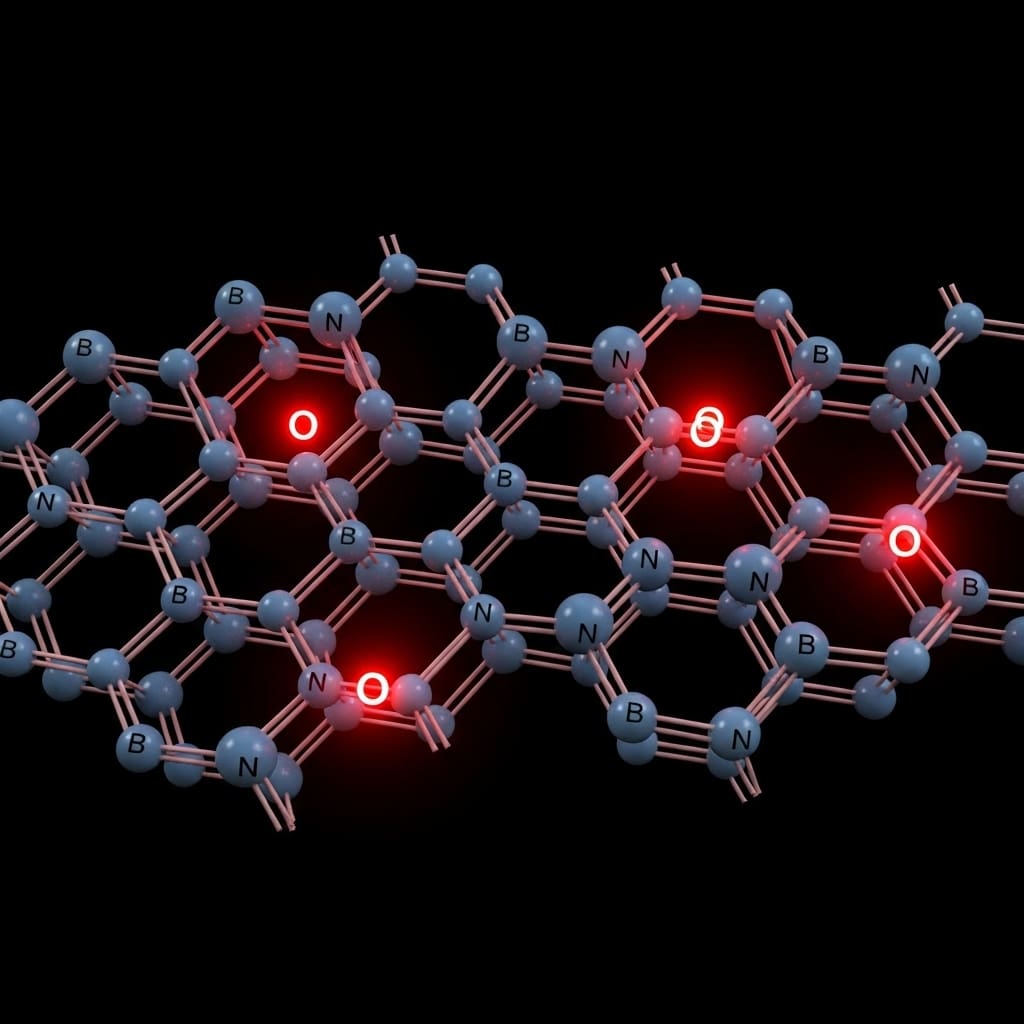
Scientists have long sought to understand the origin of the intense 3.5 eV luminescence observed in hexagonal boron nitride, a material with promising applications in single-photon emission. Marek Maciaszek from the Faculty of Physics at Warsaw University of Technology, working at the Center for Physical Sciences and Technology (FTMC), alongside collaborators including first author Maciaszek and co-author(s) et al., now reveal that this prominent emission arises from oxygen atoms substituting for nitrogen within the hBN lattice. This research is significant because it clarifies the microscopic origin of a frequently observed photoluminescence band, demonstrating a complex transition mechanism involving both charge-state changes and substantial structural rearrangements of the defect and its surrounding atoms. The team’s calculations accurately reproduce the observed emission energy and lineshape, providing crucial insight for controlling and optimising the optical properties of this important two-dimensional material.
Oxygen substitution in hexagonal boron nitride explains persistent luminescence
Researchers have pinpointed the origin of a persistent luminescence observed in hexagonal boron nitride, a material gaining prominence in quantum technologies. Specifically, the study demonstrates that a broad emission band centered around 3.5 eV arises from hole capture by oxygen atoms substituting for nitrogen within the hBN lattice.
This discovery resolves a long-standing ambiguity regarding the microscopic source of this signal, which has been consistently observed across various experimental conditions. The work details a non-trivial transition mechanism involving both a change in charge state and a significant structural reconfiguration of the defect.
The investigation reveals that the neutral oxygen defect adopts a low-symmetry configuration, exhibiting out-of-plane displacement of the oxygen atom and its neighbouring atoms. Conversely, the positive charge state relaxes into a high-symmetry, in-plane configuration. This substantial structural change releases considerable energy, red-shifting the emission to a calculated peak of 3.63 eV, closely matching the experimentally observed value.
The calculated emission lineshape also aligns with experimental data, exhibiting a full width at half maximum of 0.69 eV, compared to the measured 0.7 eV. Employing spin-polarized density functional theory with the HSE hybrid functional and a 288-atom supercell, the researchers performed ab initio calculations to model the defect’s behaviour.
These calculations, utilising a plane-wave energy cutoff of 500 eV and the Grimme D3 dispersion correction, yielded a band gap of 5.95 eV and lattice constants of a=2.490 Å and c=6.558 Å, demonstrating strong agreement with established experimental values. The study’s findings are crucial for optimising hBN material growth and tailoring its properties for specific quantum and optoelectronic applications.
Understanding the physics and chemistry of point defects at this level is essential for advancing hBN-based technologies. The research clarifies the role of oxygen impurities, confirming their abundance as predicted by secondary-ion mass spectrometry, X-ray photoelectron spectroscopy, and annular dark-field scanning transmission electron microscopy. By identifying substitutional oxygen as the source of the 3.5 eV luminescence, this work provides a critical step towards controlling and enhancing the performance of hBN-based single-photon emitters and other quantum devices.
Computational parameters for hexagonal boron nitride modelling
Ab initio calculations underpinned this work, employing spin-polarized density functional theory as implemented in VASP with a plane-wave energy cutoff of 500 eV. The projector-augmented wave method was used to describe the electron-ion interactions, and the exchange-correlation energy was approximated using the hybrid HSE functional with a mixing parameter of 0.31 to accurately reproduce the experimental band gap.
A 288-atom supercell (6x6x2) facilitated the modelling, with Brillouin zone sampling restricted to the Γ point only. Atomic positions were iteratively relaxed until forces on all ions fell below 0.01 eV/Å, and a more stringent criterion of 0.005 eV/Å was applied during phonon frequency calculations. Van der Waals interactions, crucial for accurate defect modelling, were accounted for using the Grimme D3 dispersion correction.
This computational methodology yielded a band gap of 5.95 eV, lattice constants of a=2.490 Å and c=6.558 Å, and a compound formation enthalpy ΔHf(hBN) of -2.89 eV, demonstrating good agreement with established experimental values of a=2.506 Å, c=6.603 Å, and ΔHf(hBN)=-2.60 eV. The formation energy of the oxygen-substituting-for-nitrogen (ON) defect was calculated using a defined formula, incorporating the total energies of the defected and defect-free supercells, alongside the chemical potentials of oxygen and nitrogen.
The Freysoldt-Neugebauer-Van de Walle scheme was implemented to correct for spurious electrostatic interactions arising from the periodic nature of the supercell. Nudged elastic band calculations, utilising the HSE functional, were performed to map the energy landscape between high- and low-symmetry configurations of the neutral charge state, revealing a spontaneous structural distortion with a negligible energy barrier.
Defect geometry and relaxation pathways in oxygen-substituted hexagonal boron nitride
Calculated emission energy reached 3.63 eV, demonstrating strong agreement with experimental observations of oxygen-related luminescence in hexagonal boron nitride. This emission originates from hole capture by oxygen substituting for nitrogen, a transition involving both charge state alteration and substantial structural reconfiguration.
The positive charge state of the defect exhibits high symmetry (D3h) with all atoms in-plane, while the neutral state adopts a low-symmetry configuration (C1) with significant atomic displacements. Oxygen displacement from the layer plane measured 0.136 Å, accompanied by boron atom displacements of 0.070 Å and 0.368 Å on either side of the layer.
A high-symmetry neutral defect configuration was found to be 0.33 eV higher in energy than the low-symmetry configuration, indicating spontaneous relaxation to the distorted geometry. Nudged elastic band calculations revealed negligible energy barriers for this relaxation process, confirming the structural change occurs readily.
The (1+/0) charge-state transition level was located at 5.09 eV above the valence band maximum, suggesting the defect predominantly exists in the positive charge state under typical thermodynamic conditions. Optical properties analysis revealed a vertical emission energy of 3.63 eV, coupled with a relaxation energy of 1.46 eV, indicative of strong electron-phonon coupling.
The average phonon energy was calculated to be 59.6 meV, resulting in a Huang-Rhys factor of 24.4, firmly establishing the system within the strong coupling regime. The calculated luminescence lineshape, with a full width at half maximum of 0.69 eV, closely matches the experimental peak at 3.5 eV, even after a 0.10 eV red-shift for direct comparison.
Oxygen-nitrogen defects and boron vacancies explain hexagonal boron nitride photoluminescence
Researchers have identified the microscopic origin of a prominent photoluminescence peak at 3.5 electron volts in hexagonal boron nitride. This emission arises from the capture of holes by oxygen atoms substituting for nitrogen within the hBN lattice, a defect denoted as ON. The transition involves a significant structural change in the defect, with the positive and neutral states exhibiting distinct geometries and symmetries.
Specifically, the neutral state adopts a low-symmetry configuration characterised by out-of-plane displacement of the oxygen atom and its neighbouring boron atoms. Calculations reveal a strong correlation between the predicted emission energy of 3.63 electron volts and the full width at half maximum of 0.69 electron volts, aligning closely with experimental observations of oxygen-doped hBN samples.
Furthermore, electrostatic attraction enables the formation of stable neutral complexes between oxygen-nitrogen defects and boron vacancies, a process potentially occurring at temperatures exceeding 900 Kelvin. The resulting complex exhibits a rich electronic structure, potentially explaining additional transitions observed in the photoluminescence spectrum at 2.3 and 2.5 electron volts.
The authors acknowledge a limitation in their modelling, focusing primarily on the isolated ON defect and its interaction with single boron vacancies. Future work could explore the influence of higher concentrations of defects and their collective behaviour on the observed optical properties. These findings establish oxygen substitution for nitrogen as a key factor in understanding the luminescence of hBN, providing a foundation for improved control and engineering of quantum emitters in this material. This improved understanding may facilitate the development of advanced optoelectronic devices and quantum technologies based on hexagonal boron nitride.
👉 More information
🗞 Substitutional oxygen as the origin of the 3.5 eV luminescence in hexagonal boron nitride
🧠 ArXiv: https://arxiv.org/abs/2602.05253


