

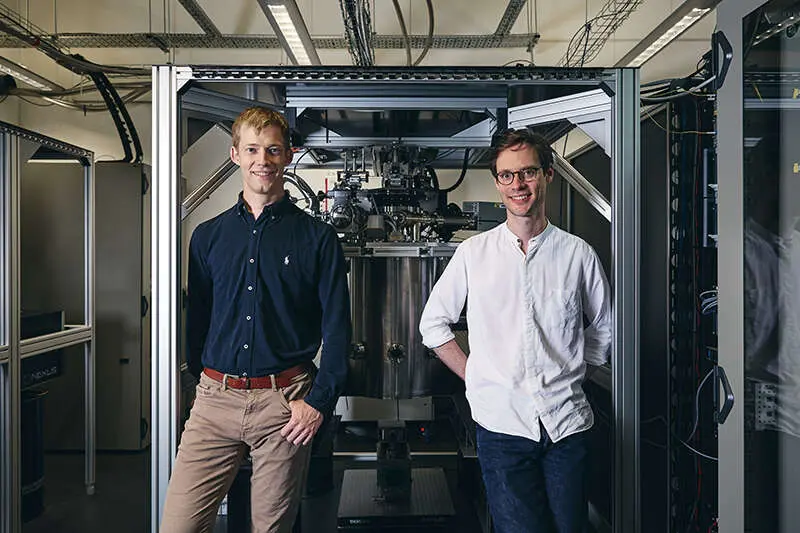
Oxford Ionics has achieved the development of quantum computers, earning them the prestigious IOP Business Innovation Award. The company’s innovative electronic qubit control system enables the creation of scalable architectures. These architectures offer world-leading performance. They are manufactured on standard semiconductor production lines.
This breakthrough tackles three crucial challenges in designing quantum computing architectures. It achieves meager gate error rates. It also enables parallel qubit control and ensures the exclusive use of scalable technologies.
Quantum Computing Breakthrough: Oxford Ionics’ Scalable Architecture
The company’s unique electronic qubit control system allows for the trapping and control of ions above the surface of a chip, enabling the construction of large-scale chips with record-setting qubit control fidelities. This achievement is particularly notable as it addresses one of the most significant challenges in designing architectures for quantum computing: achieving low gate error rates that remain stable as the number of qubits increases.
Oxford Ionics’ approach also enables parallel qubit control, which is essential for performing different operations on all qubits simultaneously. This capability is critical for scaling up quantum computers to tackle complex problems in various fields, such as catalytic science. The company has already established key partnerships with industry leaders to apply its technology to real-world challenges.
The significance of Oxford Ionics’ breakthrough is profound. It can integrate its architecture into a single device using technologies that can be built at scale. This contrasts with other architectures, which may excel in one or two areas but struggle to achieve all three simultaneously. The company’s innovative approach has the potential to accelerate the development of practical quantum computers that can be manufactured on standard semiconductor production lines.
Overcoming Quantum Computing Challenges
Designing architectures for quantum computing is a complex task. It requires achieving three critical goals. These include extremely low gate error rates, parallel qubit control, and scalability using standard technologies. Oxford Ionics has demonstrated a way to overcome these challenges. They developed an electronic qubit control system. This system can trap and control ions above the surface of a chip.
One of the primary obstacles in quantum computing is maintaining low gate error rates as the number of qubits increases. Oxford Ionics’ approach has achieved record-setting qubit control fidelities. This achievement is essential for ensuring the accuracy and reliability of quantum computations. The company’s architecture also enables parallel qubit control, which is critical for scaling up quantum computers to tackle complex problems.
Another significant challenge in quantum computing is integrating technologies that can be built at scale into a single device. Oxford Ionics’ approach uses standard semiconductor production lines. This method makes manufacturing large-scale chips with high fidelity and low error rates possible. This achievement can potentially accelerate the development of practical quantum computers used in various fields.
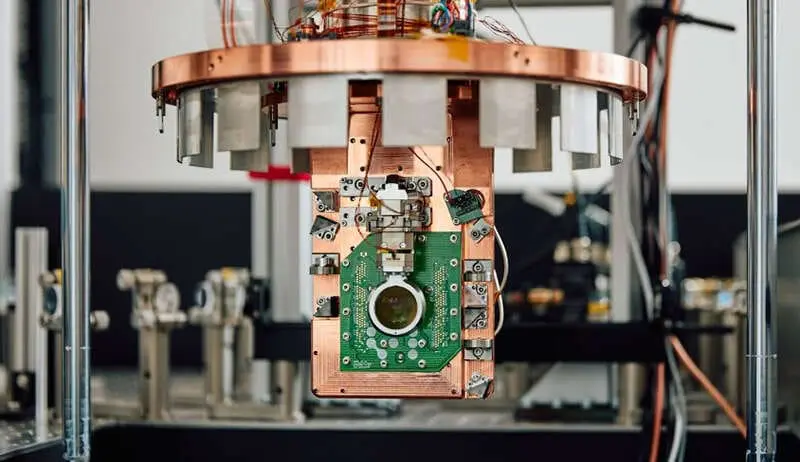
Scalable Quantum Computing Architecture
Oxford Ionics’ innovative architecture is designed to be scalable, enabling the construction of large-scale chips with high fidelity and low error rates. The company’s electronic qubit control system allows for the trapping and control of ions above the surface of a chip, making it possible to build out large-scale systems.
The scalability of Oxford Ionics’ architecture is critical for tackling complex problems in various fields, such as catalytic science. The company’s approach enables parallel qubit control. It maintains low gate error rates. This has the potential to accelerate the development of practical quantum computers. These computers can be used to solve real-world challenges.
Oxford Ionics’ architecture is also designed to be integrated into a single device using standard semiconductor production lines. This enables the manufacturing of large-scale chips with high fidelity. It also achieves low error rates. These factors are essential for scaling up quantum computers.
Industry Partnerships and Applications
Oxford Ionics has established key partnerships with industry leaders. They aim to apply their technology to real-world challenges in various fields. One area of application is catalytic science. The company’s innovative approach has the potential to accelerate the development of practical quantum computers. These computers can be used to solve complex problems.
Oxford Ionics’ technology has vast and varied applications, ranging from optimizing chemical reactions to simulating complex materials. By partnering with industry leaders, the company is well-positioned to develop practical solutions for various fields.
Oxford Ionics’ breakthrough has significant implications for the development of quantum computing. The company’s innovative approach has the potential to accelerate the development of practical quantum computers that can be manufactured on standard semiconductor production lines, paving the way for widespread adoption and application in various fields.
External Link: Click Here For More


