

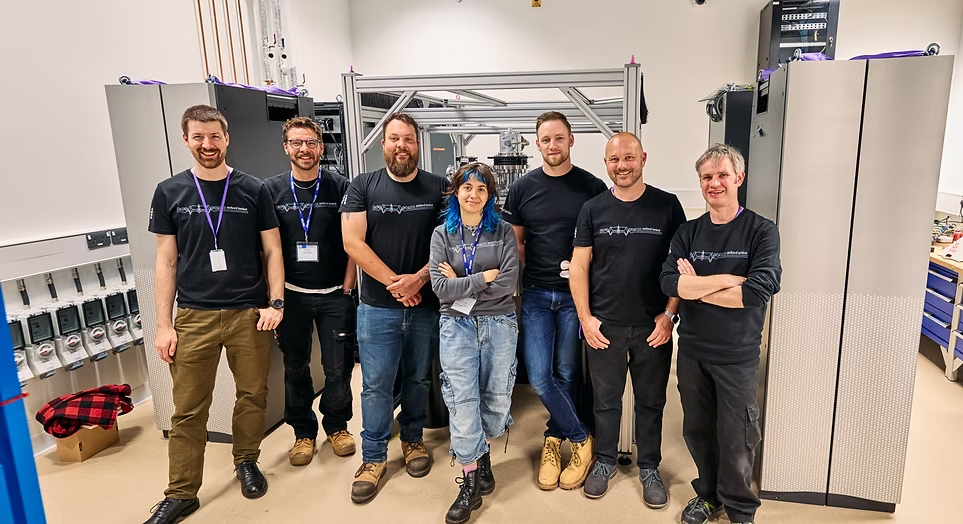
Oxford Ionics has successfully installed QUARTET (QUantum Advantage-Ready Trapped-ion Exploration Testbed), a full-stack, trapped-ion quantum computer, at the UK’s National Quantum Computing Centre (NQCC) at Harwell, funded in collaboration with Innovate UK as part of its testbed programme and the UK’s Quantum Missions program. The system leverages Oxford Ionics’ proprietary Electronic Qubit Control technology, integrating all qubit trapping and control mechanisms onto a standard electronic chip manufactured via conventional semiconductor foundries, achieving record performance in single-qubit gate fidelity, two-qubit gate fidelity, and quantum computing capability.
The consortium, which includes Riverlane and Bay Photonics, was selected for a Quantum Missions pilot for its Q-Surge project to upgrade QUARTET to include 2D qubit connectivity. The system is field-upgradeable, allowing the NQCC to benefit from seamless upgrades to the exact specification as Oxford Ionics’ highest-performing systems without changing surrounding infrastructure. Founded in 2019 by Dr Tom Harty and Dr Chris Ballance, Oxford Ionics has raised 37 million.
Quantum System Installation
This deployment, funded in collaboration with Innovate UK as part of the NQCC’s testbed programme, facilitates critical applications research with partners spanning industry, academia, and government, aiming to accelerate the development of commercially viable quantum solutions. The NQCC’s strategic focus on application-driven research positions QUARTET as a key resource for validating algorithms and exploring novel quantum applications.
QUARTET distinguishes itself through Oxford Ionics’ proprietary Electronic Qubit Control technology, a departure from traditional laser-based qubit manipulation. This approach integrates all necessary components for trapping and controlling qubits onto a standard electronic chip fabricated using conventional semiconductor foundries, offering substantial advantages in scalability and performance.
By eschewing lasers, the system reduces complexity and cost, while simultaneously enhancing the potential for large-scale qubit integration – a critical factor in achieving fault-tolerant quantum computation. Oxford Ionics currently holds world records in three key performance metrics: single-qubit gate fidelity, two-qubit gate fidelity, and quantum state preparation and measurement (SPAM).
These achievements underscore the efficacy of the electronic qubit control architecture and its potential to overcome the limitations of existing quantum computing platforms. High-fidelity gates and accurate state preparation are paramount for executing complex quantum algorithms and mitigating the effects of decoherence, a major obstacle to maintaining quantum information.
A crucial aspect of QUARTET’s design is its field-upgradeability, allowing the NQCC to benefit from future performance enhancements without requiring extensive infrastructure modifications. The system’s Quantum Processor Unit (QPU) can be replaced with updated versions, ensuring this marks a major milestone not just for our company, but for unlocking a future powered by quantum computing.
More information
External Link: Click Here For More


