

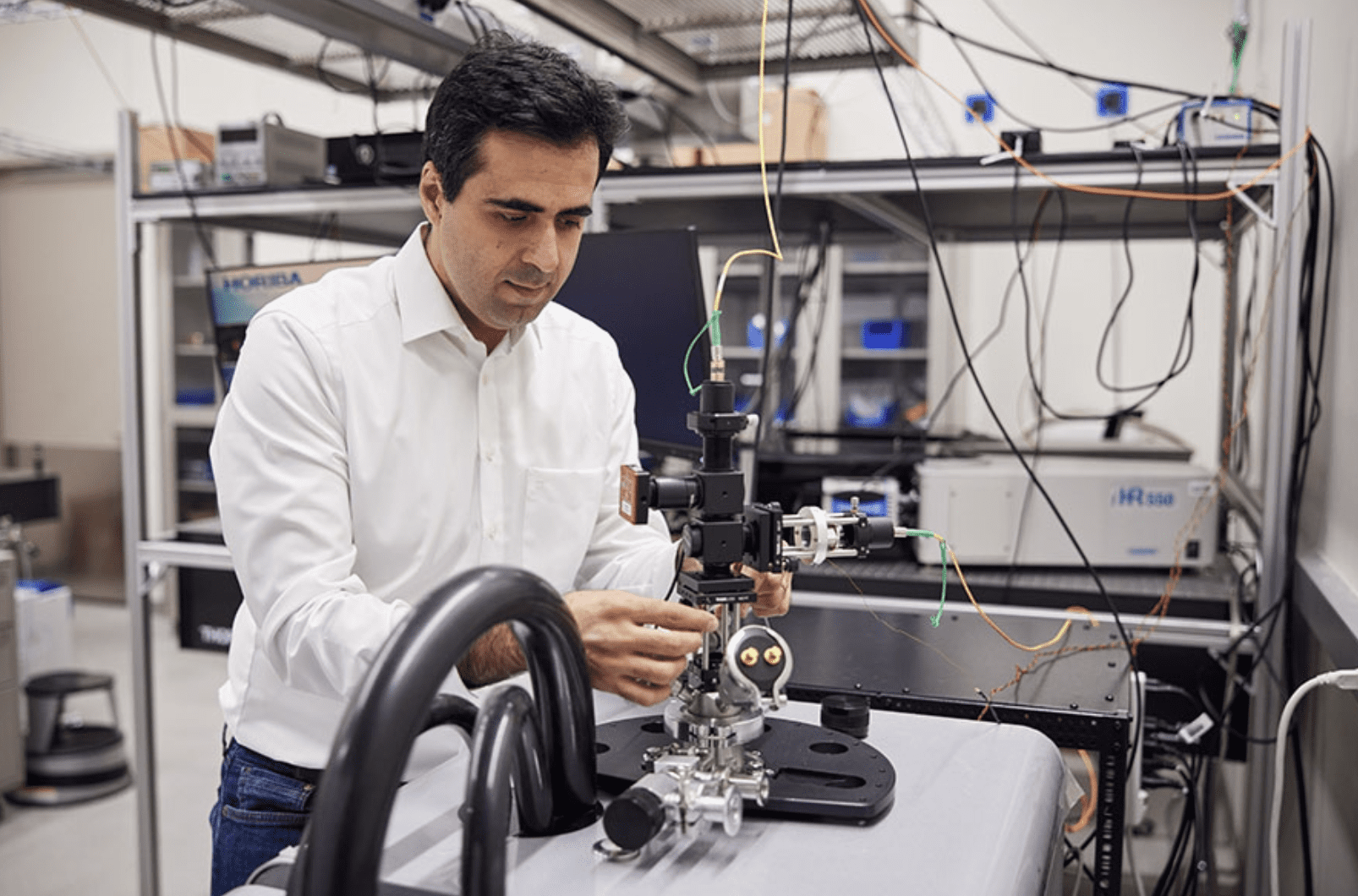
Alisa Javadi, a professor at the University of Oklahoma School of Electrical and Computer Engineering and the Homer L. Dodge Department of Physics and Astronomy, has received funding from the U.S. Department of Energy Early Career Research Program to advance quantum technology development. Her research focuses on using cerium oxide as a host for quantum bits, or qubits, which require an environment free of magnetic noise to function properly.
Currently, diamond is the leading material for quantum emitters, but it’s expensive and contains magnetic carbon atoms that need further purification. Cerium oxide, made of cerium and oxygen, lacks magnetic nuclei, making it an ideal candidate for hosting qubits. Javadi’s project aims to contribute to the progress of photonic quantum technologies, which could significantly impact secure communication technologies and biology.
Advancing Quantum Technology Development with Cerium Oxide Qubit Hosts
The development of quantum technology has been hindered by the need for an environment free of magnetic noise to function properly. Currently, diamond is the leading material for quantum emitters, but it is expensive and contains magnetic carbon atoms, which require further isotopic purification. Alisa Javadi, a professor at the University of Oklahoma School of Electrical and Computer Engineering and the Homer L. Dodge Department of Physics and Astronomy, has received funding from the U.S. Department of Energy Early Career Research Program to explore a promising alternative: cerium oxide as a host for quantum bits, or qubits.
Cerium oxide is made up of cerium and oxygen, both lacking magnetic nuclei, making it an ideal candidate for hosting qubits. By providing a noise-free environment, this material has the potential to significantly impact a broad range of disciplines, such as secure communication technologies and biology. Javadi’s project, “Color Centers in Noise-Free Hosts for Quantum Sensing and Communication Applications,” aims to contribute to the progress of photonic quantum technologies.
The study’s first phase will focus on identifying color centers, or optically active quantum bits, and understanding their properties. Color centers are typically arrangements of extrinsic atoms in the host, atoms that are not native to the host. The team will use theoretical studies to narrow the search for the right combination of these atoms to a handful of candidates. They will then grow the host crystals through pulsed laser deposition, a technique that allows for testing with short turnaround times.
Understanding Color Centers and Their Properties
Color centers are a crucial component in the development of quantum technology. These optically active quantum bits are typically arrangements of extrinsic atoms in the host material. Javadi’s team will use theoretical studies to identify the right combination of these atoms, narrowing down the search to a handful of candidates. This understanding is essential for the development of qubits that can function properly in a noise-free environment.
The team will then grow the host crystals through pulsed laser deposition, a technique that allows for testing with short turnaround times. This approach enables the rapid testing and validation of theoretical predictions, accelerating the discovery process. By understanding the properties of color centers, Javadi’s project aims to provide a significant breakthrough in the development of quantum technology.
The Role of Geometry in Optical Emission
Geometry plays a crucial role in the optical emission of ensembles of emitters. One phenomenon of interest is superradiance, where quantum emitters work collectively to generate bursts of energy. Javadi’s project will explore how geometry influences superradiance in different forms of arrangement of emitters, including three-dimensional crystals and two-dimensional sheets.
This research has significant implications for the development of quantum technology. By understanding how geometry affects optical emission, researchers can design and optimize materials for specific applications. This knowledge can be used to create more efficient and effective qubits, leading to breakthroughs in secure communication technologies and biology.
The Potential Impact of Cerium Oxide Qubit Hosts
The potential impact of cerium oxide qubit hosts is significant. By providing a noise-free environment, this material has the potential to revolutionize quantum technology development. Secure communication technologies, which rely on the principles of quantum mechanics, can be developed more efficiently and effectively. Biology can also benefit from this research, as it can lead to new insights into the behavior of quantum systems.
Javadi’s project has received $875,524 in funding from the Office of Basic Energy Sciences and the Department of Energy’s Established Program to Stimulate Competitive Research. The project began on July 1, 2024, and will conclude on June 30, 2029. This research has the potential to make a significant contribution to the development of quantum technology, paving the way for breakthroughs in various fields.
External Link: Click Here For More


