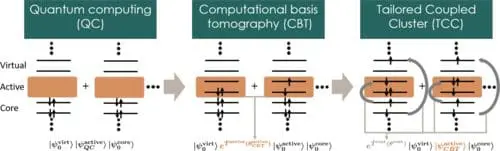
Researchers from Osaka University have developed a computational technique known as the coupled cluster method to improve the accuracy of quantum computing in quantum chemistry. The method addresses the issue of ignoring electron correlations in quantum computations of chemical systems. The team demonstrated the effectiveness of their method by verifying potential energy curves and estimating the activation energy of a chemical reaction. This development could be a significant step towards overcoming the limitations of quantum computing, particularly in handling electronic degrees of freedom in molecular systems.
What is the Coupled-Cluster Method in Quantum Computing?
The coupled cluster method is a computational technique used in quantum chemistry to solve the many-body Schrödinger equation for the motion of electrons in a molecular system. This method, proposed by a team of researchers from the Graduate School of Engineering Science and the Center for Quantum Information and Quantum Biology at Osaka University, aims to correct quantum computing results using a well-established classical theory. The team includes Luca Erhart, Yuichiro Yoshida, Viktor Khinevich, and Wataru Mizukami.
The researchers argue that introducing an active space approximation is inevitable for the quantum computations of chemical systems. However, this approximation tends to ignore the electron correlations related to non-active orbitals. To address this issue, the team has developed a method that efficiently extracts the quantum state from a quantum device using computational basis tomography. The extracted expansion coefficients of the quantum state are then embedded into the coupled cluster ansatz within the framework of the tailored coupled cluster method.
How Does the Coupled Cluster Method Improve Quantum Computing?
The team demonstrated the performance of their method by verifying the potential energy curves of LiH, H2O, and N2 with a correlation energy correction scheme. Their method showed reasonable potential energy curves even when the standard coupled cluster fails. The researchers also investigated the sufficient numbers of measurements for tomography.
Furthermore, the method successfully estimated the activation energy of the Cope rearrangement reaction of 1,5-hexadiene together with perturbative triples correction. These demonstrations suggest that the team’s approach has the potential for practical quantum chemical calculations using quantum computers.
What is the Future of Quantum Computing with the Coupled Cluster Method?
Quantum chemistry is expected to be a significant application of quantum computing, where it could potentially outperform its classical counterpart. Quantum computers can hold and manipulate a superposition of an exponential number of electronic configurations using a polynomial number of quantum bits (qubits). They are therefore considered particularly suitable for simulations of strongly correlated systems where the nature of quantum superpositions is often difficult to handle using current classical computers.
However, for the foreseeable future, quantum computers will be limited in the number of qubits they have. In most cases, they cannot handle all the electronic degrees of freedom (orbitals and electrons) of a targeted molecule on a quantum computer. The coupled cluster method proposed by the team at Osaka University could be a significant step towards overcoming these limitations and advancing the field of quantum computing.
Publication Date: 2024-06-03
Authors: Luca Erhart, Yuichiro Yoshida, Viktor Khinevich, Wataru Mizukami, et al.
Source: Physical review research
DOI: https://doi.org/10.1103/physrevresearch.6.023230