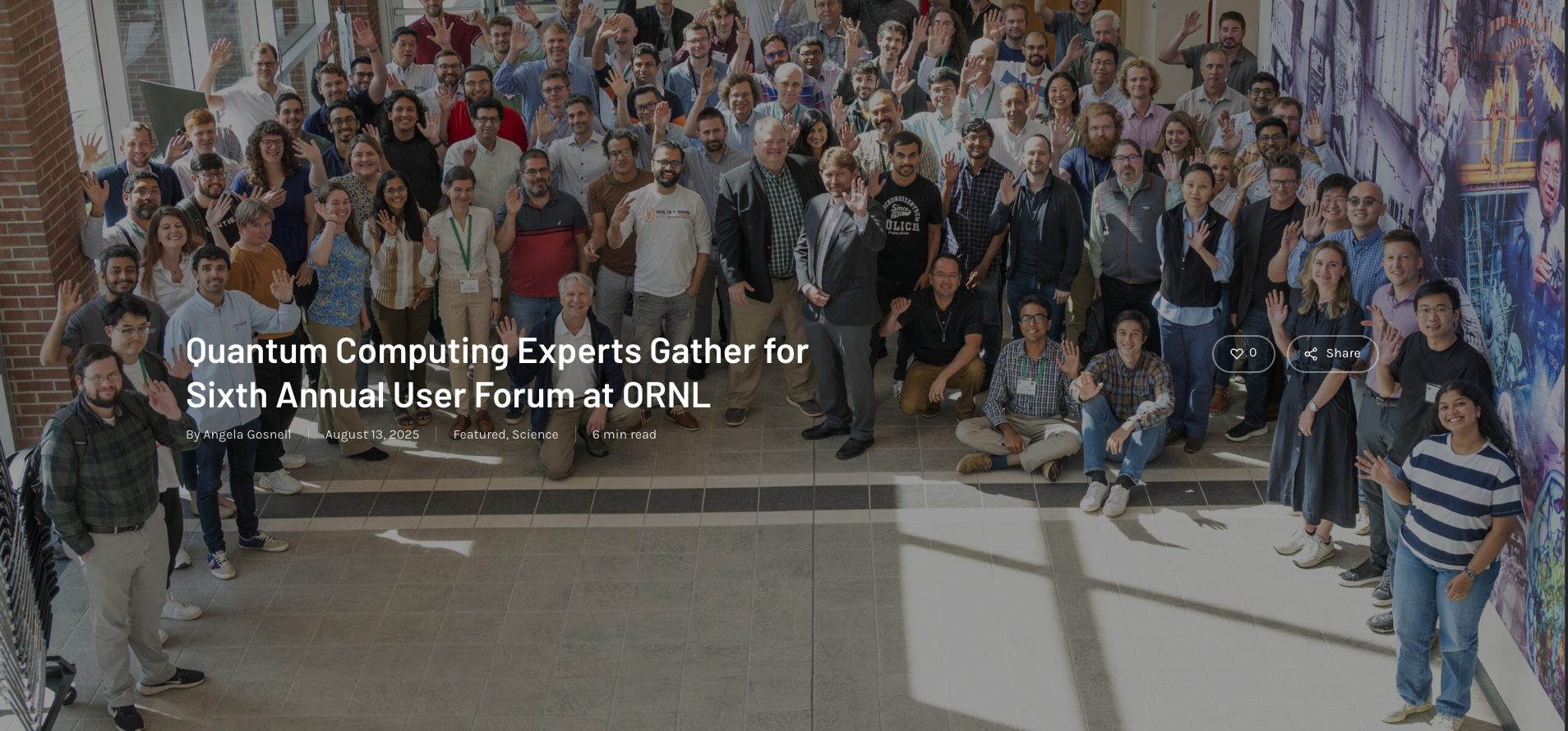
The sixth annual Quantum Computing User Forum (QCUF) convened at Oak Ridge National Laboratory from July 21 to July 24, hosting over 140 registered attendees to discuss advancements in quantum computing applications and software. The forum, facilitated by the Oak Ridge Leadership Computing Facility and the Quantum Computing User Program (QCUP) – established in 2017 – featured research presentations, panel discussions, and interactive workshops with representatives from IonQ, Quantinuum, IBM, and IQM. A poster session showcased 24 projects, with awards presented to researchers Anthony Wilkie (University of Tennessee, Knoxville) for work on quadratic constrained binary optimization, Ashlyn Burch (ORNL) for the Quantum-Accelerated Inter Testbed, and Esam El-Araby (University of Kansas) for utilizing quantum computing to solve multidimensional partial differential equations. QCUP currently facilitates access to quantum computing systems for over 500 users worldwide.
Forum Overview
The sixth annual Quantum Computing User Forum welcomed over 140 registered attendees to Oak Ridge National Laboratory from July 21 to July 24, representing the largest event to date in the series’ history. The forum facilitated discussions regarding common practices in the development of applications, software, and simulations for quantum computing devices and systems, and featured research presentations, panel discussions, interactive workshops, and an in-depth poster session. Hosted by the Oak Ridge Leadership Computing Facility, or OLCF, the event provided a platform for users to explore emerging technologies and strengthen national competitiveness.
Over the course of four days, attendees participated in vendor-hosted workshops each morning and user talks throughout the afternoons, with industry representatives from IonQ, Quantinuum, IBM and IQM contributing to the programme. The forum highlighted recent research through workshops and keynote talks focusing on the latest advancements in quantum hardware, methods for mapping problems onto quantum computers, and results from scaling up scientific applications of Quantum Computing Applications. A key focus was also the integration of quantum computing with high-performance computing, an area of particular emphasis for the OLCF’s Quantum Computing User Program, or QCUP.
The event’s poster session, held on July 22, featured 24 displays showcasing a variety of quantum computing projects, with users voting for their favourite submissions. Three winning posters were selected: “Learning Feasible Quantum States for Quadratic Constrained Binary Optimization Problems” by Anthony Wilkie of the University of Tennessee, Knoxville; “The Quantum-Accelerated Inter Testbed” by Ashlyn Burch of ORNL; and “Utilizing Quantum Computing for Solving Multidimensional Partial Differential Equations” by Esam El-Araby of the University of Kansas. Researchers behind these top selections were awarded certificates on the final day of the forum.
QCUP, which began in 2017 and is funded by the Department of Energy’s Office of Science Advanced Scientific Computing Research program, enables participants to collaborate with ORNL connections across various scientific domains, providing access to quantum resources to support their research. The program currently supports over 500 users worldwide and continues to grow, fostering collaboration between vendors, users, and national AI researchers to accelerate progress in Quantum Computing Applications. Applications for QCUP access are accepted throughout the year, with further information available on the program’s user-documentation page.
Key Discussions and Presentations
Attendees praised the forum’s organization and the opportunity to explore emerging technologies, insights that participants believed would strengthen the nation’s competitive edge. One attendee, David Nicholaeff from New Mexico, highlighted the challenge of democratizing user workflows and found the week to be inspiring, noting the productivity gained through collaboration between vendors, users and national AI researchers.
Participants also valued the speaker lineup, the depth of vendor presentations, and the session layout, with one attendee emphasizing the invaluable connections made and the usefulness of direct interaction with QCUP organizers for project planning. QCUP, established in 2017 and funded by the Department of Energy’s Office of Science Advanced Scientific Computing Research program, currently supports over 500 users worldwide, enabling collaboration with ORNL connections across various scientific domains to facilitate access to quantum resources for research. The program accepts applications throughout the year, with detailed user documentation available online.
Awarded Research
The sixth annual Quantum Computing User Forum hosted over 140 registered attendees and featured research presentations, panel discussions, interactive workshops, and an in-depth poster session. The event, hosted by the Oak Ridge Leadership Computing Facility, or OLCF, was the largest iteration of the forum to date.
Over four days, attendees participated in panel discussions and hands-on workshops hosted by industry representatives from IonQ, Quantinuum, IBM, and IQM. The forum highlighted recent research through workshops and keynote talks focusing on the latest in quantum hardware, methods for mapping problems onto quantum computers, and results from scaling up scientific applications of quantum computing. A particular focus was given to the integration of quantum computing with high-performance computing.
A poster session on July 22 featured 24 poster displays on various quantum computing topics, with users voting for their favorite submissions. Three winning posters were awarded certificates: “Learning Feasible Quantum States for Quadratic Constrained Binary Optimization Problems” by Anthony Wilkie of the University of Tennessee, Knoxville; “The Quantum-Accelerated Inter Testbed” by Ashlyn Burch of ORNL; and “Utilizing Quantum Computing for Solving Multidimensional Partial Differential Equations” by Esam El-Araby of the University of Kansas.
Attendees praised the forum’s organization and the opportunity to explore emerging technologies, believing these insights would strengthen the nation’s competitive edge. One attendee, David Nicholaeff from New Mexico, noted the value of collaboration between vendors, users, and national AI researchers, and another emphasized the invaluable connections made with QCUP organizers for project planning.
Collaborative Benefits and Future Outlook
The forum fostered collaboration, with attendees noting the benefits of connections made with both vendors and QCUP organizers for future project planning. Participants also valued the opportunity to connect with each other, believing these interactions would inspire innovation and strengthen national competitiveness.
The event featured a poster session displaying 24 projects, allowing users to vote for their preferred submissions. The three winning posters were awarded certificates and recognized for their research: “Learning Feasible Quantum States for Quadratic Constrained Binary Optimization Problems” by Anthony Wilkie, University of Tennessee, Knoxville; “The Quantum-Accelerated Inter Testbed” by Ashlyn Burch, ORNL; and “Utilizing Quantum Computing for Solving Multidimensional Partial Differential Equations” by Esam El-Araby, University of Kansas.
The sixth annual forum, with over 140 registered attendees, provided a platform for discussing common practices in the development of applications, software, and simulations for quantum computing systems. Workshops and keynote talks highlighted recent research, including advancements in quantum hardware, methods for mapping problems onto quantum computers, and results from scaling up Quantum Computing Applications. A strong focus was maintained on the integration of quantum computing with high-performance computing.
More information
External Link: Click Here For More