

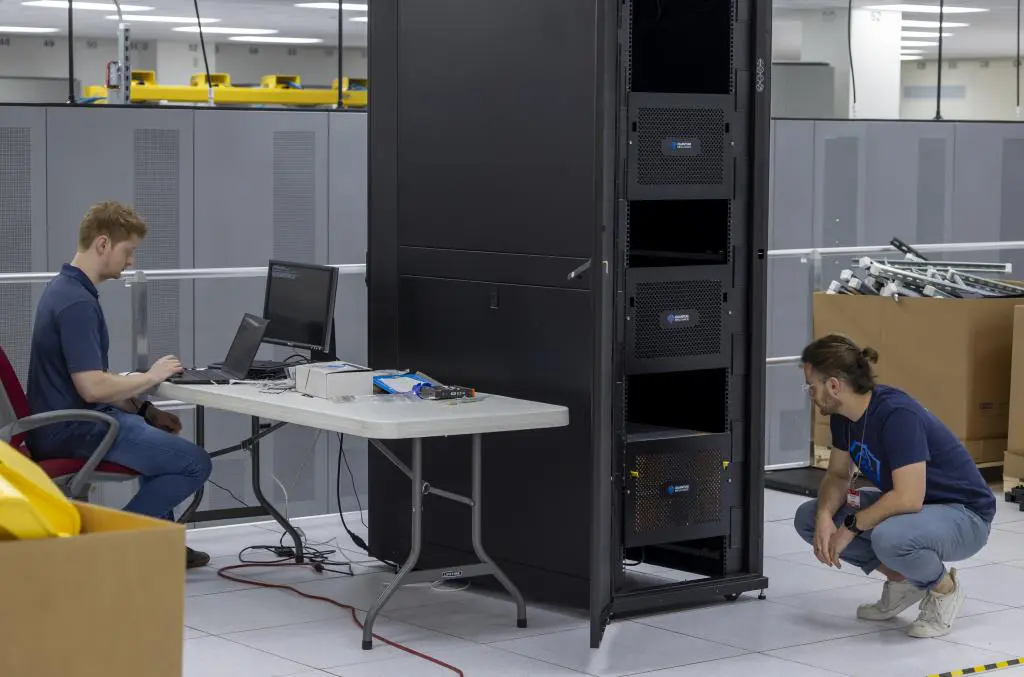
Dr. Marcus Doherty from Quantum Brilliance, a company headquartered in Australia and Germany, announced the installation of a hybrid quantum‑classical computing system at the Oak Ridge Leadership Computing Facility. The system comprises three Quantum Development Kits, each housing a diamond‑based quantum processing unit, for a total of six qubits that operate at room temperature in a compact package. By integrating the QPU with conventional GPU and CPU components, the platform enables parallelised quantum algorithms to run alongside high-performance computing workloads —a capability that the Oak Ridge National Laboratory will use to test hybrid architectures and accelerate applications in computational chemistry and machine learning.
Oak Ridge National Laboratory and Quantum Brilliance Deploy First Commercial Quantum Cluster
Oak Ridge National Laboratory (ORNL) and the Australian‑German quantum‑technology company Quantum Brilliance inaugurated the United States’ first on‑site, commercial quantum‑computer cluster on 2 September 2025. The installation, housed in the Oak Ridge Leadership Computing Facility’s Advanced Computing Ecosystem testbed, marks a milestone for both institutions and the Department of Energy’s Office of Science, which oversees ORNL through UT‑Battelle. The cluster is the first of its kind to integrate a diamond-based quantum processor into a high-performance computing (HPC) environment, enabling researchers to experiment with hybrid quantum-classical workflows at scale.
The system comprises three Quantum Development Kits (QDKs), each containing a Quantum Processing Unit (QPU) that together provide six qubits. Quantum Brilliance’s hybrid full‑stack platform integrates these QPUs with conventional graphics processing units (GPUs) and central processing units (CPUs), allowing parallel and hybrid quantum‑classical algorithms to run on a single, ruggedised package. The QPUs are engineered to operate at ambient temperature, eliminating the need for cryogenic cooling, laser, or vacuum infrastructure that typically characterises other qubit technologies.
According to Quantum Brilliance’s technology and innovation manager Andreas Sawadsky, the choice of diamond as a host material fundamentally alters the qubit environment. “In our case, the use of diamond as a host material changes the equation entirely,” he explained. Diamond’s exceptional hardness suppresses thermal vibrations even at room temperature, reducing decoherence caused by heat and electromagnetic noise. This intrinsic stability enables QPUs to function efficiently without the complexity and cost of cryogenic systems, thereby significantly reducing size, weight, and power consumption.
The collaboration has attracted a diverse team of experts. OLCF Program Director Ashley Barker noted that hosting the Quantum Brilliance system will mature “the real mechanics of hybrid computing coscheduling, end‑to‑end performance tuning, data and workflow orchestration, workforce development and more,” thereby moving HPC‑quantum integration from a conceptual pilot to a fully embedded capability. Director of the Department of Energy’s Quantum Science Center, Travis Humble, added that the research into quantum‑HPC integration is “a fundamental part of the lab strategy to realise the next‑generation of leadership‑class computing systems.” Quantum Brilliance Chief Technology Officer Dr. Marcus Doherty said, “We expect the OLCF will use our system to test different architectures and methods for hybrid and parallel quantum computing, including demonstrating applications in computational chemistry and machine learning that benefit from parallelisation.” CEO Mark Luo emphasised the broader vision: “This effort demonstrates what is possible and paves the way for large‑scale deployments globally, with hundreds of thousands, potentially millions, of systems. This is about so much more than just hardware; it is about building a future where quantum and classical systems collaborate on an unprecedented scale.”
The installation is a tangible step toward integrating quantum computing into existing HPC infrastructures. By providing a testbed for coscheduling, performance optimisation, and workflow orchestration, the cluster will inform the engineering pathway to a future where hundreds of parallel quantum computers are embedded within classical supercomputers. The collaboration also aims to accelerate tasks that currently rely on GPUs, such as large‑scale simulations in computational chemistry and machine learning, by leveraging the unique capabilities of the diamond‑based quantum processor.
The team assembled at the testbed includes Jim Rogers, Mallikarjun Shankar, Mariam Akhtar, Leigh Cameron, Reuben Singer, Lachlan Whichello, Simon Gemmell, Marcus Doherty, Sai Meghana Tunikipati, Andreas Sawadsky, Travis Humble, and Josh Cunningham. Their combined expertise spans quantum hardware design, HPC architecture, software development, and systems integration, underscoring the multidisciplinary nature of the project.
In sum, the deployment of Quantum Brilliance’s diamond‑based quantum processor at ORNL represents a significant advance in the practical integration of quantum technology with classical supercomputing. It provides a platform for testing hybrid algorithms, refining performance tuning, and exploring large‑scale deployment scenarios that could reshape computational science across a range of disciplines.
The diamond‑based QPU is a key innovation: it operates at ambient temperature in a compact, ruggedised package that eliminates the need for cryogenic refrigeration, high‑power lasers or vacuum chambers that are typical of other qubit technologies. The system comprises three Quantum Development Kits, each containing a parallelised QPU, for a total of six qubits. As technology and innovation manager Andreas Sawadsky explained, diamond’s extreme hardness suppresses thermal vibrations that would otherwise disrupt qubit coherence, allowing the processor to maintain stability without the complexity and cost of cryogenic infrastructure. The result is a GPU‑sized device that delivers reduced size, weight and power consumption while preserving the quantum advantage for selected workloads.
Integration with ORNL’s leadership‑class supercomputers is expected to unlock new hybrid algorithms that exploit the QPU’s strengths for tasks such as computational chemistry and machine‑learning inference. Chief Technology Officer Dr. Marcus Doherty highlighted that the collaboration will test a range of architectures and parallelisation strategies, informing the engineering pathway toward an HPC ecosystem populated by hundreds of parallel quantum computers. The project, championed by Quantum Brilliance CEO Mark Luo, is part of a broader effort to demonstrate that quantum and classical systems can collaborate at scale without the logistical burdens of cryogenics, thereby paving the way for large‑scale deployments across North America, Europe and the Asia Pacific.
Hybrid Quantum Classical Workflows Tested for Computational Chemistry and Machine Learning
On 2 September 2025 Oak Ridge National Laboratory announced that its Oak Ridge Leadership Computing Facility (OLCF) has become the first U.S. site to host a commercial quantum‑classical hybrid cluster. The installation, supplied by Quantum Brilliance, comprises three Quantum Development Kits (QDKs) that together contain six qubits. Each QDK houses a parallelised quantum processing unit (QPU) that is integrated with conventional graphics processing units (GPUs) and central‑processing units (CPUs), forming a full‑stack platform that supports simultaneous quantum and classical workloads. The QPU is a diamond‑based quantum processor that operates at ambient temperature inside a compact, ruggedised package, obviating the need for cryogenic cooling, high‑power lasers or vacuum chambers that are typical of other qubit technologies.
The hybrid system is positioned within OLCF’s Advanced Computing Ecosystem testbed, a data‑centre sandbox designed for experimentation with emerging computer architectures. Program Director Ashley Barker of the OLCF explained that the on‑site deployment will allow the laboratory to mature the practical aspects of quantum‑classical coscheduling, end‑to‑end performance tuning, data and workflow orchestration, and workforce development. “By hosting a Quantum Brilliance system on site, we will be maturing the real mechanics of hybrid computing coscheduling, end‑to‑end performance tuning, data and workflow orchestration, workforce development and more so we can eventually move HPC‑quantum integration from a conceptual pilot to a fully embedded capability within leadership computing,” she said.
Quantum Brilliance’s chief technology officer, Dr Marcus Doherty, highlighted the research agenda that will be pursued on the cluster. “We expect the OLCF will use our system to test different architectures and methods for hybrid and parallel quantum computing, including demonstrating applications in computational chemistry and machine learning that benefit from parallelisation,” he said. The collaboration will therefore probe how quantum algorithms can accelerate tasks such as electronic‑structure calculations and large‑scale neural‑network inference when coupled to the OLCF’s exascale‑class Frontier supercomputer.
The diamond‑based QPU is a key innovation that stems from the material’s extreme hardness, which suppresses thermal vibrations that normally cause decoherence. Technology and innovation manager Andreas Sawadsky explained that “in our case, the use of diamond as a host material changes the equation entirely.” He added that the intrinsic stability of diamond allows the QPU to function without the complexity and cost of cryogenics, lasers or vacuum systems, thereby dramatically reducing size, weight and power consumption. CEO Mark Luo underscored the broader vision: “This effort demonstrates what is possible and paves the way for large‑scale deployments globally, with hundreds of thousands, potentially millions, of systems. This is about so much more than just hardware; it is about building a future where quantum and classical systems collaborate on an unprecedented scale.”
The partnership, which brings together Oak Ridge National Laboratory, the Department of Energy’s Office of Science, and Quantum Brilliance—based in Australia and Germany—builds on a decade of joint work. Director of the DOE Quantum Science Centre, Travis Humble, noted that “our research into quantum‑HPC integration is a fundamental part of the lab strategy to realise the next‑generation of leadership‑class computing systems.” The team on site includes Jim Rogers, Mallikarjun Shankar, Mariam Akhtar, Leigh Cameron, Reuben Singer, Lachlan Whichello, Simon Gemmell, Sai Meghana Tunikipati, Andreas Sawadsky, Travis Humble and Josh Cunningham, all of whom will contribute to the development of hybrid workflows that could transform computational chemistry and machine‑learning research.
Original Press Release
Source: Oak Ridge National Laboratory (U.S. Department of Energy national laboratory)
View Original Source


