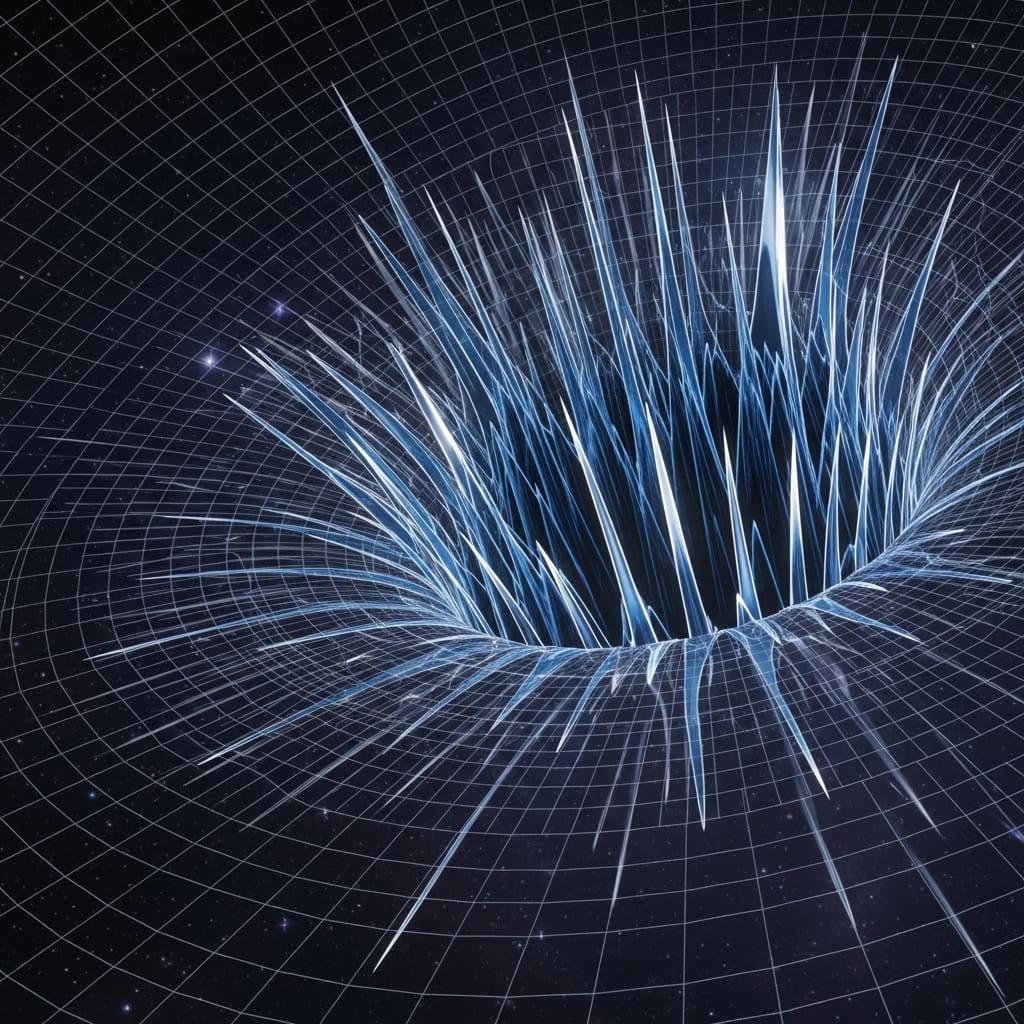
Researchers are challenging established theories about the fate of matter falling into black holes, suggesting the chaotic ‘Kasner epochs’ previously thought to dominate near the singularity may not be the full story. Mei-Ning Duan (Institute of Theoretical Physics, Chinese Academy of Sciences), Li Li, and Yu-Xuan Li, alongside Fu-Guo Yang (School of Physical Sciences, University of Chinese Academy of Sciences), demonstrate that incorporating higher-derivative corrections to gravity fundamentally alters the dynamics inside black holes. Their work reveals three distinct phases , modified Kasner eons, persistent oscillations, and growing amplitude spikes , representing a significant departure from classical predictions and a more ordered, potentially predictable, landscape within these extreme gravitational environments. This comprehensive approach promises a deeper understanding of gravitational nonlinearity in the most intense conditions imaginable.
This comprehensive approach promises a deeper understanding of gravitational nonlinearity in the most intense conditions imaginable.
Black hole singularities beyond Kasner epochs
Scientists have demonstrated a fundamental alteration to our understanding of spacetime singularities within black holes, challenging the long-held belief that dynamics near these singularities are governed by a sequence of Kasner epochs. This work reveals that the classical Kasner geometry only persists under highly constrained conditions, signifying a departure from established models of black hole interiors. Through this approach, they uncovered that quantum gravitational corrections can impose order on the chaotic dynamics previously predicted by the Belinski-Khalatnikov-Lifshitz (BKL) limit and its associated “Cosmological Billiards” description. This suggests that the interior structure of black holes is far more ordered than previously thought.
Experiments show that the introduction of higher-curvature terms, such as the Gauss-Bonnet term, dramatically alters the free Kasner motion in superspace, reminiscent of Lagrangians found in classical time crystals. The team employed a plane-symmetric ansatz to examine hairy black holes, revealing that the resulting Kasner eons can be characterised by two exponents defining the geometry as it approaches the singularity. As the singularity is approached, curvature invariants of order N grow as 1/τ 2N, inevitably leading to the dominance of higher-derivative terms in the extreme ultraviolet regime. This research establishes that the energy-momentum tensor associated with the geometry dictates the conditions for maintaining a Kasner form, and the team’s findings reveal a richer and more ordered landscape of behaviours in the deep interior of black holes. The work opens new avenues for exploring the interplay between dynamic matter fields and higher-derivative gravitational corrections, providing a crucial step towards a more complete understanding of quantum gravity and the origins of our universe, as probing black hole singularities also illuminates the initial Big Bang singularity.
Singularity Dynamics with Scalar Fields and Curvature
To facilitate analysis, the team harnessed two scaling symmetries within the equations of motion, setting the horizon parameter zH to 1 and χ(zH) to 0 for numerical computations. This simplification allowed scientists to uniquely determine solutions once a value for ψ(zH) was established, applying this approach consistently across all black hole solutions presented in the work. The research further transformed the equations using the coordinate transformation ρ = ln z, enhancing the visibility of periodic behaviours for specific potential functions V(ψ). This coordinate shift enabled clearer identification of oscillatory patterns within the complex system.
Scientists then developed a method for analysing oscillatory regimes, focusing on the critical scenario with a quartic potential V ∼ c4ψ4. Numerical simulations confirmed that f ≫ 1 and ψ ≫ 1 deep within the interior, justifying the neglect of the 1/f term in the initial equations, resulting in a simplified system. Quantitative agreement between the full equations of motion and the approximate equations, as demonstrated in Figure S1, validated this approximation. The team extracted positions of interior peaks from simulations, specifically nine central peaks in the range z/zH ∈ [103, 1022], to test for logarithmic scaling of the period.
Further analysis involved identifying scaling relations for oscillatory growth, extracting peak positions zn assuming the form zn = a1(n + b1)1/γ, and analysing amplitudes epxn fitting the form epxn = a2zδn + b2. These analyses, supported by numerical simulations, revealed power-law periodicity and modulated amplitudes, demonstrating the sensitivity of spike dynamics to the specific model potential. The study meticulously documented these behaviours across various potential functions, including power-law, exponential, and super-exponential divergence, highlighting the intricate relationship between potential form and oscillatory dynamics.
Singularity dynamics reveal three oscillatory phases of system
The team measured that Kasner-like geometry persists only under highly constrained conditions, indicating a departure from classical Kasner phenomenology. Experiments revealed that deviations of the parameter px from 3/d control the timescale of the breakdown of the initial Kasner phase, with larger deviations leading to earlier collapse. Data shows that for a quartic. These equations exhibit a key simplification where the left-hand sides depend only on logarithmic derivatives, while the right-hand sides share a common factor of ψ²/ f, enabling periodic solutions with a period ρ₀. Results demonstrate that in Case I, the functions ψ/ψ, f/ f, χ, and ψ²/ f are all constant, representing a trivial case with an arbitrary period ρ₀.
Conversely, Case II is non-trivial, characterized by a finite period ρ₀ dependent on system parameters, as evidenced by the periodic oscillations observed. The phase diagram in the c⁴-α² plane, with a boundary defined by the equation, separates Case I and Case II dynamics, with the boundary occurring at c⁴α² = d³ / 432(d −1)(d −2)(d −3) when px = 3/d. Tests prove that as the phase boundary is approached from Case II, the oscillation period ρ₀ increases and ultimately diverges. For potentials diverging more rapidly than ψ⁴, the study found even richer dynamics, with sustained oscillatory growth of effective exponents ept and epx as the singularity is approached, revealing potential discrete self-similarity. Specifically, for V ∼ψ⁶, the team recorded that peak oscillations share a common period in the coordinate p z/ zH, though their equilibrium positions and amplitudes differ, signaling coupled quasi-periodic evolution.
Higher curvature alters singularity dynamics revealed by simulations
The persistence of Kasner-like geometry is now found to be limited to highly constrained situations. The governing criterion for these phases is the asymptotic scaling of the scalar potential relative to a specific curvature order, with faster-diverging potentials leading to spike dynamics and slower ones potentially allowing for Kasner eons. The authors acknowledge that their analysis focuses on Einstein-Gauss-Bonnet gravity, but suggest the key features generalise to other theories with higher powers of curvature. Researchers note that the findings overturn conventional understanding of near-singularity dynamics, suggesting that quantum corrections and higher-order curvature terms become dominant at high energies, invalidating Kasner eons for potentials diverging faster than a certain threshold. Further investigation is warranted to explore less symmetric near-singularity solutions and the impact of different matter sectors. Additionally, the observed periodic dynamics may have implications for novel early-universe scenarios and cosmological singularities.
👉 More information
🗞 Beyond Kasner Epochs: Ordered Oscillations and Spike Dynamics Inside Black Holes with Higher-Derivative Corrections
🧠 ArXiv: https://arxiv.org/abs/2601.21658