

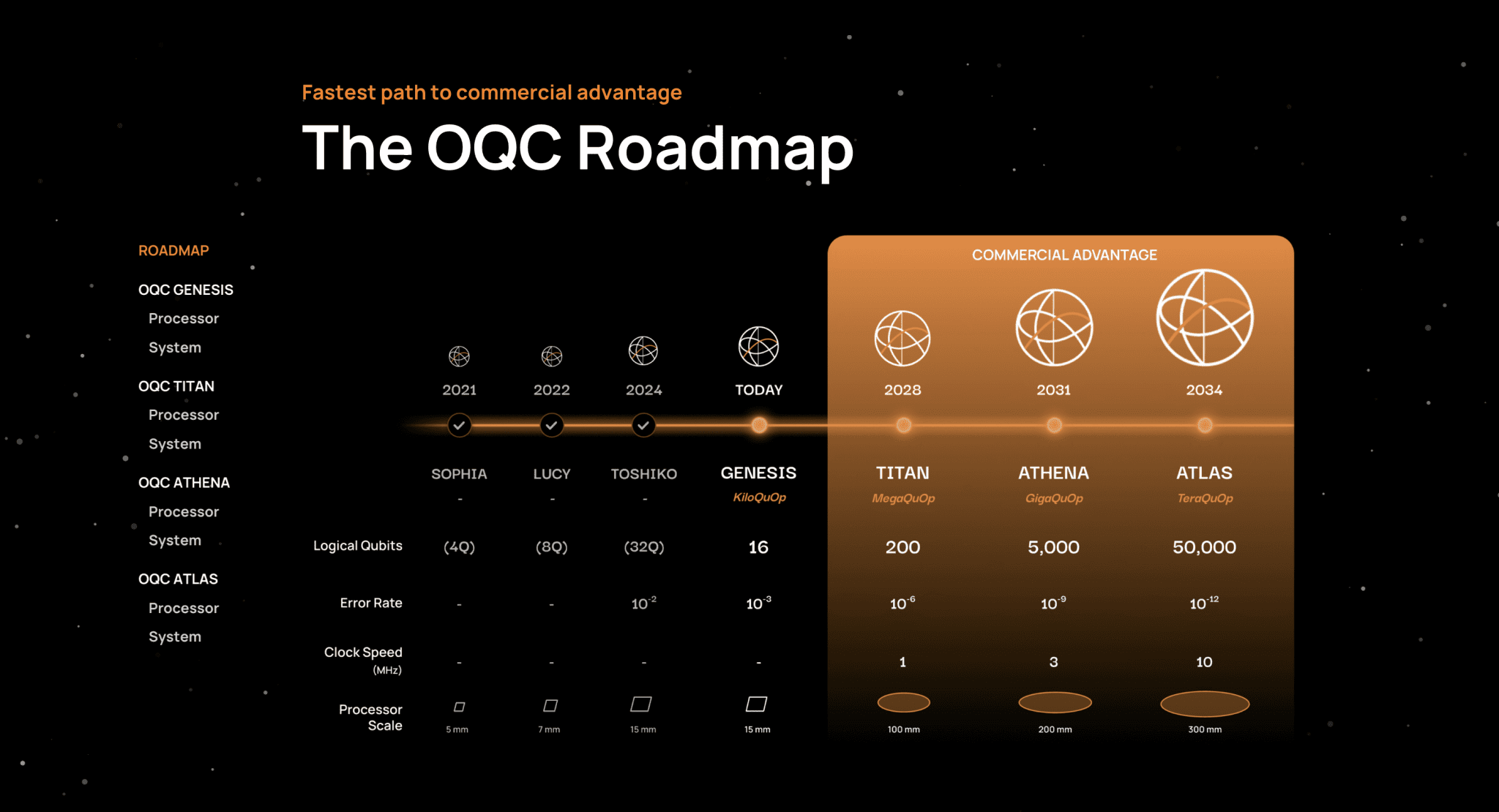
Oxford Quantum Circuits (OQC), a UK-based quantum computing company, has published a roadmap detailing its projected development of quantum computers capable of delivering 200 logical qubits by 2028 and scaling to 50,000 logical qubits by 2034. This trajectory positions OQC as a leading developer in the field, exceeding published roadmaps from other providers, and focuses on transitioning from current physical qubit-based systems to the logical qubit era where error correction enhances computational power. The company anticipates initial applications in areas such as fraud detection and cyber threat analysis by 2028, with broader transformative potential across sectors including financial services, security, drug discovery and quantum chemistry as qubit numbers increase. OQC’s approach aims to achieve this scalability with a ten-fold reduction in the physical-to-logical qubit ratio compared to current state-of-the-art technologies, and is supported by demonstrated two-qubit gate fidelity of 99.8% achieved in 25 billionths of a second.
Oxford Quantum Circuits (OQC) advances a focused trajectory on scaling logical qubits while minimising associated physical qubit overhead. The company projects achieving practical quantum advantage by 2028 with a 200-logical qubit system, targeting applications in fraud detection and cyber threat analysis. This advantage relies on an architecture designed to reduce the physical-to-logical qubit ratio required for robust error correction, positioning OQC as a key player in the rapidly evolving quantum computing landscape. OQC’s commitment to innovation and strategic partnerships positions it as a key player in the rapidly evolving quantum landscape.
OQC’s strategy centers on ‘Application Optimised Compute’, tailoring system engineering to specific computational challenges where quantum algorithms offer performance gains over classical methods. This contrasts with a general-purpose approach, enabling co-design of hardware and software for targeted applications and fostering a more efficient development process. Initial applications will address problems currently intractable for classical computers, or those requiring excessive computational resources. The company prioritises application-specific optimisation, focusing on developing quantum algorithms and software tailored to specific use cases.
By 2034, scaling to 50,000 logical qubits will
By 2034, scaling to 50,000 logical qubits will broaden the scope of solvable problems, unlocking new possibilities in scientific discovery and technological innovation. Beyond 2028, the projected scaling to 50,000 logical qubits anticipates applications including decryption, materials science and financial modelling. Complex simulations in materials science and drug discovery will become feasible, facilitating the design of novel compounds and materials with tailored properties. Advanced financial modelling, including risk assessment and portfolio optimisation, will benefit from the ability to explore a wider range of scenarios and optimise complex parameters.
Direct integration of quantum computers into existing commercial data centres is a key enabler of this timeline, streamlining deployment and reducing infrastructure costs. This deployment model bypasses the need for specialised infrastructure and facilitates seamless access to quantum processing for clients in security, defence, and finance, accelerating adoption and driving innovation. Embedding quantum capabilities within established IT ecosystems delivers practical benefits to customers and positions OQC as a leader in quantum-as-a-service.
OQC’s architecture aims to achieve a ten-to-one ratio of physical to logical qubits, a significant reduction compared to current approaches that often require tens or hundreds of physical qubits per logical qubit. This efficiency stems from a commitment to high-fidelity qubits and advanced error correction techniques, enabling more efficient use of quantum resources. Demonstrated gate fidelities of 99.8% at a speed of 25 nanoseconds indicate a high level of control and coherence in the hardware, validating the company’s technological advancements.
OQC’s commitment to high-fidelity qubits and advanced error
OQC’s commitment to high-fidelity qubits and advanced error correction techniques is crucial for achieving scalable quantum computation. High-fidelity qubits minimise errors during quantum computations, while advanced error correction techniques mitigate the impact of remaining errors. These technologies are essential for building reliable and scalable quantum computers. OQC’s projections for achieving practical quantum advantage by 2028 and scaling to 50,000 logical qubits by 2034 demonstrate its ambitious vision and technological leadership. These milestones represent significant steps towards realising the full potential of quantum computing and transforming industries.
External Link: Click Here For More


