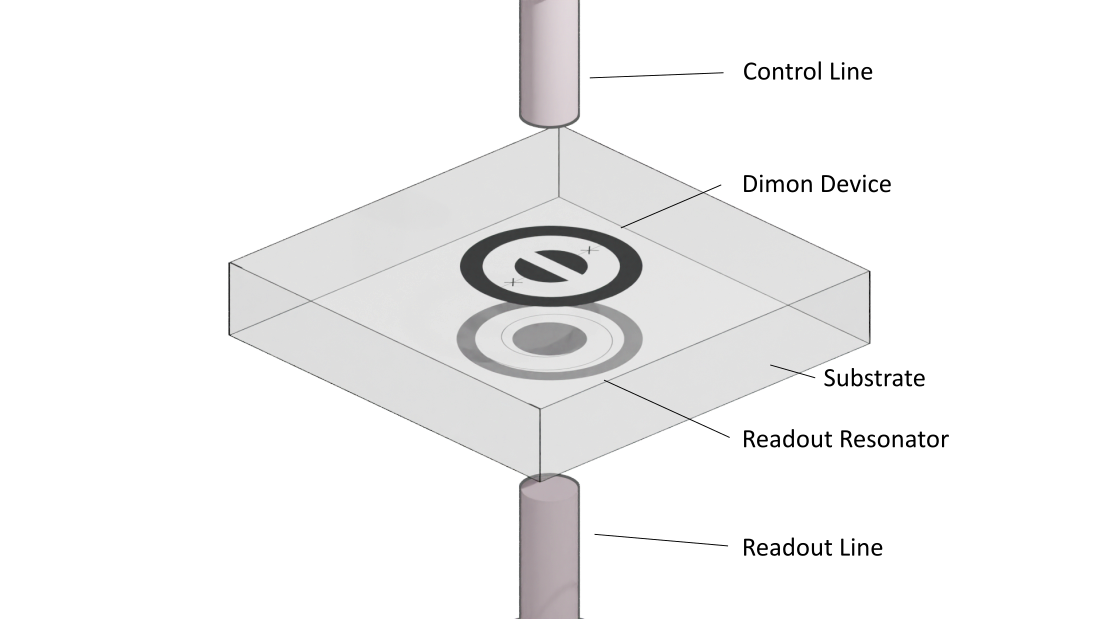
Brian Vlastakis and the team at OQC are pioneering a new approach to quantum error correction with their dual-rail dimon qubit (DDQ) technology. This research details a hardware-efficient method for scaling to the qubit numbers needed for useful quantum computation, demonstrating significant reductions in bit-flip and phase-flip error rates and paving the way for a future where quantum computers are more economically viable and capable of running complex algorithms. By focusing on error-detection at the hardware level, OQC aims to fundamentally change the economics of quantum computing and accelerate the path towards commercially-useful quantum computation, with a roadmap extending to 2035.
Researchers demonstrate progress in quantum error correction by utilising dual-rail dimon qubits, a fixed-frequency multimode superconducting qubit technology, to establish robust error detection capabilities. This innovative approach generates a logical subspace distinctly separate from error-detected states, enabling precise identification and mitigation of errors during quantum computations. By removing data originating from relaxation events within error-detected states, scientists reduce the impact of physical qubit limitations on logical qubit computations, ultimately improving quantum memory performance. The successful implementation of dual-rail dimon qubits represents a significant milestone in the pursuit of fault-tolerant quantum computing.
The team successfully implemented this technology and measured logical bit-flip and phase-flip error rates, observing substantial reductions compared to the constituent physical modes. Coherence metrics demonstrate a tenfold improvement over physical modes, achieving performance levels comparable to high-quality superconducting qubit hardware. The ability to characterize and understand decoherence mechanisms is crucial for optimising qubit performance and extending coherence times.
Researchers confirmed the stability and repeatability of these
Researchers confirmed the stability and repeatability of these devices through continuous measurements across an array of three devices over a period of fifty hours. The successful demonstration of stable and repeatable performance across multiple devices underscores the maturity of the dual-rail dimon qubit technology. This reliability is essential for building large-scale quantum systems that can perform complex calculations with high accuracy.
The dimon encoding exhibits unique sensitivities to noise sources, providing valuable insights into decoherence mechanisms and informing the development of improved qubit designs. The unique sensitivities of the dimon encoding provide a valuable tool for investigating the factors that limit qubit coherence. This knowledge will inform the development of improved qubit designs and control techniques.
The implementation of dual-rail dimon qubits offers a hardware-efficient method for scaling the number of physical qubits required for complex quantum computations. The team’s findings demonstrate the potential for reducing the overhead associated with quantum error correction, a critical factor for scaling quantum computers. By minimising the number of physical qubits required to encode a single logical qubit, scientists can reduce the complexity and cost of building large-scale quantum systems.
This research marks a transition from focusing solely on improving physical qubits to building systems based on robust logical qubits. The development of robust quantum error correction techniques is crucial for unlocking the full potential of quantum computing. By addressing the challenges of qubit decoherence and error accumulation, scientists are paving the way for a new era of scientific discovery and technological innovation.
The dual-rail dimon qubit design allows for the
The dual-rail dimon qubit design allows for the creation of a logical subspace, effectively isolating computational states from noise and disturbances. Observed decay profiles deviate from typical exponential decay patterns, confirming the effectiveness of the implemented error detection and post-selection processes. The resulting error-detected quantum processing unit supports benchmarking of quantum algorithms and delivers performance levels comparable to industry standards.
The team’s research highlights the importance of interdisciplinary collaboration in advancing quantum computing. By combining expertise in physics, engineering, and computer science, scientists are able to overcome the complex challenges associated with building and controlling quantum systems. This collaborative approach is essential for accelerating the development of practical quantum technologies.
By addressing the challenges of qubit decoherence and error accumulation, scientists are unlocking new possibilities for solving complex problems in fields such as medicine, materials science, and artificial intelligence. The ability to detect and correct errors in real-time is essential for building reliable quantum systems capable of performing complex calculations. This research paves the way for developing more sophisticated error correction codes and architectures.
External Link: Click Here For More