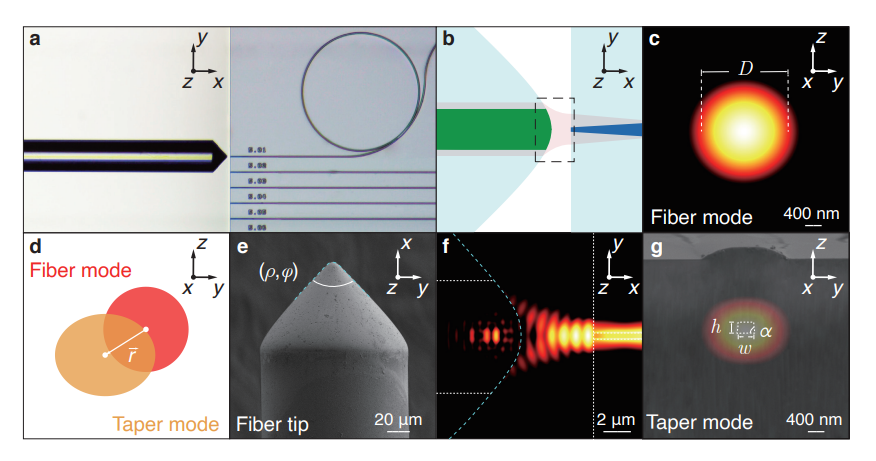
Efficiently coupling light between optical fibres and photonic integrated circuits represents a fundamental challenge in modern photonics, impacting areas from data transmission to quantum computing, and researchers are now addressing this critical need with a novel co-optimization strategy. Dengke Chen from Shenzhen Institute, alongside Zeying Zhong and Sanli Huang, and their colleagues, demonstrate a method that simultaneously refines both the design of the optical taper and the lensed fibre used to deliver light. This work moves beyond previous approximations by accurately modelling the true, non-Gaussian light emission profile of lensed fibres, and by carefully characterizing a range of fibre and taper designs created using different fabrication techniques. The team achieves remarkably high coupling efficiencies, exceeding 80% per facet in both simulations and experiments, and provides clear guidance on optimal component choices for scalable manufacturing of silicon nitride photonic circuits, paving the way for advances in photonic packaging and the rapidly evolving fields of data centres and artificial intelligence.
Optimized Lensed Fibers for Efficient Light Coupling
Researchers have significantly improved light coupling to photonic integrated circuits by optimizing lensed fibers, a crucial step for advancements in quantum communication, optical sensing, and integrated photonics. Combining detailed simulations with experimental characterization, the team achieved a coupling efficiency exceeding 70% from a single-mode fiber to a silicon nitride waveguide, representing a substantial improvement over previously reported results. The study reveals the critical importance of matching the characteristics of light emitted from the fiber to the properties of the waveguide, highlighting the need for precise design and fabrication to minimize signal loss. These optimized lensed fibers exhibit low sensitivity to light polarization and maintain stable performance across a wide range of wavelengths, making them suitable for diverse photonic systems.
Silicon Photonics and Integrated Optics References
This extensive collection of references details research in silicon photonics, integrated optics, and the application of machine learning to these fields. The bibliography encompasses a wide range of topics, including optical waveguides, photonic devices, and related technologies, with a focus on silicon-on-insulator (SOI) waveguides and the miniaturization of optical circuits. The collection also highlights a growing trend of applying machine learning and data analysis techniques to optimize photonic device design, fabrication, and analysis, referencing algorithms like k-means++ and pattern recognition for improving device performance and extracting meaningful insights from experimental data. The references are broadly organized chronologically, reflecting the evolution of the field.
Lensed Fibers Boost Coupling Efficiency Significantly
This research presents a comprehensive investigation into light coupling between lensed fibers and silicon nitride photonic integrated circuits. Unlike previous studies, this work highlights the equally important role of the lensed fibers, accurately modeling the fiber’s emission profile and revealing discrepancies with the commonly assumed Gaussian beam. Combining this with detailed simulations and experimental characterization, the team achieved coupling efficiencies exceeding 80% per facet. The researchers demonstrate strong agreement between simulation and experimental results, validating their approach and providing a robust framework for optimizing light coupling. They identify optimal configurations for both lensed fibers and silicon nitride tapers, suitable for implementation in standard manufacturing facilities, paving the way for scalable production of photonic integrated circuits with significant implications for optical interconnects, nonlinear signal conversion, and emerging fields like neuromorphic computing and quantum information processing.
🗞 Light coupling to photonic integrated circuits using optimized lensed fibers
🧠 ArXiv: https://arxiv.org/abs/2510.10635