

The behaviour of quantum systems at moderate temperatures presents a significant challenge to realising practical quantum technologies, as maintaining delicate quantum states becomes increasingly difficult. Christopher Mastandrea from the University of California, Merced, Costin Iancu from Lawrence Berkeley National Laboratory, and Hao Guo from Southeast University, along with their colleagues, now demonstrate a way to observe a specific quantum property, the Uhlmann phase, even within the limitations of current quantum computers. Their work focuses on a spin-1 system exhibiting a unique topological regime at intermediate temperatures, sandwiched between more conventional behaviours at very low and very high temperatures. By designing and optimising a quantum circuit for implementation on IBM quantum computers, the team successfully measures this Uhlmann phase, revealing clear evidence of interesting finite-temperature topological phenomena and paving the way for exploring more complex quantum behaviours on near-term quantum hardware.
Uhlmann Phase Characterizes Mixed Quantum States
This paper details advancements in quantum computing, focusing on the Uhlmann phase and its applications in characterizing and improving quantum systems. The research centers on the Uhlmann phase, a geometric phase applicable to mixed quantum states, states that are not pure, which is crucial because real-world quantum systems often exhibit mixed states due to imperfections. This contrasts with traditional geometric phases limited to pure states, offering a new tool for analyzing complex quantum systems. The work acknowledges the current state of quantum computing as being in the Noisy Intermediate-Scale Quantum (NISQ) era, where quantum computers are limited in size and prone to errors.
Researchers focused on techniques to mitigate these errors and improve computational performance, including dynamical decoupling and error correction strategies, alongside circuit optimization and qubit mapping techniques. The team utilized quantum software development kits like Qiskit and BQSKIT to build and simulate quantum circuits, employing advanced techniques for circuit compilation and optimization. Performance evaluation and benchmarking were emphasized to assess the capabilities of quantum gates and circuits, and the paper delves into the theoretical foundations of geometric phases, including the Uhlmann phase, and their applications in areas like quantum interferometry.
Uhlmann Phase Extraction via Quantum Circuitry
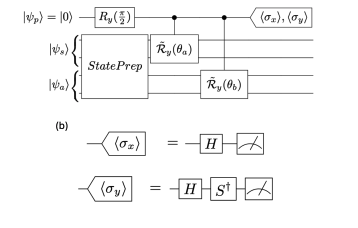
Researchers developed a quantum circuit to investigate topological properties of spin-1 systems, leveraging the Uhlmann phase and employing a unique approach to state preparation and measurement. The core of the methodology involves constructing a circuit that accurately simulates the evolution of a spin-1 system, allowing for the extraction of the Uhlmann phase, a quantity sensitive to the system’s topological characteristics. A key innovation lies in representing a spin-1 system using qubits, as current quantum computers primarily operate with two-level systems. Researchers addressed this by representing the spin-1 system with two qubits, effectively encoding its three energy levels within the combined state.
This required a transformation between the standard computational basis and a “physical basis” corresponding to the energy levels of the spin-1 system, accomplished through a specifically designed unitary matrix. The process of preparing the initial state and implementing the Uhlmann process demanded significant optimization to overcome the limitations of current quantum hardware. Initial circuit designs proved too complex, exceeding error thresholds. Researchers employed advanced optimization techniques using software platforms like Qiskit and BQSQit, substantially reducing the number of quantum gates required, enabling clear and measurable signals.
Measurements were performed using a generalized form of the DQC1 procedure, requiring two separate circuits to measure expectation values. Each circuit was run thousands of times to generate sufficient statistical data, and the resulting expectation values were used to determine the Uhlmann phase. This enabled researchers to demonstrate finite-temperature topological phenomena on current quantum hardware.
Temperature Stabilizes Quantum Topological Order
Researchers have demonstrated the observation of a unique topological state in a spin-1 quantum system, revealing a surprising interplay between temperature and quantum properties. Unlike conventional understanding, temperature typically destroys topological order, this work shows a finite-temperature regime where topological characteristics are maintained, sandwiched between topologically trivial states. The team achieved this breakthrough by simulating the quantum system using a circuit on IBM’s quantum computers, focusing on the Uhlmann phase as a key indicator of topological order. The Uhlmann phase acts as a fingerprint of the system’s topological properties, and its quantized values provide inherent resilience against errors, making it suitable for investigation on noisy intermediate-scale quantum (NISQ) computers.
By carefully controlling the quantum system and its environment, researchers were able to observe distinct jumps in the Uhlmann phase, confirming the existence of the finite-temperature topological regime. A significant challenge lay in the limitations of current quantum hardware, as the complexity of the initial circuit exceeded the capabilities of the available quantum processors. Through substantial optimization using software tools, the team dramatically reduced the required computational resources, enabling the clear observation of the topological transitions. The results demonstrate that the Uhlmann phase can be accurately measured using a relatively simple extension of a technique called deterministic quantum computation with one qubit (DQC1), which extracts information about a quantum state using a single additional qubit. This offers a promising pathway for probing subtle quantum phenomena on NISQ devices and could be extended to more complex systems.
Quantized Uhlmann Phase Observed in Spin System
This research demonstrates the existence of an intermediate-temperature topological regime for a spin-1 system, characterized by a quantized Uhlmann phase. This discovery challenges conventional understanding that topological order is destroyed by temperature, revealing a stable regime between topologically trivial states at low and high temperatures. Researchers achieved this by simulating the spin-1 system on quantum hardware and carefully measuring the Uhlmann phase, a geometric phase that serves as a robust indicator of topological order. The team employed advanced circuit optimization techniques to overcome the limitations of current quantum processors and achieve clear, measurable signals. The ability to accurately measure the Uhlmann phase using a relatively simple extension of the DQC1 technique offers a promising pathway for probing subtle quantum phenomena on NISQ devices. This approach could be extended to more complex systems, potentially offering a new tool for characterizing and understanding quantum materials.
🗞 Intermediate-temperature topological Uhlmann phase on IBM quantum computers
🧠 ArXiv: https://arxiv.org/abs/2508.02915


