Spin defects in hexagonal boron nitride (hBN) represent a promising platform for nanoscale magnetic field sensors, and researchers are now gaining greater control over optimising their performance. Saksham Mahajan, Ravi Kumar, and Aferdita Xhameni, all from University College London, alongside colleagues including Basanta Mistri from the Indian Institute of Technology Madras, investigate how irradiation conditions impact the magnetic field sensitivity of these defects within hBN nanoflakes. Their work demonstrates that careful control of the fabrication process, specifically the ion beam used to create the defects, is crucial for maximising both signal strength and spin coherence. The team achieves an impressive AC magnetic sensitivity and confirms that the defects and associated lattice damage remain well-confined to the implanted regions, paving the way for practical applications of 2D material-based sensors.
Boron Vacancies as Stable Qubit Candidates
This research details the creation and characterization of point defects, specifically boron vacancies, within hexagonal boron nitride (hBN) for potential use in quantum technologies. The investigation involves creating these vacancies using ion implantation and thoroughly examining their properties using advanced spectroscopic techniques. Researchers utilized ion implantation to precisely create boron vacancies, employing Raman spectroscopy to identify and monitor their formation. Multi-wavelength Raman spectroscopy revealed information about the arrangement of different hBN phases, with peak intensity increasing with specific laser wavelengths, suggesting a resonance effect.
Optically Detected Magnetic Resonance (ODMR) spectroscopy probed the spin properties of the boron vacancies, revealing crucial information about their quantum behaviour. The team extracted zero-field splitting parameters from the ODMR spectra, finding these values changed with defect concentration. Measurements of ODMR signal linewidth and contrast provided further insights into the spin characteristics, while Hahn echo coherence time measurements achieved 63. 6 ±1. 1 nanoseconds.
Further analysis showed a spin relaxation time of 6. 5 ±0. 2 microseconds, but instantaneous spin diffusion limited overall coherence. The distribution of defects created by the ion beam was modelled using a Gaussian distribution, accounting for both laser and ion beam profiles. This modelling helped understand the spatial arrangement of the vacancies within the hBN material. This comprehensive approach, combining experimental techniques and theoretical modelling, provides a strong foundation for understanding and controlling these quantum systems.
Focused Ion Beam Creates Boron-Vacancy Centres
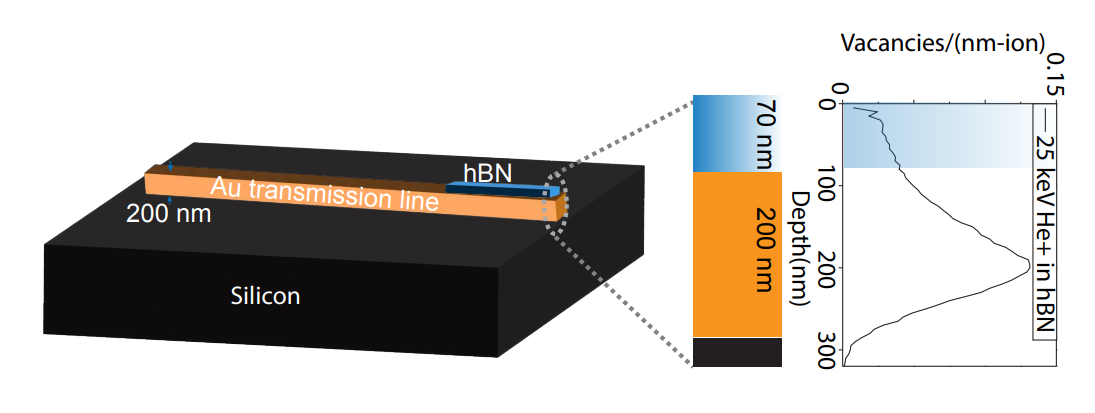
This work pioneers a focused ion beam technique to engineer boron-vacancy (V B ) centres in hexagonal boron nitride (hBN) nanoflakes, optimizing their magnetic field sensitivity. Researchers employed helium focused ion beam (FIB) irradiation to create these centres within approximately 70nm thick hBN nanoflakes, carefully controlling ion fluence from 10¹² to 10¹⁵ ions/cm². Calculations predicted a uniform distribution of V B defects throughout the flake thickness. A key aspect of the experimental design involved leaving portions of each nanoflake unimplanted, allowing for direct comparison of modified and pristine hBN regions.
Following ion implantation, the team meticulously characterized the resulting V B centres using photoluminescence (PL) measurements and pulsed optically detected magnetic resonance (PODMR) spectroscopy. PL measurements, performed with a 522nm laser, revealed characteristic V B emissions centred around 820nm, confirming successful centre creation. PODMR spectroscopy, conducted under zero applied magnetic field, revealed correlations between coherence times and lattice disorder. The study demonstrates that the concentration of V B centres increases with ion fluence, up to a point. However, beyond an ion fluence of 10¹⁴ ions/cm², significant degradation in both spin coherence and hBN lattice quality occurs.
At the optimal implantation dose of 10¹⁴ ions/cm², the team achieved an AC magnetic sensitivity of approximately 1 μT/√Hz, representing a significant advancement in 2D material-based sensing. Detailed analysis using Raman spectroscopy and PL imaging confirmed that the V B centres and associated lattice damage are well-localized to the implanted regions, demonstrating precise control over centre placement. This innovative approach enables the fabrication of hBN-based devices with tailored magnetic properties, paving the way for advanced quantum sensing applications.
Boron Vacancy Centers in Hexagonal Boron Nitride
Scientists achieved a breakthrough in creating and optimizing quantum sensors using hexagonal boron nitride (hBN) nanoflakes, demonstrating precise control over the creation of boron-vacancy (V B ) centers. The research focused on utilizing helium focused ion beam (FIB) irradiation to introduce these centres and carefully tuning the implantation conditions to maximize sensor performance. Experiments revealed that the spin properties and hBN lattice structure remain largely preserved up to an ion fluence of 10¹⁴ ions/cm², beyond which significant degradation occurs. The team measured the optical and spin characteristics of hBN samples subjected to varying ion fluences, employing photoluminescence, optically detected magnetic resonance, and Raman spectroscopy.
Results demonstrate a direct correlation between ion fluence, fluorescence intensity, and lattice disorder, allowing for precise optimization of sensor characteristics. Specifically, the team observed that the relative fluorescence intensity increased with ion fluence, indicating a higher concentration of V B centers. At an optimal implantation dose of 10¹⁴ ions/cm², the team achieved an AC magnetic sensitivity of approximately 1 μT/√Hz, representing a significant advancement in 2D material-based quantum sensing. Measurements confirm that this sensitivity is maintained while preserving the hBN crystallinity, crucial for robust sensor operation. Furthermore, the patterned implantation enabled by the FIB allowed for precise localization of V B centers and associated lattice damage to the implanted regions. This work demonstrates how careful selection of fabrication parameters can be used to optimize the properties of V B centers in hBN, supporting their application as quantum sensors based on 2D materials.
Optimized Boron Nitride Quantum Sensor Performance
This work demonstrates that focused ion beam irradiation effectively patterns V−B centres within hexagonal boron nitride, creating potential quantum sensors embedded in two-dimensional materials. Researchers systematically investigated how varying the ion fluence impacts the properties of these centres, crucial for their application as local magnetic sensors. The team found that increasing the concentration of V−B centres, achieved through higher ion fluence, introduces defects that ultimately reduce measurement sensitivity, despite enhancing brightness. Optimal results were obtained with an ion fluence of 10¹⁴ ions/cm², yielding a DC magnetic field sensitivity of 30 μT/√Hz and an AC sensitivity of approximately 1 μT/√Hz.
These sensitivities are currently limited by reductions in optical detection magnetic resonance spin contrast, stemming from lattice damage caused by ion implantation and, at higher concentrations, by interactions between the V−B centre spins themselves. Attempts to decouple the creation of V−B centres from defect formation through natural migration were unsuccessful. The findings provide valuable insights into the limiting factors affecting the sensitivity of these ion-implanted sensors and will aid in the development of optimised, two-dimensional magnetic sensor arrays.
🗞 Impact of irradiation conditions on the magnetic field sensitivity of spin defects in hBN nano flakes
🧠 ArXiv: https://arxiv.org/abs/2510.13991