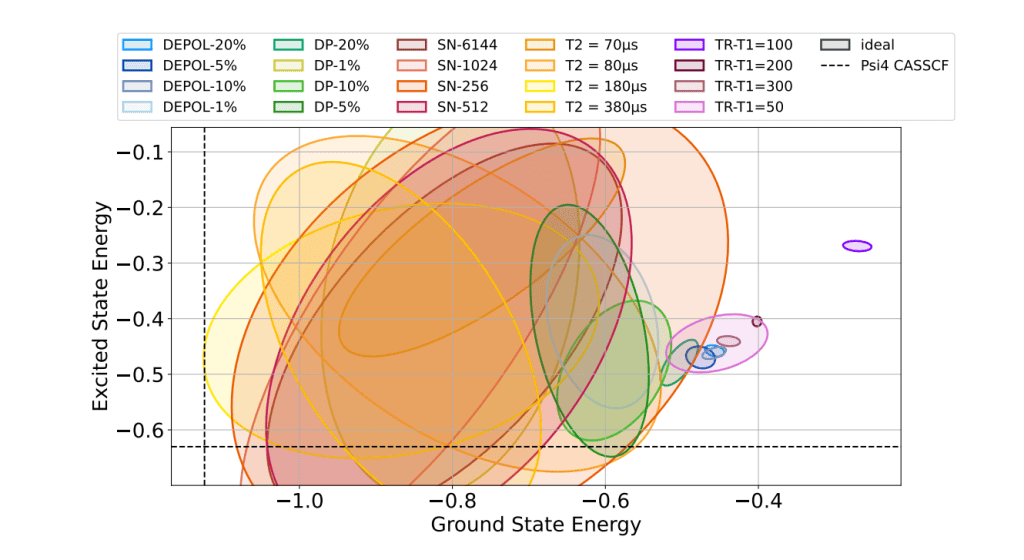
The pursuit of accurate molecular simulations faces a significant challenge from the inherent noise present in current quantum computers, which can disrupt calculations and compromise results. Silvie Illésová from IT4Innovations, Tomáš Bezděk from the Technical University of Munich, and Vojtěch Novák from VSB-Technical University of Ostrava, alongside Bruno Senjean and Martin Beseda, systematically investigate how different numerical optimisation methods perform under realistic quantum noise conditions. Their work assesses the stability and accuracy of six commonly used optimisation strategies when applied to molecular simulations, specifically focusing on the hydrogen molecule. The team’s findings reveal that the BFGS method consistently delivers the most accurate results with minimal computational cost, even when moderate noise is present, offering valuable insight for selecting appropriate optimisation techniques as quantum computing technology advances and enabling more reliable chemistry computations on near-term hardware.
VQE Optimization Robustness Under Quantum Noise
This research presents a comprehensive statistical benchmarking study of optimization methods used within the Variational Quantum Eigensolver (VQE) algorithm, focusing on their performance under realistic quantum noise conditions. The study rigorously compares how different classical optimization algorithms minimize the energy function within VQE, a crucial factor for achieving accurate results on real-world quantum hardware. VQE relies on a classical optimizer to adjust parameters in a quantum circuit, and the choice of optimizer significantly impacts calculation efficiency and accuracy. Researchers acknowledge that quantum computers are inherently noisy and that simulating realistic noise models is essential for evaluating VQE on near-term devices.
They tested a wide range of optimization algorithms, including established methods like BFGS, Nelder-Mead, and CMA-ES, as well as more recent approaches like Adam and Bayesian Optimization. This broad comparison provides valuable insights into the strengths and weaknesses of each algorithm. The study utilizes quantum simulators to model quantum circuits and introduce realistic noise, implementing models for phase damping, depolarizing errors, and thermal relaxation. Researchers applied these algorithms to specific molecular systems, allowing them to assess the generalizability of the results. Performance was measured by evaluating achieved energy accuracy, computational efficiency, convergence rate, and robustness across different noise conditions.
A key strength of this work lies in its robust statistical framework. Researchers ran each optimization algorithm multiple times with different random seeds and noise realizations to obtain statistically significant results. They employed Multivariate Analysis of Variance (MANOVA) to compare algorithm performance across multiple metrics simultaneously, using Mahalanobis distance to account for correlations. Permutational MANOVA (PERMANOVA) provided a non-parametric alternative for data that didn’t meet the assumptions of parametric tests. Post-hoc tests, including Holm’s method and Friedman’s test, identified significant differences between algorithms, while Benjamini-Hochberg procedure controlled the False Discovery Rate to prevent spurious findings.
The research benefits from readily available software like Qiskit and Psi4, and the replication package is openly available on Zenodo, a repository for open research data. The exact Git commit version and environment specification are provided, ensuring reproducibility. This commitment to transparency and reproducibility makes the study a valuable contribution to the field of quantum computing, providing practical guidance for researchers and practitioners working on VQE and other hybrid quantum-classical algorithms.
Optimizing Variational Quantum Eigensolver Performance for H2
This study systematically investigates the performance of six numerical optimization algorithms, BFGS, SLSQP, Nelder-Mead, Powell, COBYLA, and iSOMA, within the State-Averaged Orbital-Optimized Variational Quantum Eigensolver (SA-OO-VQE) framework applied to the hydrogen molecule. Researchers selected the hydrogen molecule as a benchmark due to its simple electronic structure and relevance as a minimal model for chemical bonding, allowing focused evaluation of optimization strategies. SA-OO-VQE, a quantum analogue of the classical MCSCF method, was employed to calculate ground-state energies, extending the scope to include excited states and providing a systematic approach for quantum hardware calculations. To assess optimizer robustness, the team subjected each algorithm to ideal, stochastic, and decoherence noise models, including phase damping, depolarizing, and thermal relaxation channels.
These noise models simulate the imperfections inherent in current Noisy Intermediate-Scale Quantum (NISQ) computers, providing a realistic evaluation of performance. Each optimizer was tested across multiple noise intensities and measurement settings, allowing researchers to characterize convergence behaviour and sensitivity to noise-induced distortions in the cost function landscape. The study employed a numerical approach, systematically evaluating the algorithms’ ability to navigate the high-dimensional cost function landscape. Researchers meticulously tracked convergence rates and the accuracy of the resulting energies, providing quantitative data on algorithm performance.
Results demonstrate that BFGS consistently achieves the most accurate energies with minimal evaluations, maintaining robustness even under moderate decoherence, while COBYLA performs well for low-cost approximations. Conversely, SLSQP exhibits instability in noisy regimes, and global approaches such as iSOMA, though promising, are computationally expensive. This comparative analysis provides practical guidance for selecting suitable optimizers in variational quantum simulations.
BFGS Optimisation Excels Under Noise Conditions
This work systematically assessed the performance of six numerical optimization algorithms, BFGS, SLSQP, Nelder-Mead, Powell, COBYLA, and iSOMA, when applied to the State-Averaged Orbital-Optimized Eigensolver for the hydrogen molecule, under various noise conditions. Researchers investigated how these algorithms perform in ideal environments and under the influence of stochastic and decoherence noise, including phase damping, depolarizing, and thermal relaxation. The study focused on evaluating convergence behaviour and accuracy of resulting energies. Results demonstrate that BFGS consistently achieves the most accurate energies with minimal evaluations, maintaining robustness even under moderate decoherence, while COBYLA performs well for low-cost approximations. Conversely, SLSQP exhibits instability in noisy regimes, and global approaches such as iSOMA, though promising, are computationally expensive. This comparative analysis provides practical guidance for selecting suitable optimizers in variational quantum simulations.
🗞 Statistical Benchmarking of Optimization Methods for Variational Quantum Eigensolver under Quantum Noise
🧠 ArXiv: https://arxiv.org/abs/2510.08727