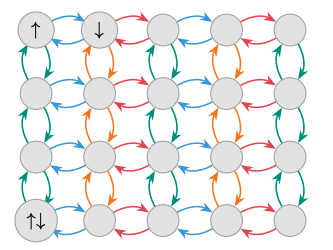
Finding the ground state energy of complex materials remains a significant challenge in computational physics, and researchers continually seek more efficient algorithms for quantum computers. Cedric Gaberle and Manpreet S. Jattana, from the Institute of Computer Science at Goethe University Frankfurt, now present a new optimisation method for the Variational Quantum Eigensolver, a leading algorithm for these calculations. Their approach builds quantum circuits incrementally, focusing on optimising smaller sections at a time, which provides a better starting point for subsequent calculations and preserves the algorithm’s ability to accurately represent complex systems. Benchmarks on established models demonstrate that this technique improves accuracy and reduces the computational effort required, making it particularly promising for use with today’s limited, yet rapidly developing, quantum hardware.
These systems, known as many-body problems, are often intractable for even the most powerful classical computers. Researchers are focusing on the Variational Quantum Eigensolver (VQE), a promising quantum algorithm for finding the lowest energy state of these systems. To improve VQE’s performance, scientists are exploring techniques like layerwise learning, quasi-dynamical evolution, and advanced classical optimization algorithms to avoid barren plateaus and reduce the impact of noise.
The research demonstrates that quasi-Newton methods, specifically BFGS, improve VQE’s convergence speed and robustness when applied to the Heisenberg and Fermi-Hubbard models. The importance of error mitigation techniques for obtaining accurate results on noisy quantum hardware was also emphasized, while layerwise learning shows promise as a method to avoid barren plateaus. This work builds on existing techniques such as various quantum circuit designs and the Jordan-Wigner transformation. Rather than optimizing all parts of a quantum calculation simultaneously, the team constructs the quantum circuit incrementally, building from smaller subsets of its components. This allows for optimization of these subsets, providing a better starting point for subsequent steps and balancing expressivity, trainability, and hardware efficiency. The research centers on constructing a parameterized quantum circuit, known as the ansatz, to approximate the ground state of a given system.
The team’s method utilizes a physics-inspired ansatz, incorporating known symmetries and correlations present in the target system. This ansatz is then strategically divided into operator building blocks, added sequentially during the optimization process. The team demonstrated the method’s effectiveness using one- and two-dimensional Heisenberg and Hubbard models with up to 20 qubits. The research team constructs the quantum circuit incrementally, building from subsets of its components to enable optimization of these subsets and provide a better starting point for subsequent steps. This quasi-dynamical approach preserves both the ability to represent complex solutions and the efficiency required for current quantum hardware. Experiments using one- and two-dimensional Heisenberg and Hubbard models with up to 20 qubits demonstrated significant improvements in accuracy and reduced computational steps compared to fixed-layer VQE methods.
The team achieved lower energy states by pre-optimizing lower-dimensional sub-regions of the energy landscape. The research demonstrates that the method is particularly effective in tackling the problem of barren plateaus, by incorporating known physical constraints and symmetries into the circuit structure. The researchers demonstrate that building a quantum calculation incrementally, by optimizing subsets of the quantum circuit, offers advantages over traditional approaches. This quasi-dynamical method balances the ability to represent complex solutions and efficiency, avoiding the computational demands of fully adaptive methods while still leveraging problem-specific knowledge to guide the calculation. Evaluations on one- and two-dimensional models show that this method achieves improved accuracy, requires fewer computational steps, or both, compared to standard techniques. The approach is particularly well-suited for current, limited-scale quantum devices by reducing the computational strain associated with deeper circuits or more complex adaptive methods.
👉 More information
🗞 Slice-Wise Initial State Optimization to Improve Cost and Accuracy of the VQE on Lattice Models
🧠 ArXiv: https://arxiv.org/abs/2509.13034