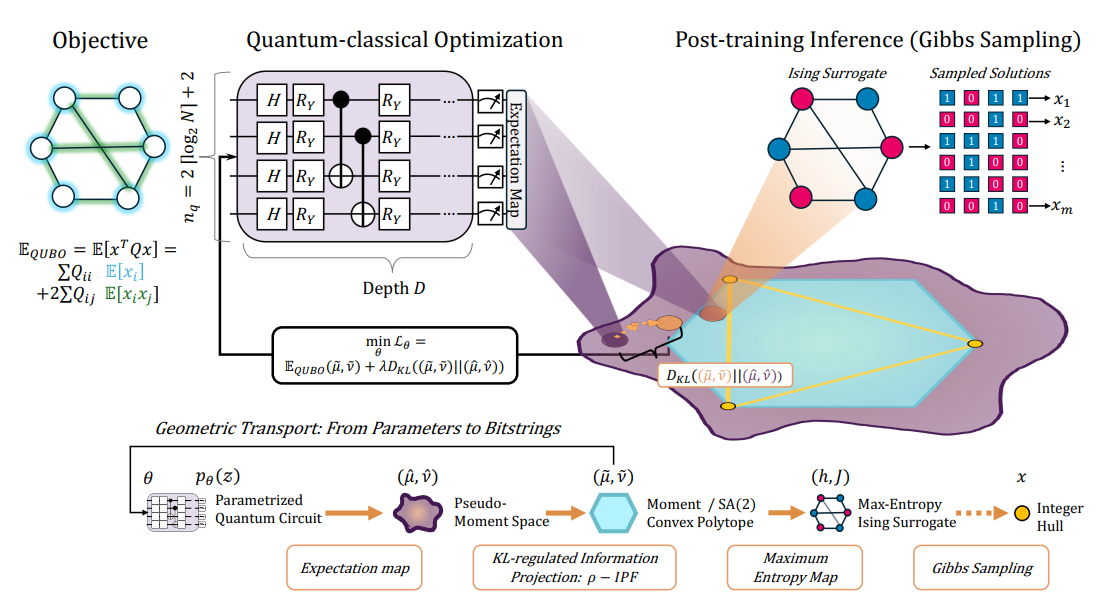
The challenge of efficiently solving complex optimization problems drives innovation in quantum computing, and researchers are now exploring ways to represent these problems using fewer qubits than previously thought possible. Gordon Ma and Dimitris G. Angelakis, from the National University of Singapore, alongside their colleagues, demonstrate a new approach to qubit-efficient optimization by framing it as a geometrical problem, aligning the quantum representation with the inherent structure of the problem itself. Their work establishes a direct link between a mathematical concept called the Sherali-Adams polytope and the consistency required for accurate quantum computation, resulting in a streamlined process that requires significantly fewer qubits. This method achieves impressive results on challenging optimization tasks, surpassing existing approaches and paving the way for more powerful and efficient quantum algorithms by leveraging the underlying geometry of the problem.
IPF and Classical Methods Solve QUBO Problems
This research investigates a new approach to solving Quadratic Unconstrained Binary Optimization (QUBO) problems, combining a quantum-inspired physics model, IPF, with classical optimization techniques. Scientists evaluated this method on a standard set of benchmark problems, demonstrating competitive performance and solutions very close to the optimal ones with relatively low computational cost. The method scales well to larger problems, successfully tackling instances with up to 2000 variables while maintaining low computational cost. The research shows that the IPF method’s performance is sensitive to a parameter controlling its complexity, with the optimal setting varying depending on the specific problem. This IPF method has the potential to solve real-world optimization problems in fields such as machine learning, finance, and logistics, and could serve as a building block for more complex hybrid quantum-classical algorithms. Future research will focus on developing more efficient IPF models, exploring different optimization algorithms, and investigating the theoretical properties of the method.
Sherali-Adams Polytope Anchors Quantum Optimization Pipeline
Recasting Problems into Reduced Geometric Spaces
Scientists have developed a novel approach to optimization by recasting problems as geometric ones, focusing on the structure of quadratic objectives and representing them within a reduced Hilbert space. Central to this work is the explicit enforcement of local consistency, achieved by anchoring learning to the geometry of the Sherali-Adams level-2 polytope, a convex relaxation representing pairwise relationships between variables. The team engineered a logarithmic-width pipeline, utilizing only qubits, and implemented a differentiable iterative-proportional-fitting (IPF) step to project data towards feasible solutions. To stabilize training and guide the system towards feasible solutions, scientists introduced a repair mechanism based on an under-relaxed IPF update, which performs local updates to gradually move statistics back toward the feasible region while maintaining smooth optimization.
This process is further refined by coupling the IPF update with a relative-entropy term, specifically a KL divergence penalty, which encourages the circuit to generate naturally feasible outputs. Experiments demonstrate that an intermediate damping value consistently stabilizes training. Crucially, the researchers established a connection between probability and optimization by recognizing that the Sherali-Adams level-2 polytope is equivalent to the Boole, Fréchet bounds, defining the pairwise feasible region. This equivalence allows the team to enforce consistency by ensuring the circuit’s learned statistics remain within this known convex body. Finally, the team developed a maximum-entropy Gibbs sampler to draw samples from the learned distribution, effectively translating the geometric representation into a probabilistic ensemble.
Sherali-Adams Polytopes Enable Qubit-Efficient Optimisation
Geometric Frameworks Enable Qubit-Efficient Optimization
Scientists have achieved a breakthrough in qubit-efficient optimization by explicitly linking it to a well-defined geometric framework, yielding a system with logarithmic width and strong empirical performance. The research centers on representing complex combinatorial problems within a smaller Hilbert space, focusing on the inherent pairwise relationships within the problem itself. The team identified that the minimal representation of quadratic objectives coincides exactly with the Sherali-Adams level-2 polytope, a mathematical object defining the tightest possible constraints on pairwise correlations. This work establishes a clear connection between probabilistic modeling and optimization geometry at the two-body level, allowing for a principled approach to learning and repair within the optimization process.
A key innovation is the implementation of a ρ-damped iterative-proportional-fitting (IPF) update, which softly projects learned quantities towards feasible solutions while maintaining differentiability for continued learning. The team then employs a maximum-entropy Gibbs sampler to decode a global distribution, providing a faithful representation of integral solutions. In most cases, the best approximation ratio exceeded 0.
Scalable Geometric Pipeline Achieves High Performance
99 at a depth of two or three layers, surpassing classical hardness thresholds. This research establishes a geometric pipeline, amplitudes to moments, feasible moments, and ultimately bitstrings, that is theoretically grounded, qubit-efficient, and empirically strong at low depth. The framework delivers a qubit-efficient system with a width scaling as Õ(log N), representing a significant advancement in the field. By framing qubit-efficient optimization as geometry, scientists can now focus on determining when quantum structure becomes truly necessary, rather than simply adding more complexity.
🗞 An Information-Minimal Geometry for Qubit-Efficient Optimization
🧠 ArXiv: https://arxiv.org/abs/2511.08362
The ability to map optimization objectives onto the geometric constraints of the Sherali-Adams polytope fundamentally changes the resource complexity estimation for quantum algorithms. Unlike brute-force quantum simulations that scale exponentially with the number of variables, this geometric anchoring allows the problem structure itself to guide the computational representation. This adherence to the polytope’s defined convex hull ensures that the necessary quantum correlations are inherently minimal, translating the combinatorial complexity into a manageable, geometrically constrained linear manifold within the Hilbert space.
A critical technical advancement lies in the implementation of the iterative-proportional-fitting (IPF) step. Conceptually, IPF acts as a differentiable projection operator, constantly nudging the quantum state vector toward the region of the Hilbert space that satisfies the established physical and mathematical constraints defined by the polytope. This iterative stabilization mechanism is crucial for maintaining coherence during computation, effectively mitigating the loss of information that typically degrades performance in near-term quantum hardware.
From a broader industry context, the development of these geometry-aware optimization frameworks moves the field closer to true quantum advantage for combinatorial problems. By decoupling the required computational resource size from the problem’s sheer dimensionality—a process enabled by polytope reduction—these hybrid quantum-classical pipelines establish a practical pathway for solving real-world NP-hard problems in sectors ranging from drug discovery simulations to high-frequency financial modeling.
Furthermore, the logarithmic-width pipeline structure hints at potential algorithmic improvements in sampling complex distributions. By encoding variable relationships in this manner, the method bypasses the limitations associated with deeply entangled, high-dimensional circuits. Instead, it leverages localized, structured interactions, which is particularly advantageous for physical quantum implementations limited by crosstalk and limited connectivity between qubits.