

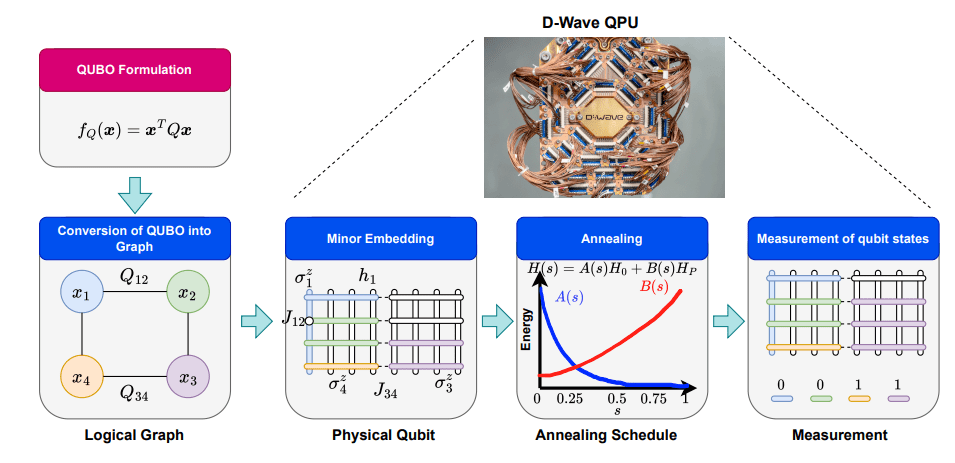
Quantum annealing holds considerable promise for solving complex optimisation problems, but its effectiveness relies heavily on carefully designed annealing schedules, which are susceptible to hardware limitations and noise. Seon-Geun Jeong, Mai Dinh Cong, and colleagues from Pusan National University, VinUniversity, PHENIKAA University, Trinity College Dublin, and the Center for Artificial Intelligence Research, now present a new framework to address this challenge. Their work introduces trust region Bayesian optimisation, a method that simultaneously refines both the timing and the specific parameters of annealing schedules. Through simulations, the team demonstrates that this approach consistently discovers schedules that outperform conventional methods, achieving improvements in solution quality, feasibility, and efficiency, and paving the way for more robust and scalable quantum annealing in practical applications.
Clique Embeddings Scale Poorly for TSP
This research investigates how well clique embeddings scale when used to solve the Traveling Salesperson Problem (TSP) on the D-Wave Zephyr quantum annealer. Clique embeddings translate a problem into a format the quantum annealer can understand, but this process requires an increasing number of physical qubits as the problem size grows. The study demonstrates that this rapid increase in qubit requirements limits the practicality of clique embeddings for larger problems due to hardware limitations and increased noise. The team established theoretical boundaries on the minimum number of physical qubits needed to represent a problem using clique embeddings and validated these predictions with experiments on various TSP instances.
Even for relatively small TSP problems, a significant portion of the available qubits on the Zephyr system is consumed by the embedding process. The analysis reveals that the number of qubits required scales between the square root of the problem size and the problem size itself, presenting a significant bottleneck for scaling up quantum annealing solutions. Longer chains of qubits, required for larger problems, are more susceptible to noise and errors, degrading the quality of the solution. The findings underscore the need for more efficient embedding strategies and alternative approaches to overcome these limitations.
Optimizing Quantum Annealing Schedules with Bayesian Optimization
Scientists have developed a new framework, utilizing trust region Bayesian optimization (TuRBO), to enhance the performance of quantum annealing (QA) by carefully designing annealing schedules. These schedules control how the quantum annealer transitions from an initial state to a solution, addressing a key limitation in previous approaches where runtime and schedule shape were often tuned independently. Researchers represent annealing paths using a truncated Fourier basis, allowing for precise control and efficient exploration of the vast parameter space. To balance exploration and exploitation, the team employs a Gaussian process (GP) surrogate model coupled with an expected improvement criterion, guiding the search towards promising schedule configurations.
A trust region mechanism further refines this search by focusing on adaptive local regions, ensuring scalability and robustness to noise. Experiments, using the Traveling Salesperson Problem (TSP) as a benchmark, demonstrate that the optimized schedules consistently outperform random and greedy search methods. The framework incorporates hardware-aware optimization mechanisms, including adaptive readout scaling and runtime budget controls, to guarantee practical execution on real QPUs under noisy intermediate-scale quantum (NISQ) conditions. Comparisons with classical optimization algorithms reveal runtime advantages for the quantum approach.
Optimized Quantum Annealing Schedules via Bayesian Optimization
Scientists have developed a trust region Bayesian optimization (TuRBO) framework to design improved annealing schedules for quantum annealing (QA), a practical realization of adiabatic quantum computation. The work addresses a critical challenge in QA, where performance is heavily dependent on the annealing schedule and limited by hardware constraints. Researchers explicitly represent annealing paths using a truncated Fourier basis and employ TuRBO to simultaneously optimize both the total runtime and the Fourier coefficients defining the schedule. The team’s method utilizes Gaussian process surrogates with expected improvement to effectively balance exploration of new schedules with exploitation of promising candidates, while trust region updates refine the search around these candidates.
To ensure schedules are practical for implementation on quantum processing units (QPUs), the framework incorporates mechanisms for adaptive readout scaling, runtime budget management, and feasibility checks. Experiments demonstrate that TuRBO consistently identifies schedules that outperform both random and greedy search strategies. Specifically, tests on the Traveling Salesperson Problem (TSP) reveal that optimized schedules yield higher success probabilities, lower chain break fractions, and improved energy quality, highlighting the effectiveness of the framework in bridging the gap between theoretical considerations and practical hardware limitations.
Optimized Quantum Annealing With Bayesian Schedules
This research presents a trust region Bayesian optimization (TuRBO) framework designed to improve the performance of quantum annealing for solving complex optimization problems. By simultaneously optimizing both the annealing time and the precise shape of the annealing schedule, the researchers demonstrate consistent improvements in solution quality when compared to random or conventional approaches. Extensive testing on instances of the Traveling Salesperson Problem, executed on the D-Wave Advantage2 system, reveals gains in energy quality, the probability of finding successful solutions, and a reduction in instances where the quantum computation fails prematurely. The study also investigated the limits of scalability, contrasting performance in ideal conditions with that of a noisy quantum annealer. Results indicate that while optimized schedules are effective for moderately sized problems, performance diminishes as problem size increases, primarily due to the challenges of embedding complex problems onto the quantum hardware and the impact of inherent noise. The research successfully bridges the gap between theoretical schedule optimization and practical implementation on real quantum hardware, establishing TuRBO as a resource-efficient strategy for schedule design in current noisy intermediate-scale quantum (NISQ) devices.
👉 More information
🗞 Trust Region Bayesian Optimization of Annealing Schedules on a Quantum Annealer
🧠 ArXiv: https://arxiv.org/abs/2510.15245


