

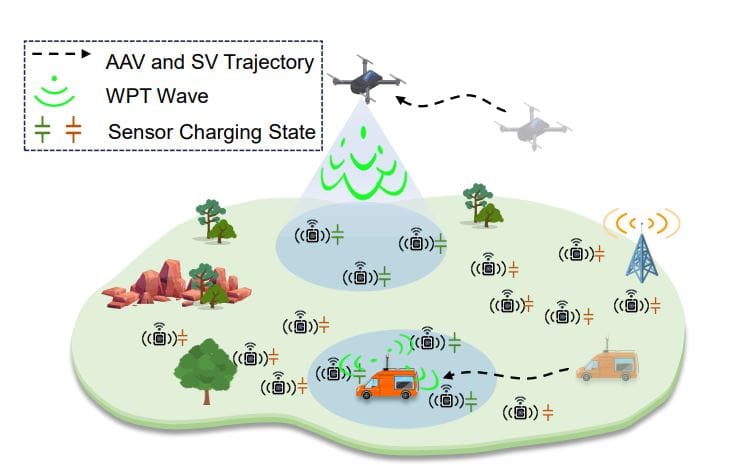
Wireless sensor networks increasingly power the Internet of Things, but their reliance on batteries severely limits their long-term viability. Researchers now investigate wireless rechargeable sensor networks as a potential solution, and Jianhang Yao, Hui Kang, and Geng Sun, along with their colleagues, explore a novel approach using both aerial and ground-based charging vehicles. Their work focuses on coordinating these heterogeneous mobile chargers to maximise energy delivery in challenging environments, balancing charging efficiency with the energy required for movement. The team develops a sophisticated algorithm that intelligently manages this complex system, achieving a substantial performance improvement over existing methods and promising significantly extended operational lifetimes for critical sensor networks.
Mobile Charging Optimisation via Reinforcement Learning
This research investigates methods for optimising mobile charging in wireless rechargeable sensor networks (WRSNs), addressing the energy constraints that limit sensor network lifespan. Scientists are exploring a multi-agent reinforcement learning (MARL) approach, combining Proximal Policy Optimization (PPO) with attention mechanisms and a Beta policy for continuous control. This innovative system aims to intelligently manage mobile chargers, such as unmanned aerial vehicles or robots, to efficiently replenish energy in dynamic environments. The core challenge lies in optimising the trajectories and charging schedules of these mobile chargers.
The proposed solution leverages PPO as its foundation, enhanced by attention mechanisms that allow chargers to prioritise sensors with the most critical energy needs. A Beta policy facilitates exploration and learning in continuous action spaces, enabling the chargers to adapt to varying conditions and optimise their movements. This approach promises increased network lifetime, improved energy efficiency, adaptability to changing demands, and scalability for large networks.
Aerial and Ground Vehicle Wireless Charging
Researchers have developed a novel system for wirelessly recharging sensor networks, overcoming the limitations of traditional battery-powered devices and enabling indefinite network operation. This work pioneers a heterogeneous mobile charging architecture that strategically combines automated aerial vehicles (AAVs) and ground smart vehicles (SVs) to deliver optimal energy distribution in challenging terrain. This approach addresses the constraints of relying solely on AAVs, which have limited energy capacity, or SVs, which face accessibility limitations. To achieve efficient charging, scientists formulated a multi-objective optimisation problem that simultaneously maximises charging efficiency, minimises energy consumption by the charging vehicles, and reduces sensor node failure rates.
Recognising the complexity of coordinating AAVs and SVs, the team engineered a deep reinforcement learning (DRL)-based approach to enable collaborative decision-making. This system dynamically balances the advantages of each vehicle type, accounting for varying energy demands, mobility limitations, and charging capabilities in real-time. The core of this innovation lies in the improved heterogeneous agent trust region policy optimisation (IHATRPO) algorithm. Researchers integrated a self-attention mechanism to enhance the system’s ability to process complex environmental data, allowing it to adapt to changing conditions and optimise charging strategies. Comprehensive simulations demonstrate that IHATRPO achieves a 39% performance improvement over the original HATRPO algorithm, significantly increasing sensor node survival rates and overall charging system efficiency.
Heterogeneous Mobile Charging Extends Sensor Network Life
Researchers have achieved a significant breakthrough in wireless sensor network longevity by developing a heterogeneous mobile charging architecture that strategically combines automated aerial vehicles (AAVs) and ground smart vehicles (SVs). This work addresses the persistent energy limitations of traditional wireless sensor networks, potentially enabling indefinite operational lifetime through wireless power transfer. The team formulated a multi-objective optimisation problem to simultaneously balance the advantages of both AAVs and SVs, considering charging efficiency, mobility energy consumption, and real-time network conditions. To overcome the computational challenges posed by this complex problem, scientists proposed the improved heterogeneous agent trust region policy optimisation (IHATRPO) algorithm.
This algorithm integrates a self-attention mechanism to enhance processing of complex environmental states and employs a Beta sampling strategy for unbiased gradient computation. Comprehensive simulation results demonstrate that IHATRPO achieves a 39% performance improvement over the original HATRPO algorithm. This substantial gain confirms the effectiveness of the new approach in optimising charging schedules and resource allocation. Furthermore, the research demonstrates a significant increase in sensor node survival rate and overall charging system efficiency. The team’s work successfully addresses the limitations of single-type charging approaches, by leveraging the complementary strengths of both platforms in complex deployment environments.
Mobile Charging Optimisation For Sensor Networks
This research presents a novel approach to sustaining wireless sensor networks through the strategic deployment of both aerial and ground-based mobile charging vehicles. Scientists have developed a system that optimises energy distribution in complex terrains, addressing the persistent energy limitations that constrain traditional sensor networks. The team formulated a complex optimisation problem considering charging efficiency, vehicle energy consumption, and sensor node survival, and then introduced the improved heterogeneous agent trust region policy optimisation (IHATRPO) algorithm to solve it. IHATRPO incorporates a self-attention mechanism to better process environmental information and a Beta sampling strategy to refine calculations in dynamic environments.
Simulation results demonstrate that IHATRPO achieves a significant performance improvement over existing methods, reducing sensor node mortality from over 90% to below 10%. Analysis of movement patterns reveals that the aerial and ground vehicles naturally coordinate to provide complementary coverage, effectively dividing labour and improving spatial efficiency. Future work will explore extending the system and integrating energy harvesting techniques to further reduce charging demands and enhance resource allocation. These advancements promise to significantly improve the operational lifespan and reliability of wireless sensor networks in challenging environments.
👉 More information
🗞 Collaborative Charging Optimization for Wireless Rechargeable Sensor Networks via Heterogeneous Mobile Chargers
🧠 ArXiv: https://arxiv.org/abs/2511.12501