Squeezed states, crucial for enhancing precision in sensing and entanglement, have traditionally been limited to systems involving just two components. Now, Jieqiu Shao from the Quantum New Mexico Institute, University of New Mexico, Diego A. R. Dalvit and Lukasz Cincio from T-4, Los Alamos National Laboratory, along with Bharath Hebbe Madhusudhana from MPA-Quantum, Los Alamos National Laboratory, demonstrate a method for creating these advantageous states in more complex, multi-component systems. The team developed a Monte-Carlo based optimisation technique to engineer control sequences for manipulating Bose-Einstein condensates, revealing a characteristic intermediate scaling of quantum information that surpasses classical limits without reaching the theoretical maximum. This achievement opens new possibilities for high-precision measurements, particularly in applications like gravimetry and gradiometry, and suggests that approaching the ultimate sensitivity limits is achievable with realistic experimental parameters.
Heisenberg Limit Achieved With Interacting Bosons
Scientists have achieved a significant step towards the Heisenberg Limit, the ultimate boundary of precision in quantum measurement, by carefully controlling interacting bosons confined within a lattice. This research demonstrates the feasibility of maximizing precision in quantum metrology through precise control of atomic interactions and initial state preparation. The core of the work involves quantum optimal control, used to design pulses that steer the system towards an optimized state, minimizing uncertainty in measurements. Simulations validate theoretical predictions, confirming the effectiveness of the control strategy for approaching the Heisenberg Limit. While the technique faces limitations when applied to larger systems due to computational complexity, the simulations provide strong evidence for its potential in smaller-scale applications.
Optimizing Control Sequences for Multi-Mode Squeezed States
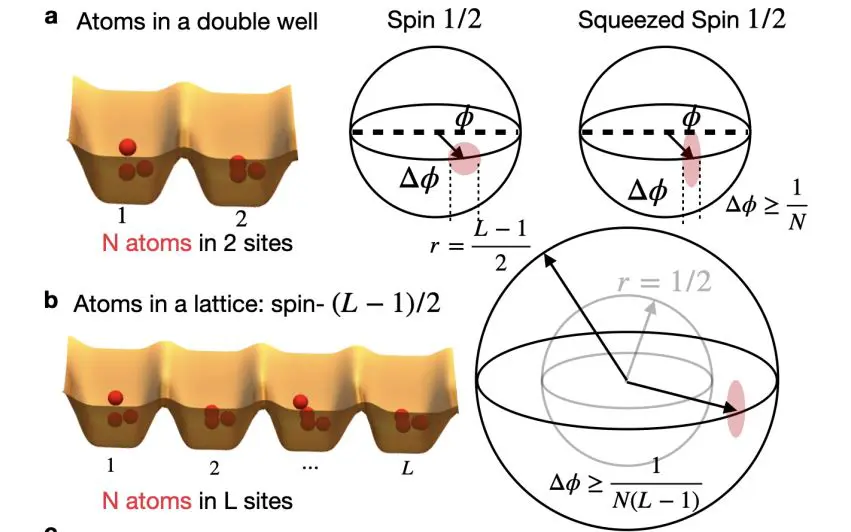
Scientists have developed a novel Monte Carlo optimization technique to efficiently engineer control sequences for multi-mode bosonic systems, crucial for enhancing the sensitivity of quantum sensors. Focusing on a Bose-Einstein condensate within an optical lattice, ideally suited for precise measurements of gravity and gradiometry, the team successfully generated useful squeezed states by leveraging tunable atomic interactions via Feshbach resonances. This new technique addresses limitations of existing quantum optimal control methods, which struggle with the complexity of multi-mode bosonic systems. Researchers analytically demonstrated that their Monte Carlo technique can design control sequences to prepare quantum states that surpass the standard quantum limit, achieving a Fisher information scaling of O(NL²), where N represents the number of bosons and L the number of lattice sites, critical for enhancing sensor precision.
Optimized Squeezed States Enhance Quantum Sensing
Scientists have achieved a breakthrough in quantum sensing by developing a Monte Carlo-based optimization technique to engineer multi-mode squeezed states in bosonic systems. Focusing on a Bose-Einstein condensate within an optical lattice, relevant for precise gravity measurements, the team demonstrated the ability to generate useful squeezed states using the Bose-Hubbard Hamiltonian, tunable via Feshbach resonances. They analytically showed that this technique can design sequences to prepare quantum states that surpass the standard quantum limit in terms of quantum Fisher information. Experiments reveal a characteristic intermediate scaling of the quantum Fisher information, specifically O(N²L + L²N), consistently achieved using the Monte Carlo technique, demonstrating its effectiveness in enhancing sensing precision. Measurements confirm that approaching the Heisenberg limit requires a significantly larger number of atoms than lattice sites, a condition readily satisfied in many experimental platforms.
Intermediate Scaling for Enhanced Quantum Sensing
Researchers have developed a new technique for creating multi-mode squeezed states in bosonic systems, such as Bose-Einstein condensates within optical lattices, addressing a significant challenge in quantum metrology. By employing a Monte-Carlo based optimization method to engineer the control of the system’s Hamiltonian, they successfully prepared squeezed states that exhibit an intermediate scaling of the Fisher information. The results demonstrate that achieving this intermediate scaling is feasible using experimentally accessible parameters and system sizes, particularly for systems where the number of atoms greatly exceeds the number of modes, crucial for translating theoretical advancements into practical quantum sensors. Importantly, the resulting Fisher information, a measure of sensing precision, demonstrates relative robustness, essential for ensuring the reliability of quantum sensors in real-world applications. Future work will focus on combining this Monte-Carlo approach with other optimization techniques, extending the method to higher-dimensional lattices, and ultimately validating the technique through precision gravity measurements.
🗞 Engineering multi-mode bosonic squeezed states using Monte-Carlo optimization
🧠 ArXiv: https://arxiv.org/abs/2511.15805