Estimating the tiny shifts in the position of a light beam is a fundamental challenge in optical imaging, with implications for everything from microscopy to gravitational wave detection. Wenhua He, Christos N. Gagatsos from the University of Arizona, and Dalziel J. Wilson, alongside Saikat Guha et al., now demonstrate a significant advance in achieving more precise beam displacement sensing. Their work addresses a long-standing limitation in the field by accounting for the effects of diffraction and simultaneously optimising both the shape of the light beam and the balance between quantum squeezing and classical light. The team reveals that a complex, multi-mode problem can be simplified into a manageable framework, ultimately identifying a strategy for designing optimal light probes even when light is lost or interacts in complex ways, paving the way for substantially improved measurement precision.
The research focuses on utilizing squeezed states of light, non-classical states that reduce noise and enhance sensitivity, while carefully considering the effects of diffraction, a natural loss of light due to its wave-like properties. The team demonstrated that a complex problem involving many possible light beam shapes can be simplified to a manageable three-mode interaction, allowing for detailed analysis and optimization. The study reveals that the optimal beam shape depends critically on the degree of diffraction loss.
When diffraction is minimal, higher-order modes, complex shapes of light, are preferred for maximizing precision. However, when diffraction is significant, a more tightly confined beam, similar to a standard Gaussian beam, provides the best results. This understanding allows scientists to tailor optical systems for specific applications, balancing sensitivity and signal strength. Researchers achieved this breakthrough by developing a method for reducing a complex, infinite-spatial-mode problem to a compact three-mode interaction framework. This simplification enabled them to analyze the performance of different light states and identify the optimal configuration for precise displacement estimation.
The results demonstrate that a single-mode squeezed light probe consistently outperforms traditional laser probes, particularly at high photon numbers, and that a two-mode homodyne detector provides optimal reception. This work has significant implications for a range of applications, including adaptive optics systems that can dynamically adjust beam shape, and quantum sensing, a field dedicated to developing sensors with unprecedented precision. By carefully considering the interplay between squeezed light, diffraction loss, and modal support, scientists can design optical systems that push the boundaries of measurement accuracy.
Optimized Squeezed Light for Displacement Estimation
Scientists have achieved a significant advance in the precision of optical beam displacement estimation, a crucial technique in numerous imaging applications. The research demonstrates a strategy for identifying quantum-optimal probes, even when dealing with complex interactions and signal loss. The team showed that a seemingly intractable problem involving infinite spatial modes can be effectively reduced to a compact three-mode interaction framework, simplifying analysis and optimization. The study reveals that an optimized single-spatial-mode Gaussian-state probe delivers substantial improvements over the best possible classical laser probe.
Specifically, the team quantified the enhancement achieved with this optimized probe, and found that a two-spatial-mode homodyne receiver is asymptotically optimal for maximizing performance at high probe energies. This means the receiver’s ability to accurately measure the displacement approaches its theoretical limit as the probe energy increases. Researchers developed a theoretical framework to analyze the quantum-Fisher Information (QFI), a key metric for estimating parameter precision. Their analysis demonstrates that, under a constraint of fixed mean probe energy, the QFI-optimal Gaussian-state probe is a single-mode squeezed-vacuum state excited in an appropriate mode.
Furthermore, the research reveals that the optimal receiver for this probe is a single-mode homodyne detection scheme operating in the same mode. This work builds upon recent advancements in manipulating squeezed light, including the ability to structure it in high-order spatial modes. The team discovered that, even with lossy interactions, the QFI-optimal spatial mode to excite a classical probe is a bi-modal-shaped mode, significantly outperforming a standard laser probe operating in the fundamental Gaussian mode. This discovery paves the way for enhanced precision in applications like atomic-force microscopy, free-space laser communications, and other sensitive optical measurements.
Optimized Probes Enhance Displacement Estimation Precision
Scientists have achieved a significant breakthrough in the precision of optical beam displacement estimation, a fundamental problem in numerous imaging applications. Their work demonstrates a strategy for identifying quantum-optimal probes, even when dealing with complex interactions and signal loss. The research reveals that a seemingly intractable problem involving infinite spatial modes can be effectively reduced to a manageable three-mode interaction framework, simplifying analysis and optimization. Experiments show that an optimized single-spatial-mode Gaussian-state probe delivers substantial improvements over the best possible classical laser probe.
Specifically, the team quantified the enhancement achieved with this optimized probe, and found that a two-spatial-mode homodyne receiver is asymptotically optimal for maximizing performance at high probe energies. This means the receiver’s ability to accurately measure the displacement approaches its theoretical limit as the probe energy increases. The team developed a theoretical framework to analyze the quantum-Fisher Information (QFI), a key metric for estimating parameter precision. Their analysis demonstrates that, under a constraint of fixed mean probe energy, the QFI-optimal Gaussian-state probe is a single-mode squeezed-vacuum state excited in an appropriate mode.
Furthermore, the research reveals that the optimal receiver for this probe is a single-mode homodyne detection scheme operating in the same mode. This work builds upon recent advancements in manipulating squeezed light, including the ability to structure it in high-order spatial modes. The team discovered that, even with lossy interactions, the QFI-optimal spatial mode to excite a classical probe is a bi-modal-shaped mode, significantly outperforming a standard laser probe operating in the fundamental Gaussian mode. This discovery paves the way for enhanced precision in applications like atomic-force microscopy, free-space laser communications, and other sensitive optical measurements.
Squeezed Light Optimizes Displacement Estimation Precision
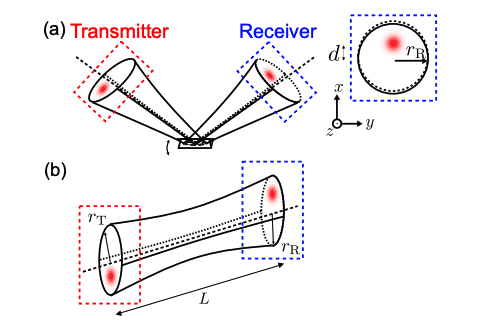
This research demonstrates a strategy for improving the precision of optical beam displacement estimation, a fundamental problem in imaging. Scientists established that, in the limit of small displacements, a complex, infinite-spatial-mode problem can be effectively reduced to a manageable three-mode interaction framework. Through this approach, they quantified the performance gains achievable with a carefully optimized single-spatial-mode squeezed light probe compared to traditional laser probes, and showed that a two-spatial-mode homodyne receiver represents an optimal detection strategy for the former at high energy levels. A key achievement of this work is the development of a method for identifying optimal single-mode squeezed states, even when diffraction loss is present and the range of supported spatial modes is limited. By carefully engineering the spatial mode of the probe light, the team reduced the estimation problem to a linear-passive multimode interaction, allowing for the identification of squeezed states that achieve Heisenberg-limited sensitivity. This research reveals that the use of entangled spatial modes, specifically a single-mode squeezed state and accompanying vacuum modes, enhances precision by creating a network of correlated sensors responsive to beam deflection.
👉 More information
🗞 Optimal single-mode squeezing for beam displacement sensing
🧠 ArXiv: https://arxiv.org/abs/2509.11457