

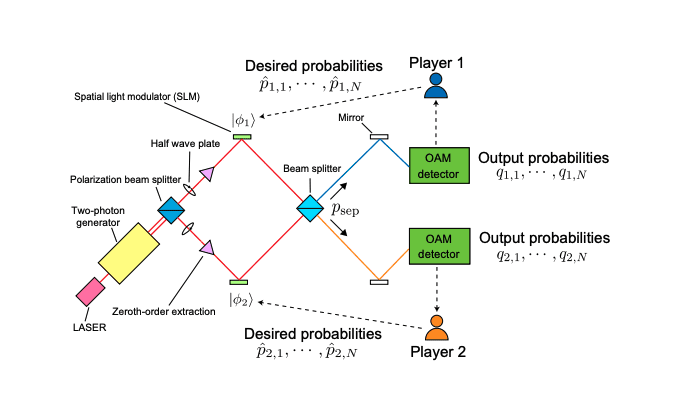
In a study published on April 11, 2025, researchers Kohei Konaka and colleagues introduced Scalable Conflict-free Decision Making with Photons, demonstrating how photons’ unique properties can enhance decision-making processes in quantum computing.
The research demonstrates an OAM-based optical method to solve the Competitive Multi-Armed Bandit (CMAB) problem in reinforcement learning. Preferences are encoded in photon OAM amplitudes, while phases are optimized to minimize conflicts. The system achieves scalable performance with improved rewards compared to existing techniques, showcasing optics’ potential for solving complex tasks efficiently.
Recent research has unveiled a promising advancement in quantum computing, introducing a method that harnesses the quantum interference of photons with orbital angular momentum (OAM). This innovation addresses the challenge of conflict-free collective decision-making, particularly relevant in systems where multiple agents or devices must make simultaneous choices without interference.
The study presents a system where each photon’s OAM state acts as a unique identifier. This allows for efficient communication and decision-making processes by leveraging quantum interference, enabling photons to interact without causing conflicts—a common issue in traditional systems where simultaneous access often leads to inefficiency.
In experimental testing, researchers successfully implemented this method with a network of 100 decision-making units, demonstrating both scalability and efficiency. The results underscored superior performance compared to classical methods, highlighting potential applications in telecommunications and artificial intelligence, where managing large volumes of data is critical.
While the technology’s current practical implementation requires complex laser networks, its scalability suggests promising real-world applications. This approach diverges from other quantum computing methods like superconducting circuits or ion traps by focusing on photons and their OAM properties, offering a unique solution to decision-making challenges.
This innovation represents a notable advancement in leveraging quantum properties for enhanced performance in computing and telecommunications, potentially transforming how large-scale decisions are made efficiently.
👉 More information
🗞 Scalable Conflict-free Decision Making with Photons
🧠 DOI: https://doi.org/10.48550/arXiv.2504.08331


