Optical sensors based on tiny microresonators hold immense promise for detecting minute changes in their surroundings, but their sensitivity faces a fundamental limit imposed by the inherent noise of light itself. Dariya Salykina from M. V. Lomonosov Moscow State University, Daniil Shakhbaziants from the Russian Quantum Center, and Igor Bilenko, along with Farid Khalili, now demonstrate a way to overcome this barrier. The team achieves this breakthrough by employing a technique called optical squeezing, which manipulates the quantum properties of light to reduce noise. This innovative approach allows the sensors to detect signals previously hidden within the noise, pushing the boundaries of sensitivity and opening new possibilities for precision measurements in fields ranging from environmental monitoring to biomedical diagnostics. The results show that sensitivity is now limited only by unavoidable optical losses and the degree to which the light can be squeezed, paving the way for even more sensitive sensors through further optimisation.
Squeezed Light Boosts Microresonator Sensor Sensitivity
This research demonstrates a pathway to significantly enhance the sensitivity of optical microresonator-based sensors by carefully controlling the quantum properties of the light used to probe them. Scientists have calculated the fundamental limits to sensitivity imposed by quantum fluctuations and revealed that employing squeezed states of light can overcome the conventional shot noise limit, a major barrier to precision measurement. This improvement allows for detection of weaker signals and, consequently, greater sensitivity across a broad range of frequencies exceeding the microresonator bandwidth.
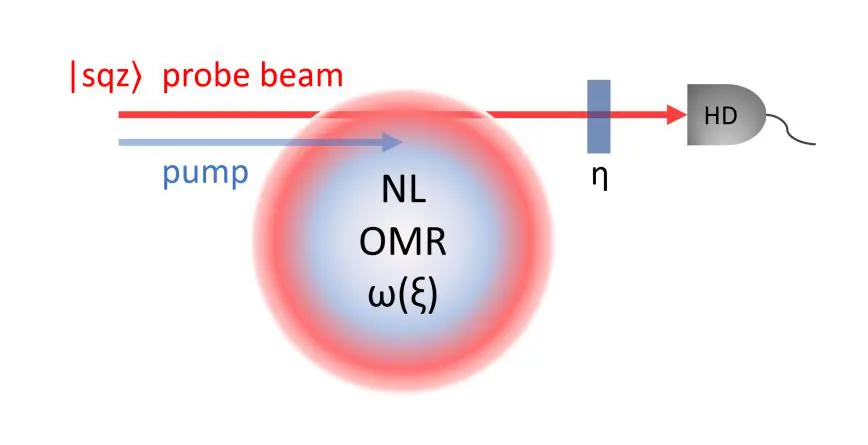
Microresonators confine light within a tiny space, creating a highly sensitive platform for optical sensors that detect changes in their environment by measuring shifts in resonant frequencies. However, the sensitivity of these sensors is fundamentally limited by quantum noise, inherent uncertainty in the light itself. This research explores how to surpass these limitations by preparing the probe light in a squeezed quantum state, a technique that redistributes quantum fluctuations to reduce noise in critical measurement properties.
The team’s calculations indicate that sensitivity is ultimately constrained only by optical losses within the system and the degree to which the light is squeezed, suggesting a clear route for further improvement through materials science and advanced optical techniques. Strategically placed anti-squeezing can also effectively mitigate the impact of external losses, further refining measurement precision. While practical implementation will require careful consideration of real-world limitations, the findings open possibilities for developing sensors with unprecedented sensitivity.
This advancement promises a new generation of sensors capable of detecting incredibly subtle changes in their environment, potentially impacting fields such as materials science, environmental monitoring, and biological sensing. Future work could focus on minimizing optical losses within the microresonator and exploring novel methods for generating and delivering highly squeezed light to optimize sensor performance, opening doors to discoveries across diverse scientific disciplines.
👉 More information
🗞 Application of optical squeezing to microresonator based optical sensors
🧠 ArXiv: https://arxiv.org/abs/2511.12138