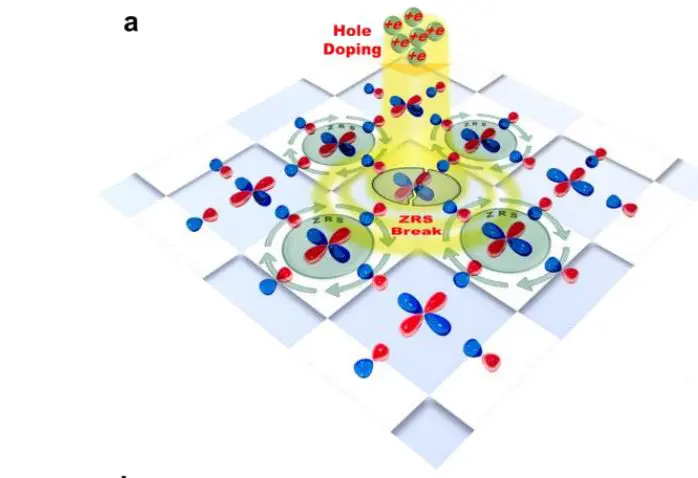
Cuprate superconductors continue to fascinate physicists due to their potential for technological innovation and their complex electronic behaviour, which remains a significant puzzle. Xiongfang Liu, Kun Han, and Yan Peng, along with their colleagues, investigate this behaviour by examining how the electronic structure of La2-xSrxCuO4 changes as it becomes heavily overdoped. Their work, which employs broadband optical spectroscopy, reveals a dramatic reconstruction of the electronic structure at higher doping levels, with shifts in the distribution of Zhang-Rice-related spectral weight. This reconstruction leads the team to propose a spontaneous, checkerboard-like arrangement of Zhang-Rice electronic states, offering a new understanding of how correlated behaviour persists even in heavily overdoped materials and providing crucial insights into the mechanisms driving high-temperature superconductivity in these complex oxides.
Overdoped Cuprates Exhibit Complex Electronic Correlations
This research investigates the complex electronic structure of overdoped cuprate superconductors, revealing a unique electronic state with implications for superconductivity. Scientists propose a model where these materials exhibit coexisting midgap antiferromagnetic and Mott insulating states, alongside the breaking of Zhang-Rice singlets and the formation of ligand holes. This interplay of electronic correlations offers a pathway towards understanding the unusual properties of these materials, highlighting that overdoped cuprates deviate from conventional metallic behavior. Polarized chiral spin disproportionation, linked to ligand hole formation, further influences the electronic structure, potentially enhancing superconducting properties.
Comparisons to nickelate materials suggest a common underlying mechanism driving these phenomena. The research employs theoretical modeling, including density functional theory and three-orbital Hubbard models, combined with determinant quantum Monte Carlo simulations to solve the Hubbard model. Analytic continuation techniques extract information about the electronic structure, and optical conductivity calculations analyze electronic properties. This work presents a nuanced understanding of the electronic structure of overdoped cuprates, moving beyond simple metallic descriptions and highlighting the importance of complex electronic correlations and unique electronic states, crucial for understanding high-temperature superconductivity and potentially designing new superconducting materials.
Doping Evolution of LSCO Electronic Structure
This research meticulously tracks the evolution of electronic structure in La2-xSrxCuO4 (LSCO) across a doping range of x=0. 15 to 0. 60, employing X-ray absorption spectroscopy and optical spectroscopic ellipsometry. Scientists systematically varied the doping concentration, fabricating a series of LSCO samples to observe resulting changes in the electronic structure. Spectral fitting of X-ray absorption spectroscopy data identified and quantified features related to Zhang-Rice singlet states, unbound Hubbard bands, and a newly discovered feature, labeled A*, which emerges prominently for doping levels exceeding x=0.
2, indicating the formation of a new unoccupied electronic state above the Fermi level. Complementing the X-ray absorption spectroscopy analysis, scientists conducted optical spectroscopic ellipsometry measurements, allowing independent determination of the real and imaginary components of the dielectric function. Analysis of the zero-crossing point of the real dielectric function component revealed changes in effective carrier density with increasing doping, and Drude-Lorentz model fitting of the optical conductivity spectra enabled precise determination of energy positions and spectral weights. These combined spectroscopic techniques provide a detailed map of the electronic structure evolution, revealing a transformation in Zhang-Rice singlet-related electronic states in the heavily overdoped regime and supporting a model of Zhang-Rice singlet breakdown.
Overdoping Transforms Lanthanum Copper Oxide Electronic Structure
This work presents a comprehensive spectroscopic investigation of lanthanum strontium copper oxide (LSCO) across a wide range of overdoping levels, from x=0. 15 to 0. 60, revealing significant changes in its electronic structure. Scientists synthesized high-quality LSCO thin films and confirmed their crystalline perfection. Measurements using X-ray absorption spectroscopy and optical spectroscopic ellipsometry revealed the emergence of a new spectral feature in heavily overdoped samples (x>0.
3), absent in optimally and slightly doped materials, indicating a fundamental modification of the electronic structure and challenging the applicability of the Zhang-Rice singlet model in the heavily overdoped regime. Theoretical work, employing determinant quantum Monte Carlo simulations of the three-orbital Emery model, corroborates the experimental findings, confirming the breakdown of the Zhang-Rice singlet description beyond a hole concentration of x>0. 2. These simulations, combined with the spectroscopic data, support the proposal of a spontaneous checkerboard-type Zhang-Rice electronic configuration in the overdoped state. Furthermore, on-site Coulomb repulsion significantly influences the evolution of the electronic structure, predicting that this spontaneous checkerboard configuration captures the coexistence of itinerant and localized carriers, offering new insight into the mechanisms governing high-temperature superconductivity and its suppression.
Checkerboard Charge Order in Heavily Doped Cuprates
This research details a comprehensive investigation into the electronic structure of heavily overdoped lanthanum strontium cuprate (LSCO), revealing a significant reconstruction of the electronic structure beyond a doping level of 0. 2. These observed changes align with theoretical simulations, indicating a departure from previously established models of cuprate behavior. The team proposes a spontaneous checkerboard-type electronic configuration, where charge distribution alternates between copper sites, coexisting with both mobile and localized carriers, suggesting that heavily overdoped cuprates do not behave as simple metallic systems, but instead exhibit a more complex, inhomogeneous correlated state. This work provides new constraints on the microscopic mechanisms driving high-temperature superconductivity and offers valuable insights applicable to other correlated metal oxides. Future research could focus on refining the understanding of how holes incorporate into the material at different doping levels and exploring the implications of the observed checkerboard configuration for superconductivity.
🗞 Checkerboard-type Zhang-Rice States in Overdoped Cuprate Superconductors
🧠 ArXiv: https://arxiv.org/abs/2512.09547