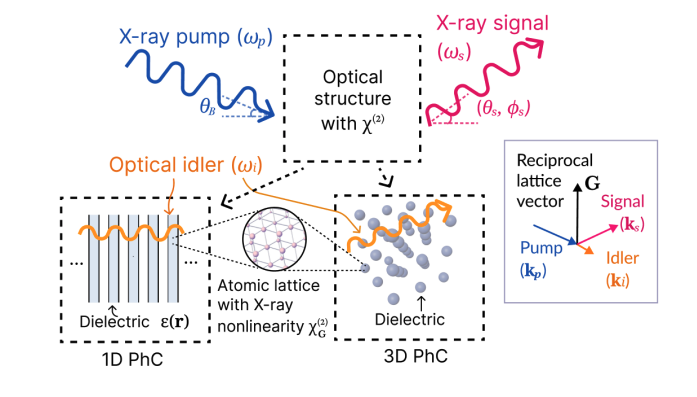
The manipulation of light at extremely high frequencies, specifically X-rays, represents a significant challenge with potentially transformative applications, and researchers are now demonstrating unprecedented control over these processes. Elina Sendonaris from the California Institute of Technology, Jamison Sloan from Stanford University, and Nicholas Rivera from Harvard University, alongside Ido Kaminer from the Technion Israel Institute of Technology and Marin Soljačić from Massachusetts Institute of Technology, have developed a method for shaping X-ray emission using carefully designed optical nanostructures. This work overcomes the historically low efficiency of controlling interactions between X-rays and visible light, offering a pathway to brighter, more focused X-ray sources and advanced imaging techniques. By employing photonic crystals, the team demonstrates a substantial enhancement in X-ray generation and precise control over the direction of emission, paving the way for innovations in fields ranging from materials science to biological imaging and spectroscopy.
Nonlinear processes underpin many technologies, from frequency converters to sources of entangled photons. Historically, observing and manipulating these processes has been limited to optical and lower frequencies. Recent advances, however, have demonstrated second-order nonlinear processes that couple X-ray and optical photons, allowing researchers to probe the electronic structure and optical response of materials. Consequently, research focuses on engineering materials with tailored properties to maximize these interactions and unlock new capabilities in areas like spectroscopy, imaging, and quantum technologies.
X-ray Entanglement via High Harmonic Generation
This research explores generating entangled photons in the X-ray regime, a significant challenge due to the inefficiency of traditional methods at these high energies. Entanglement, a crucial quantum phenomenon, could unlock new types of quantum devices and experiments. The team proposes using photonic crystals to enhance the efficiency of generating entangled X-ray photons. These nanostructures control light flow and can be designed to enhance nonlinear optical processes, making entangled photon generation easier. Researchers leveraged high harmonic generation, a process where intense laser light interacts with a gas to create X-ray photons, and used the photonic crystal to shape the laser pulse and enhance this process. Simulations demonstrate that generating entangled X-ray photons using this approach is possible, with the photonic crystal significantly enhancing efficiency and allowing control over the generated photon properties. This research could enable X-ray quantum technologies, revolutionize materials science with unprecedented resolution and sensitivity, advance quantum imaging, improve security with new cryptography protocols, and test fundamental aspects of quantum mechanics in the X-ray regime.
X-ray to Visible Light Conversion Demonstrated
Researchers have demonstrated new control over the interaction between X-rays and visible light, opening doors to advanced imaging and spectroscopy techniques. Manipulating these nonlinear optical processes has traditionally been limited by the extremely small wavelengths of X-rays, making it difficult to fabricate controlling structures. This team has shown that carefully designed nanostructures, specifically photonic crystals, can effectively shape and enhance these interactions. The research centers on X-ray to optical parametric down-conversion, where a high-energy X-ray photon is converted into a pair of lower-energy photons, one visible and one also in the X-ray range.
By embedding a gallium arsenide photonic crystal within the experimental setup, the researchers achieved a 2. 2-fold increase in the conversion rate, normalized to the crystal’s fill factor, compared to using a simple material. This enhancement stems from the photonic crystal’s ability to modify the available states for the emitted photons, effectively increasing the conversion probability. Beyond increasing the rate, the photonic crystal also provides precise control over the direction and energy of the emitted X-rays, directing them into specific beams dictated by the crystal’s internal structure. Extending these findings to three-dimensional photonic crystals, the team demonstrated even greater control over the X-ray emission spectrum, creating highly tailored X-ray beams with unique properties. This ability to sculpt both the energy and direction of X-rays promises significant advancements in techniques like ghost imaging and spectroscopic methods, potentially revolutionizing fields reliant on precise X-ray manipulation.
X-ray Nonlinearity via Photonic Crystal Shaping
This research demonstrates the ability to manipulate nonlinear optical processes using optical nanostructures at X-ray frequencies. By employing photonic crystals, the team successfully shaped the characteristics of X-rays generated through X-ray to optical parametric down-conversion, achieving a significant enhancement in efficiency and control over the direction of emitted X-rays. This represents a step forward in controlling light-matter interactions at extremely high energies, potentially enabling the development of brighter, more focused X-ray sources and advanced imaging techniques. The findings suggest possibilities for improved ghost imaging, allowing for the observation of dynamic processes in materials with enhanced resolution, and spectroscopic methods that surpass conventional limitations. Further research is needed to optimize nanostructure designs and explore the full potential of this approach across a wider range of X-ray energies and materials, with future work potentially focusing on integrating these nanostructures into practical devices and investigating their application to diverse scientific challenges requiring high-resolution X-ray imaging and spectroscopy.
🗞 Controlling X-ray emission with optical nanostructures
🧠 ArXiv: https://arxiv.org/abs/2507.22302