In photonic technology, a paradigm-shifting discovery has emerged, leveraging nonlinear non-reciprocal susceptibility to achieve unparalleled optical isolation. A recent study published in Light: Science & Applications has introduced a novel approach, harnessing intrinsic responses to attain high-performance optical isolation without relying on external magnetic fields or precise phase matching.
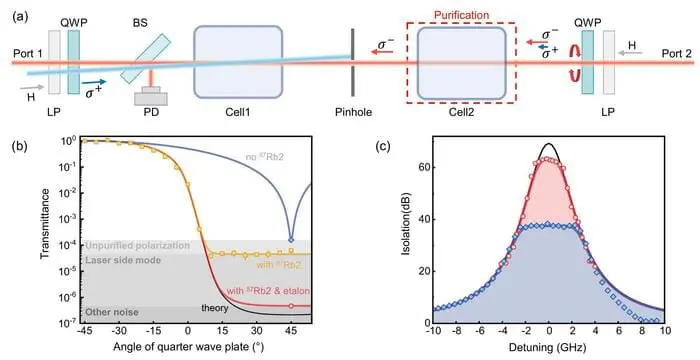
By exploiting the inherent properties of the medium, researchers have demonstrated a record-high isolation ratio of 63.4 dB, surpassing existing benchmarks and showcasing the vast potential of this mechanism in overcoming traditional limitations. This innovative concept, known as self-induced optical non-reciprocity, has far-reaching implications for the development of magnetic-free non-reciprocal devices, with applications spanning the ultraviolet, mid-infrared, and terahertz frequency ranges, and holds promise for the creation of on-chip isolators that could revolutionize the field of integrated optics.
Introduction to Optical Non-Reciprocity
The field of photonic technology has witnessed significant advancements in recent years, with discoveries in light-matter interactions and broken time-reversal symmetry paving the way for novel approaches to non-reciprocal optical systems. A study published in Light: Science & Applications presents a groundbreaking concept that leverages nonlinear non-reciprocal susceptibility (NLNR) to achieve high-performance optical isolation. This innovative approach has the potential to transform our understanding of optical non-reciprocity and its applications.
Optical non-reciprocity refers to the ability of an optical system to transmit light in one direction while blocking it in the opposite direction. Conventional methods for achieving optical non-reciprocity typically rely on magneto-optical media or nonlinear optics effects, which often require external magnetic fields and precise phase matching. In contrast, the NLNR mechanism harnesses intrinsic responses to achieve ideal optical isolation without such requirements. This breakthrough has significant implications for the development of advanced photonic devices.
The research team, led by Professor Chang-ling Zou from the University of Science and Technology of China, demonstrated a record-breaking isolation ratio of 63.4 dB, currently the highest reported for magnetic-free optical isolation. This remarkable achievement highlights the potential of the NLNR mechanism in overcoming limitations associated with traditional approaches. The device also exhibits an isolation bandwidth exceeding 20 dB of 12.5 GHz, which is more than an order of magnitude greater than the bandwidth of previous isolators that used atomic ensembles as the medium.
Mechanisms of Self-Induced Optical Non-Reciprocity
The concept of self-induced optical non-reciprocity is central to the advancements reported in this study. This mechanism relies on the inherent properties of the medium to facilitate non-reciprocity through the input signal itself. The researchers demonstrate that combining the signal’s Kerr-type optical nonlinearity with spatial asymmetry effectively blocks counter-propagating light while allowing forward light transmission. This self-induced non-reciprocal isolator has achieved high-performance magnetic-free isolation, but it still requires the presence of forward light to isolate the backward light.
The research team further placed the self-induced non-reciprocal medium within an asymmetric cavity to address this limitation. This improvement allows for the blockage of backward light, provided that its intensity remains below a specific threshold, even in the absence of forward light. Since this threshold is significantly higher than the typical reflective light intensity encountered in practical applications, this design effectively realizes a magnetic-free and passive ideal isolator. The physical mechanism of self-induced non-reciprocity is not only applicable to rubidium atomic ensembles but can also be extended to other atomic and molecular systems.
The use of an asymmetric cavity to enhance the self-induced non-reciprocal effect is a crucial aspect of this research. By carefully designing the cavity, the researchers were able to optimize the isolation ratio and bandwidth of the device. The experimental results demonstrate that the self-induced non-reciprocal isolator can achieve high-performance optical isolation with a record-breaking isolation ratio and a wide bandwidth.
Applications and Future Prospects
The discovery of self-induced optical non-reciprocity has significant implications for the development of advanced photonic devices. The potential applications of this technology are diverse, ranging from ultraviolet to mid-infrared or terahertz frequency ranges. In the field of integrated optics, coupling between evanescent waves from waveguides and gas atoms in free space holds promise for the development of on-chip magnetic-free non-reciprocal devices.
The ability to realize non-reciprocal devices in various frequency ranges opens up new opportunities for the development of novel photonic systems. For example, self-induced non-reciprocal isolators could be used to improve the performance of optical communication systems, enhance the sensitivity of spectroscopic instruments, or enable the creation of ultra-compact and efficient optical devices. The research team’s findings have sparked significant interest in the scientific community, and further studies are expected to explore the full potential of self-induced optical non-reciprocity.
The development of on-chip magnetic-free non-reciprocal devices is a particularly exciting area of research. By integrating self-induced non-reciprocal isolators with other photonic components, researchers can create ultra-compact and efficient optical systems that are suitable for a wide range of applications. The use of gas atoms in free space as the medium for self-induced non-reciprocity offers a promising approach for realizing on-chip devices, as it eliminates the need for complex fabrication processes and enables the creation of highly compact devices.
External Link: Click Here For More