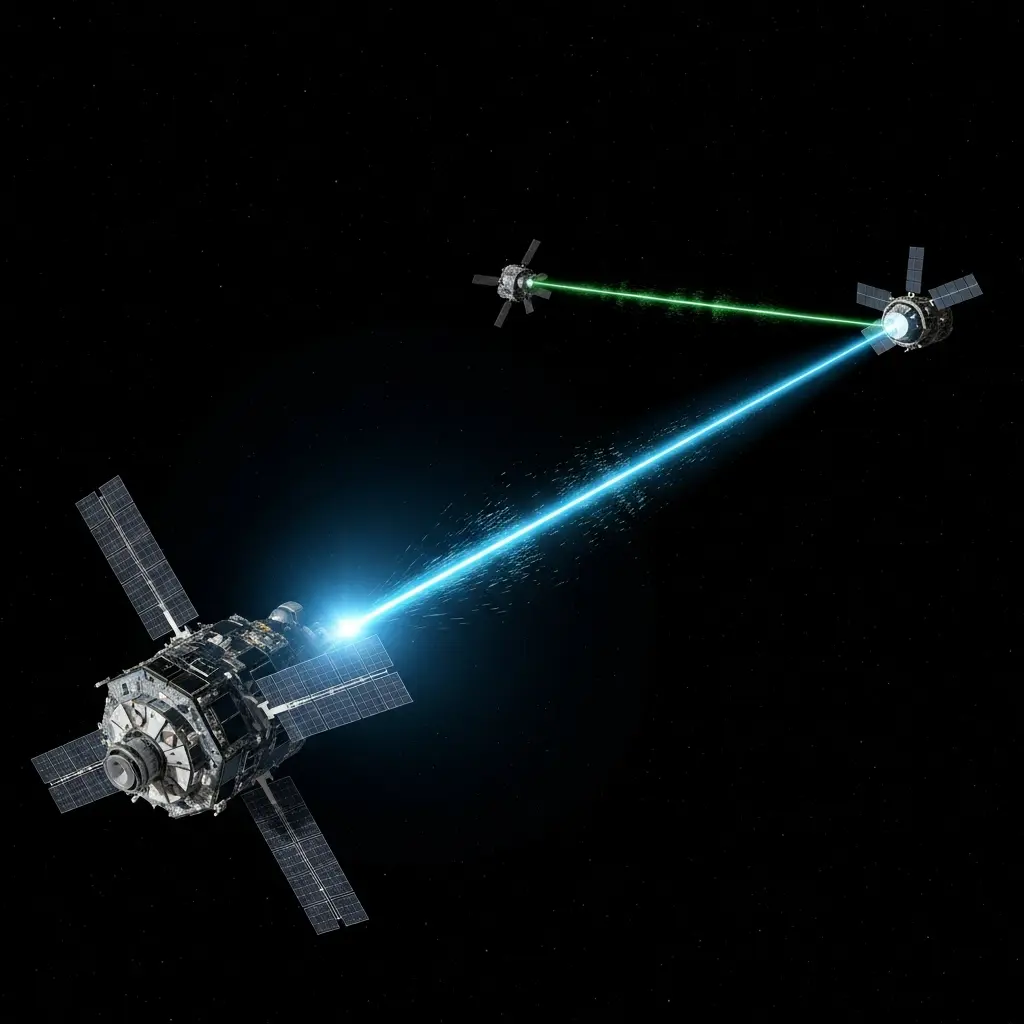
Scientists are tackling the escalating data demands of space exploration with a novel approach to interplanetary communications. Jason Gerard from Concordia University, alongside Juan A. Fraire of Inria and CONICET-Universidad Nacional de C ordoba, and Sandra Cespedes, present the first contact plan design (CPD) framework specifically tailored for free-space optical (FSO) networks, addressing a critical oversight in current deep-space infrastructure planning. This research is significant because it accounts for optical head retargeting delay , the time needed to physically redirect laser beams between spacecraft and Earth , a factor previously ignored that dramatically reduces usable contact time. By introducing a delay/disruption-tolerant networking (DTN) model and a new duty-cycle metric, the team demonstrates that accurately modelling retargeting delay can boost network capacity by over 30 percent compared to existing methods, revealing that prioritising fewer, longer optical links is key to maximising throughput in future missions.
The team achieved this by combining a temporal network capacity model with a mixed-integer linear programming (MILP) scheduler, embedding a physics-driven model of optical head retargeting delay, the time required to mechanically point a laser terminal to a new receiver. This innovative approach captures directional temporal flows across both direct-to-Earth optical links and two-hop relay paths utilising delay/disruption-tolerant networking (DTN) satellites, offering a comparative evaluation against heuristic and delay-unaware models.
Novel Metrics for Assessing Optical Link Capacity
Analyzing Capacity Loss with Novel Metrics
The study reveals a novel optical network duty-cycle metric, quantifying the proportion of time spent actually transmitting data versus the total contact window duration, thereby exposing capacity lost due to retargeting delay, a previously unanalysed issue. Experiments show that the MILP scheduler delivers over 30 percent higher network capacity compared to a greedy algorithm, demonstrating a significant performance improvement. More importantly, the research establishes a fundamental behavioural shift: when retargeting delays are accurately modelled, optimal schedules favour fewer, but longer, optical links, maximising throughput while minimising retargeting overhead. These findings demonstrate that assuming zero-delay conditions substantially overestimates achievable performance and yields unrealistic contact plans, highlighting the necessity for PAT-aware temporal modelling in future autonomous optical backhaul networks.
This breakthrough unveils a critical understanding of how optical communication networks should be scheduled to account for the mechanical limitations of laser-based systems. The work opens new avenues for optimising data relay from deep-space missions, potentially unlocking significantly higher data rates and more efficient use of limited resources. By accurately modelling retargeting delays, ranging from seconds to minutes, the team’s framework provides a more realistic assessment of network capacity and enables the creation of contact plans that maximise data transmission. The researchers prove that prioritising longer, less frequent links minimises the overhead associated with constantly re-aiming optical terminals, leading to a substantial increase in overall network efficiency.
Furthermore, the introduction of the optical network duty-cycle metric provides a valuable tool for evaluating the performance of different scheduling algorithms and identifying areas for improvement. Using realistic orbital dynamics and communication models, the study underscores the need to move beyond simplified assumptions and embrace the complexities of real-world optical communication systems. The team’s MILP scheduler not only outperforms existing algorithms but also provides insights into the fundamental trade-offs between link duration, retargeting delay, and overall network capacity, paving the way for more intelligent and autonomous interplanetary communication networks.
FSO Retargeting Delay in MILP Scheduling significantly impacts
Designing Robust Communication Frameworks for Deep Space
Designing Contact Plans for Deep-Space Links
Scientists developed a novel contact plan design (CPD) framework specifically for free-space optical (FSO) interplanetary backhaul networks, addressing limitations in existing RF-based systems. The research tackled the critical issue of retargeting delay, the time required for an optical terminal to mechanically redirect its laser from one partner to another, which significantly reduces usable contact time and was previously unaddressed in CPD models. This work pioneers the inclusion of this delay within a mixed-integer linear programming (MILP) scheduler, enabling more realistic and efficient contact planning. The study employed a detailed model capturing directional temporal flows across both direct-to-Earth optical links and two-hop relay paths utilising delay/disruption-tolerant networking (DTN).
Nodes within the network queried route tables to determine the outbound queue for forwarding data bundles, a process essential for establishing communication pathways. Researchers meticulously accounted for the unique challenges of deep-space link acquisition, which necessitates operation without direct feedback from the partner terminal due to substantial one-way light times, potentially exceeding 30 minutes for Earth-Mars communication with a 40-minute one-way light time. Establishing links involved initial coarse pointing, followed by closed-loop fine-pointing using fast steering mirrors (FSM) to maintain alignment throughout the contact window. Experiments utilized a contact plan formatted as a list of fields detailing each contact opportunity, synchronizing satellites and ground stations to establish optical links at precise times.
The team engineered a novel optical network duty-cycle metric quantifying the proportion of time spent transmitting relative to the total contact window duration, revealing capacity lost due to retargeting delay. This innovative metric allowed for a direct assessment of scheduling efficiency and the impact of retargeting overhead. The MILP scheduler was benchmarked against a greedy algorithm, demonstrating a substantial performance improvement of over 30 percent in network capacity. Furthermore, the research uncovered a fundamental shift in optimal scheduling behaviour: accurate modelling of retargeting delays favoured fewer, but longer, optical links, maximizing throughput while minimizing the time spent repositioning the laser terminal. This finding demonstrates that previous assumptions of zero-delay significantly overestimated achievable performance and yielded impractical contact plans. The approach enables a more nuanced understanding of the trade-offs between link duration, retargeting overhead, and overall network capacity, paving the way for more efficient deep-space communication architectures.
The Critical Challenge of Retargeting Delay
Overcoming Delay Limitations in Space Optical Backhaul
Retargeting delay limits optical backhaul performance significantly
Future Applications in Space Communications
Scientists have developed a groundbreaking contact plan design (CPD) framework specifically for optical interplanetary backhaul networks, addressing a critical limitation in current space communication systems. Researchers tackled the challenge of rapidly increasing scientific telemetry from space exploration missions, which overwhelms existing RF-based deep-space infrastructure. The team measured and modeled the impact of optical head retargeting delay, the time required to mechanically point a laser terminal to a new receiver, revealing it to be a dominant impairment unique to optical networks. Experiments revealed that this retargeting delay can range from seconds to minutes, significantly reducing usable contact time for data transmission.
The study introduces the first PAT-aware CPD framework, capturing directional temporal flows across both direct-to-Earth optical links and two-hop relay paths using delay/disruption-tolerant networking (DTN). Scientists also defined a novel optical network duty-cycle metric, quantifying the proportion of time spent transmitting relative to the total contact window duration, thereby exposing capacity lost due to retargeting delay. Results demonstrate that the team’s MILP scheduler delivers over 30 percent higher network capacity compared to a conventional greedy algorithm implementing the same underlying flow model. This substantial improvement highlights the effectiveness of accounting for retargeting delays in contact plan optimization.
Data shows a fundamental behavioral shift when retargeting delays are accurately modeled: optimal schedules favor fewer, but longer, optical links. These longer links maximize throughput while simultaneously minimizing the overhead associated with frequent retargeting. Measurements confirm that assuming zero-delay conditions substantially overestimates achievable performance and yields unrealistic contact plans. The breakthrough delivers a more accurate and efficient approach to scheduling optical communication links in space, crucial for maximizing data return from future missions. Tests prove that the developed framework accurately represents the usable portion of each contact window, bridging the gap between scheduled capacity and actual delivery. The research uncovered that the MILP scheduler consistently outperformed the greedy algorithm across various scenarios, demonstrating its robustness and adaptability. This work underscores the need for PAT-aware temporal modeling in future autonomous optical backhaul networks, paving the way for more reliable and high-bandwidth communication with spacecraft and probes throughout the solar system.
PAT delays boost FSO network capacity
Scientists have developed a new contact plan design (CPD) framework specifically for free-space optical (FSO) interplanetary backhaul networks. This model accurately captures the impact of pointing, acquisition, and tracking (PAT) delays, the time needed to retarget optical terminals between data transmissions, a factor previously overlooked in network scheduling. Researchers demonstrate that incorporating these retargeting delays fundamentally alters network behaviour, favouring fewer, longer optical links to maximise throughput and minimise overhead. The findings reveal a greater than 30 percent increase in scheduled network capacity when using a mixed-integer linear programming (MILP) scheduler, compared to existing greedy algorithms.
Importantly, the study establishes that assuming zero delay significantly overestimates achievable performance and creates unrealistic contact plans. The authors acknowledge that the current work focuses on contact plan generation and does not evaluate end-to-end routing performance. Future research will extend this approach to assess routing over these retargeting-aware contact plans. These results underscore the critical need for PAT-aware temporal modelling in autonomous optical backhaul systems operating at interplanetary distances. By accurately accounting for retargeting delays, mission planners can create more feasible and efficient schedules, ultimately enabling a substantial increase in the volume of scientific data returned from deep-space missions. The research highlights a shift towards prioritising fewer, longer contacts, a strategy that maximises data transmission time while minimising the time lost to mechanical adjustments of optical terminals.
🗞 Contact Plan Design For Optical Interplanetary Communications
🧠 ArXiv: https://arxiv.org/abs/2601.18148