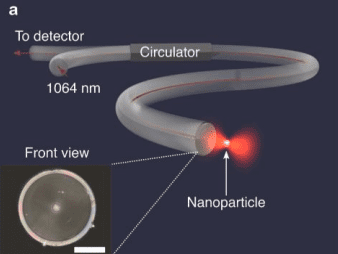
On April 22, 2025, a team led by Seyed Khalil Alavi and Harald Giessen introduced a novel compact levitation platform using a single 3D-printed fiber lens in their study titled Compact vacuum levitation and control platform with a single 3D-printed fiber lens, advancing quantum sensing technology.
Levitated dielectric particles in a vacuum offer precision applications but face challenges with traditional optical tweezers requiring complex bulk optics. A novel approach uses a single optical fiber with a high numerical aperture (NA) lens printed directly on its facet, creating a compact, robust system without alignment issues. The high NA enables stable trapping of nanoparticles even during controlled fiber motion and enhances light collection for efficient detection and stabilization. This innovation advances practical portable systems and simplifies complex experiments involving levitated particles.
Recent research has demonstrated a novel method for cooling mechanical motion using optical tweezers, achieving an effective temperature of approximately 187 millikelvin. This innovation employs a compact fiber-based trap with a microsphere, offering significant advantages in efficiency and practicality.
The methodology relies on feedback control based on real-time measurements of the particle’s position within the optical trap. By leveraging principles related to system fluctuations and dissipation, researchers can dynamically adjust cooling strategies. This approach enhances efficiency, enabling precise control over mechanical motion at ultra-low temperatures.
The experiment achieved a remarkable reduction in thermal noise, resulting in a displacement sensitivity of about 3.8 picometers per square root hertz. This level of precision is crucial for advanced sensing applications, as it minimizes interference from environmental factors, thereby improving measurement accuracy.
This advancement holds promise for enhancing quantum sensors and potentially revolutionizing quantum communication systems. The compact nature of the setup makes it ideal for practical applications, reducing reliance on extensive laboratory infrastructure. Potential uses extend beyond sensing to include improved navigation systems and medical diagnostics, where precision is paramount.
Looking ahead, the study highlights opportunities for further improvements, such as integrating balanced homodyne detection to enhance sensitivity. This technology could pave the way for breakthroughs in fields requiring extreme precision, including space-based experiments and high-precision manufacturing.
In summary, this development represents a significant advancement in quantum sensing technology, offering new possibilities for precise measurements and applications across various scientific and technological domains.
👉 More information
🗞 Compact vacuum levitation and control platform with a single 3D-printed fiber lens
🧠 DOI: https://doi.org/10.48550/arXiv.2504.15734