

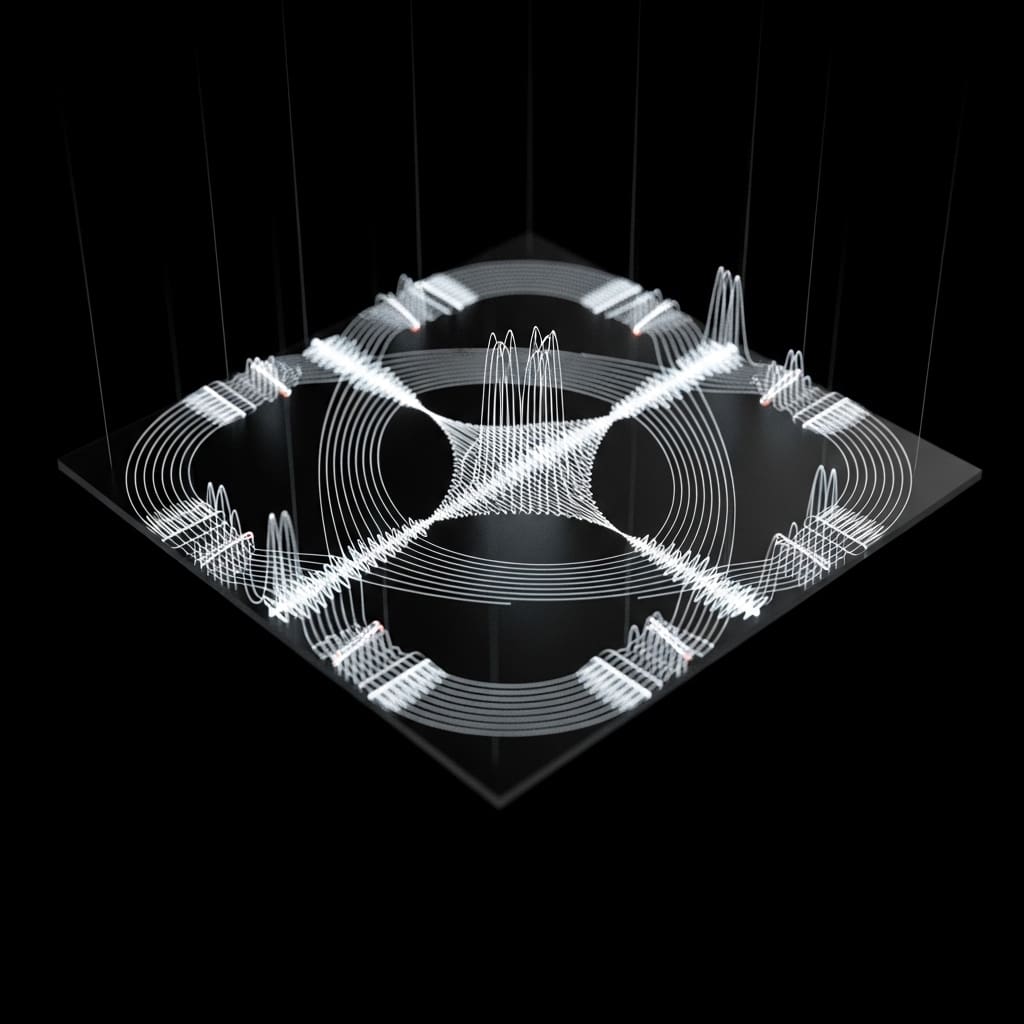
Scientists are developing new methods for manipulating qubits, fundamental units of quantum information, and a significant challenge lies in achieving rapid and versatile control over large arrays of these delicate systems. Edita Bytyqi, Josiah Sinclair, Joshua Ramette, and Vladan Vuletić, working collaboratively between the Massachusetts Institute of Technology and the University of Wisconsin-Madison, present a novel optical rastering device capable of generating arbitrary two-dimensional optical potentials at a refresh rate of 1MHz. This innovation overcomes limitations inherent in current technologies, such as acousto-optic deflectors and spatial light modulators, which restrict both speed and movement patterns. Demonstrating a 40×40 resolution scalable to 100×100, this device promises to enhance qubit connectivity, facilitate more efficient quantum circuits, and potentially broaden applications beyond quantum computing into fields like LiDAR and fluorescence microscopy.
Within a vacuum chamber, light races across a tiny chip containing tens of thousands of microscopic mirrors. This new device steers optical beams with a speed and freedom previously unattainable, allowing precise control over individual quantum bits and promising a future where qubits can be connected and manipulated in complex, three-dimensional arrangements.
Scientists are developing a new optical system to precisely control neutral atoms, essential components in emerging quantum computing technologies. Current methods rely on devices like acousto-optic deflectors and spatial light modulators, but these are limited by slow response times and geometric constraints, restricting movement to simple grid-like patterns.
Now, a team has engineered an optical rastering device capable of generating any two-dimensional pattern at a refresh rate of 1MHz, a speed previously unattainable. Achieving this active control presents technical challenges, as traditional systems struggle with the trade-off between speed and precision when steering optical beams. The newly designed device overcomes these limitations through a dual-axis approach, employing a “fast” axis for rapid switching and a “slow” axis for scanning.
This configuration allows for arbitrary 2D intensity patterns, opening possibilities beyond restrictive grid formats. Initial demonstrations show a resolution of 40×40, with potential for scaling to 100×100, aligning with the requirements of advanced neutral atom devices. The implications extend far beyond quantum information processing, with applications in diverse fields including LiDAR and high-resolution fluorescence microscopy.
By simultaneously transporting qubits in any direction, this technology promises to enhance connectivity within quantum circuits, enabling more efficient computations. Once fully developed, this device could unlock new levels of performance in quantum simulations and potentially accelerate the development of practical quantum computers. It utilizes a virtually imaged phased array combined with an electro-optic modulator to achieve high-speed control via angular dispersion, while a counter-propagating pair of acousto-optic deflectors cancels acoustic lensing effects, allowing for refresh rates exceeding 1MHz.
Experiments reveal an access time of 260 nanoseconds for the dual-axis deflectors, a 1.76-fold improvement over single acousto-optic deflectors. The static spatial resolution is measured at 66, and a active resolution of 17 is maintained during linear scans at speeds up to 1MHz.
Velocity-modulated intra-pulse amplification delivers nanosecond switching and 40×40 resolution imaging
VIPA switching occurred in 4.8 ±0.4 nanoseconds, as measured on a photodetector, a speed limited by the 125MHz bandwidth of the detection electronics. This initial test utilised a 2mm thick air-spaced VIPA with a 95% partial reflector coating. Activating a sideband on the fibre electro-optic modulator (EOM) at frequencies between 0.1 and 25.5GHz produced two distinct spots on a camera, corresponding to carrier and sideband frequencies.
Optical relaying, employing a 1:1 4f-setup with 30mm lenses and a central aperture, filtered the sideband, and the deflected beam’s switching time was then assessed. The combined VIPA and digital acousto-optic deflector (DAOD) rasterer achieved a 2D resolution of approximately 40×40, defined by composite imaging mapping points across varying frequencies, though measurements were limited to 25.5GHz by the EOM and RF signal generator.
Individual spot sizes were determined to be 15 ±1μm in width and 11.3 ±0.2μm in height, derived from Lorentzian and Gaussian fits. At a 1MHz refresh rate, constrained by the DAOD response time, the device can raster arbitrary 2D optical potentials, transporting atoms in steps of approximately 100nm at a top speed of 0.1μm/μs. The design could be scaled to a 2D resolution of roughly 100×100.
Current transmission efficiency stands at approximately 0.02, stemming from transmission losses through the fibre EOM, DAOD diffraction efficiency, and VIPA sideband transmission. Future improvements, such as heating the fibre EOM to 60% efficiency, interferometric sideband filtering, and a slave laser seeded to the EOM output, could deliver Watt-level optical power. Also, VIPA transmission efficiency is projected to reach 90% through I/Q control of generated sidebands and tighter input focusing, potentially yielding approximately 500mW of optical power at the atoms, sufficient for generating several hundred movable traps.
High speed beam steering via MEMS mirror and telescope optics
A 40×40 optical rastering device constitutes the core of this work, designed to precisely direct beams across a two-dimensional space. A beam originating from a single source undergoes collimation and is directed towards a custom-built micro-electro-mechanical system (MEMS) mirror, possessing a diameter of 3.6mm, which serves as the primary deflecting element.
Driving these tilts are piezoelectric actuators, allowing for refresh rates reaching 1MHz, critical for active control applications. Then, the deflected beam passes through a telescope system, expanding its size to cover the target area. Careful alignment of this telescope is essential to maintain beam quality and ensure uniform illumination across the 40×40 array.
A half-wave plate and a polarizing beam splitter are incorporated to control the beam’s intensity and polarization, offering additional degrees of freedom for manipulation. This configuration allows for arbitrary 2D patterns to be generated, moving beyond the limitations of grid-based systems commonly found in acousto-optic deflectors (AODs) and spatial light modulators (SLMs).
The design prioritises scalability, with the potential to expand the resolution to 100×100, accommodating existing and future device requirements. Instead of relying on sequential scanning, the system achieves simultaneous control over multiple points, advantageous for applications like volumetric imaging, promising reduced phototoxicity compared to traditional raster-scanning methods.
The choice of a MEMS mirror over alternative technologies, such as AODs, stems from its ability to achieve higher refresh rates and greater control over beam shape. By directly manipulating the beam’s direction, the system avoids the diffraction limitations inherent in AODs, enabling finer control and higher resolution. This methodology aims to create a flexible platform for diverse photonic applications, ranging from quantum information processing to LiDAR and free-space optical communication.
Correcting signal distortion enables parallel atom manipulation for quantum computing
Scientists are steadily refining the tools needed to control individual atoms, a feat central to building practical quantum computers and simulators. For years, manipulating these qubits has relied on systems that scan sequentially. Now, a new optical device promises to address atoms in a truly parallel fashion, potentially accelerating operations by orders of magnitude.
This isn’t simply about making things faster; it’s about unlocking circuit designs previously considered impractical due to the limitations of serial control. Achieving this speed has historically demanded trade-offs in precision, as traditional acousto-optic deflectors suffer from distortions that blur the signal as scanning speeds increase. Instead of accepting this compromise, researchers have devised a solution involving a second, counter-propagating acoustic wave to cancel out these distortions.
By effectively ‘sharpening’ the beam, they’ve demonstrated a quadrupling of active resolution, allowing for finer control even at a refresh rate of one million cycles per second. While the current demonstration showcases a 40×40 array, extending this to 100×100, and beyond, will demand careful engineering to maintain both speed and accuracy. Once this is achieved, the implications extend far beyond quantum computing, benefiting areas like high-resolution microscopy and LiDAR, which also rely on precise beam steering.
The system’s complexity currently represents a hurdle to widespread adoption. Building and calibrating a double-acousto-optic deflector setup is not trivial. However, the potential gains in qubit connectivity and circuit efficiency are substantial enough to warrant further investment. Beyond this specific implementation, the broader effort to move from serial to parallel qubit control is likely to spur exploration of alternative technologies, perhaps involving micro-fabricated optical phased arrays or entirely new approaches to manipulating atomic states.
👉 More information
🗞 Device for MHz-rate rastering of arbitrary 2D optical potentials
🧠 ArXiv: https://arxiv.org/abs/2602.16025
