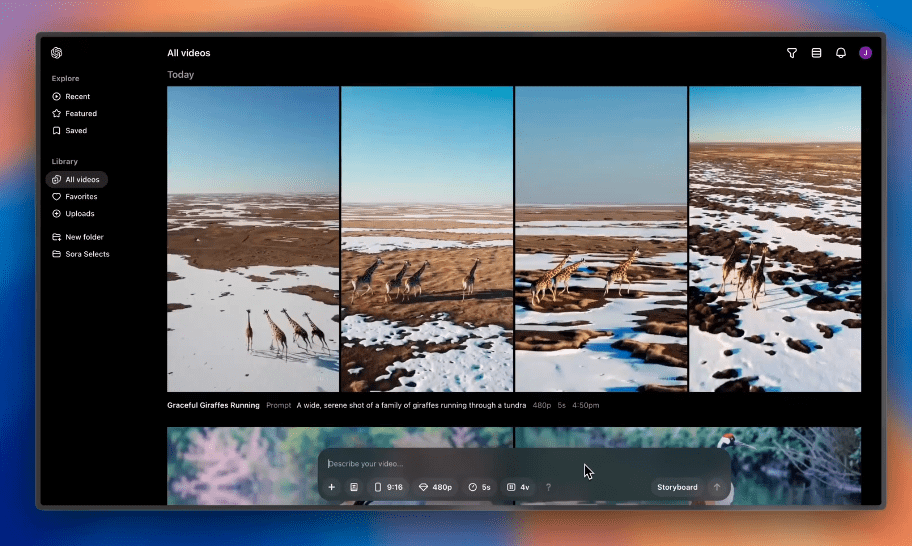
OpenAI has announced the release of Sora, a video generation model that can create realistic videos from text. The model is now available at sora.com as a standalone product for ChatGPT Plus and Pro users.
Sora serves as a foundation for AI that understands and simulates reality, an essential step toward developing models that can interact with the physical world. The new version of Sora, called Sora Turbo, is significantly faster than the previous model and allows users to generate videos up to 1080p resolution and twenty seconds long.
OpenAI has developed new interfaces to make it easier for users to prompt Sora with text, images, and videos. The company is working to ensure the technology is used responsibly and has introduced safeguards such as visible watermarks and metadata to identify Sora-generated videos.
Introduction to Sora: A Video Generation Model
Sora is a video generation model that has been developed to create realistic videos from text inputs. This model serves as a foundation for artificial intelligence (AI) that understands and simulates reality, which is an important step towards developing models that can interact with the physical world. The initial research progress on Sora was shared earlier this year, and since then, a new version of the model, known as Sora Turbo, has been developed. This new version is significantly faster than the previous one and is being released as a standalone product at Sora.com to ChatGPT Plus and Pro users.
The development of Sora marks an important milestone in the field of AI research, as it demonstrates the potential for machines to generate realistic videos that can be used for a variety of purposes. The model uses a combination of natural language processing (NLP) and computer vision techniques to generate videos from text inputs. This allows users to create videos that are tailored to their specific needs, such as creating educational content or telling stories.
One of the key features of Sora is its ability to generate videos up to 1080p resolution, up to 20 seconds long, and in widescreen, vertical, or square aspect ratios. Users can also bring their own assets to extend, remix, and blend with the generated content, or generate entirely new content from text. The model also includes a storyboard tool that allows users to precisely specify inputs for each frame, giving them greater control over the final product.
The release of Sora Turbo is an important step towards making video generation technology more accessible to a wider range of users. However, it is worth noting that the model still has many limitations, including generating unrealistic physics and struggling with complex actions over long durations. Despite these limitations, the potential for Sora to enable new forms of creativity and storytelling is significant, and its development marks an important milestone in the field of AI research.
Technical Details of Sora
The technical details of Sora are complex and involve a combination of NLP and computer vision techniques. The model uses a deep learning architecture that is trained on a large dataset of videos and text inputs. This training data allows the model to learn patterns and relationships between the input text and the output video, enabling it to generate realistic videos.
One of the key technical challenges in developing Sora was ensuring that the generated videos were realistic and coherent. To address this challenge, the developers used a variety of techniques, including object detection, tracking, and segmentation. These techniques allow the model to identify and track objects within the scene, generating more realistic and coherent videos.
The model also includes a number of features that are designed to improve its performance and usability. For example, the storyboard tool allows users to specify inputs for each frame, giving them greater control over the final product. The model also includes a feature that allows users to upload their own assets, such as images or videos, which can be used to extend, remix, and blend with the generated content.
Despite the technical challenges involved in developing Sora, the potential benefits of the model are significant. For example, it could be used to create educational content, such as video tutorials or lectures, that are more engaging and effective than traditional text-based materials. It could also be used to create entertainment content, such as short films or animations, that are more realistic and immersive than traditional forms of storytelling.
Safety and Monitoring Features
The safety and monitoring features of Sora are an important aspect of the model’s development. The developers have implemented a number of measures to prevent the misuse of the model, including blocking the creation of child sexual abuse materials and sexual deepfakes. The model also includes advanced detection tools that can identify and filter out uploads that contain nudity or other forms of explicit content.
In addition to these technical measures, the developers have also established a set of strict moderation standards for uploads featuring people. These standards are designed to prevent the misappropriation of likeness and deepfakes, and to ensure that users are aware of what is allowed and what is not. The model also includes in-product reminders about these policies, which are designed to educate users about the potential risks and consequences of misusing the model.
The developers have also worked with red-teamers, who are domain experts in areas such as disinformation, illegal content, and safety, to rigorously test the model and identify potential risks. This feedback has played a key role in shaping Sora, helping to fine-tune its safeguards while making the model as useful as possible.
Potential Applications of Sora
The potential applications of Sora are significant and varied. For example, it could be used to create educational content, such as video tutorials or lectures, that are more engaging and effective than traditional text-based materials. It could also be used to create entertainment content, such as short films or animations, that are more realistic and immersive than traditional forms of storytelling.
In addition to these applications, Sora could also be used in a variety of other fields, such as marketing, advertising, and journalism. For example, it could be used to create personalized advertisements that are tailored to an individual’s interests and preferences. It could also be used to create interactive news stories that allow readers to engage with the content in new and innovative ways.
The potential benefits of Sora are significant, and its development marks an important milestone in the field of AI research. However, it is worth noting that the model still has many limitations, including generating unrealistic physics and struggling with complex actions over long durations. Despite these limitations, the potential for Sora to enable new forms of creativity and storytelling is significant, and its development is likely to have a major impact on a variety of fields in the coming years.
Future Developments and Improvements
The future developments and improvements of Sora are likely to be significant, as the model continues to evolve and improve over time. For example, the developers may work to address some of the limitations of the current model, such as generating unrealistic physics or struggling with complex actions over long durations.
In addition to these technical improvements, the developers may also work to expand the range of applications for Sora, exploring new uses for the model in fields such as education, entertainment, and marketing. They may also work to improve the safety and monitoring features of the model, ensuring that it is used responsibly and ethically.
One potential area of development for Sora is the integration of other AI models or technologies, such as natural language processing or computer vision. This could enable the model to generate even more realistic and coherent videos, and to expand its range of applications.
Another potential area of development is the use of Sora in virtual reality (VR) or augmented reality (AR) environments. This could enable users to create immersive and interactive experiences that are more engaging and effective than traditional forms of storytelling.
Overall, the future developments and improvements of Sora are likely to be significant, as the model continues to evolve and improve over time. Its potential applications are varied and extensive, and its development is likely to have a major impact on a variety of fields in the coming years.
External Link: Click Here For More