

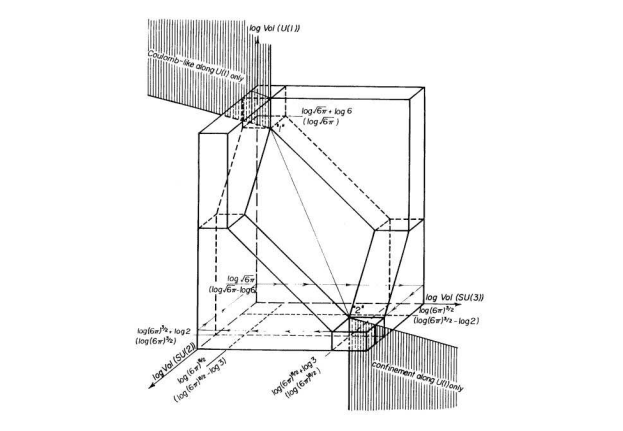
The fundamental constants governing the universe, such as the fine structure constant, remain a central puzzle in physics, and scientists continually seek deeper understanding of their origins. Holger Bech Nielsen from Niels Bohr Insitutet and colleagues now demonstrate a remarkable connection between several key energy scales, including the Planck scale and scales related to the heaviest known particles, revealing they align on a linear relationship when plotted against a hypothetical lattice structure. This achievement represents a significant step towards establishing evidence for a ‘fluctuating lattice’ underpinning reality, where the very fabric of spacetime exhibits mechanical fluctuations, and allows for the prediction of fundamental constants with unprecedented accuracy, matching experimental values to within a fraction of a percent. By linking these disparate energy scales, the research offers a novel framework for understanding the interconnectedness of physical phenomena and potentially unifying the forces of nature.
Random Dynamics and Early Universe Cosmology
This extensive collection of publications and preprints centers on theoretical physics, particularly Grand Unified Theories, particle physics, and cosmology, with a recurring emphasis on Random Dynamics. Originating in the late 1960s and early 1970s, Random Dynamics proposes a framework for understanding fundamental physics without relying on pre-defined symmetries, allowing dynamics to emerge from a more fundamental, random basis. This approach connects to the existence of three generations of quarks and leptons, incorporates concepts of skewness and lognormal distributions, and links multiple point criticality to the finetuning problem in physics, even predicting specific values for fundamental constants. Froggatt as a frequent collaborator. D. L. Bennett’s doctoral thesis provides a deep exploration of the mathematical foundations of Random Dynamics and its implications for fundamental constants, while M.
Ninomiya also collaborated extensively in the early development of this framework. The research extends to collaborations with experts in neutrino physics and investigations into topological defects like domain walls and monopoles. The publications cover a broad range of specific research areas, including attempts to incorporate Random Dynamics into Grand Unified Theories, extensive work on neutrino mass and seesaw mechanisms, and connections to cosmological inflation and the Hubble constant tension. Early work on string theory and dual resonance models laid the groundwork for the development of Random Dynamics.
Key publications include Bennett’s foundational doctoral thesis and a recent paper by Froggatt and Nielsen addressing the Hubble constant tension using Random Dynamics. Publications from collaborations at the Large Hadron Collider and LEP provide experimental context for the theoretical investigations. This collection represents a long-term research program exploring an alternative to traditional symmetry-based approaches to fundamental physics, with its viability suggested by continued development and connections to current cosmological problems.
Energy Scales Predict Fine Structure Constants
Scientists have developed a novel method for calculating fine structure constants by examining relationships between key energy scales, including the Planck scale and a newly defined “fermion tip” scale related to the heaviest Standard Model fermions. The research centers on identifying a linear correlation between the logarithms of these energy scales and powers of a hypothetical lattice link length. By analyzing four precisely determined energy scales, the team interpolated to an approximate SU(5) unification scale, achieving sufficient accuracy to predict differences between inverse fine structure constants with remarkable precision. This self-referential approach obtains the three fine structure constants from theoretically predictable quantities, including the SU(5)-like unification scale identified through their linear plot.
Meticulous examination of four precisely known energy scales allowed interpolation to the unification scale, accounting for deviations from strict SU(5) symmetry, resulting in agreement within errors of a few units in the second decimal place. Researchers extended this approach by revisiting earlier work establishing relationships between the three fine structure constants and three theoretical parameters, reminiscent of SU(5) unified theories. Analyzing deviations from standard GUT-SU(5) relations predicted by their quantum correction model, they calculated experimentally determined inverse fine structure constants at the approximate unification scale. This allows them to propose that the “fundamental” fine structure constants represent a critical value separating different phases, potentially indicating a phase transition or strong crossover in the underlying physics.
Lattice Structure Predicts Fine Structure Constants
Scientists have achieved remarkably precise calculations of fine structure constants by developing a model based on a fluctuating lattice structure underlying physical phenomena. The work centers on relationships between energy scales, including the Planck scale, a “fermion tip” scale related to the heaviest Standard Model fermions, and an approximate SU(5) unification scale, and the power of a hypothetical lattice link length. Researchers discovered these energy scales, when plotted against the power of the lattice link length, align remarkably linearly, suggesting the existence of a fluctuating lattice structure in nature. The team interpolated to an approximate unification scale, predicting the differences between inverse fine structure constants with exceptional accuracy.
Specifically, the predicted difference between the non-abelian inverse fine structure constants at the Z-mass was closely matching the experimental value, with deviations of less than one percent. Furthermore, the study predicts the fine structure constants themselves, with an uncertainty of only three units in the inverse constants. The model proposes a gauge theory lattice fluctuating in density, composed of a Standard Model group cross-producted with itself three times, potentially explaining the origin of three fermion families. This research builds upon earlier work exploring “confusion” mechanisms that favor diagonal subgroups, suggesting a possible anti-GUT structure underlying the Standard Model.
👉 More information
🗞 Ontological Fluctuating Lattice Cut Off
🧠 ArXiv: https://arxiv.org/abs/2510.18517

