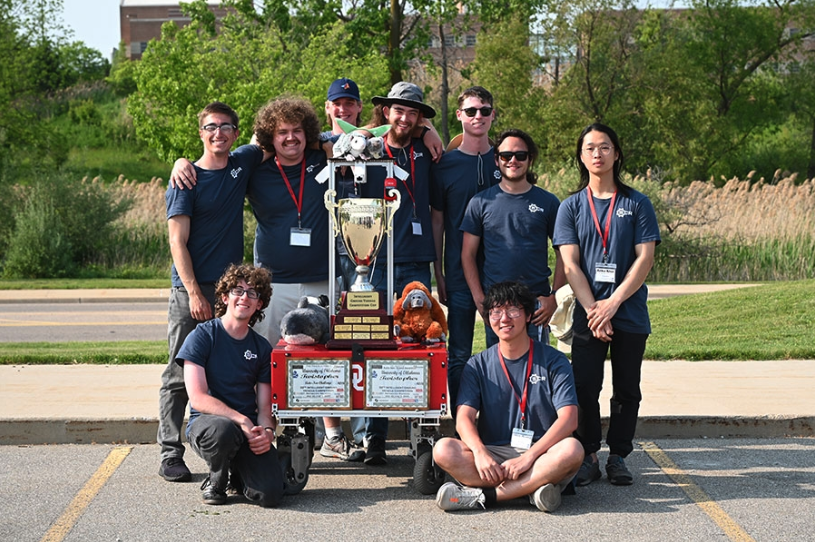
The University of Oklahoma’s Sooner Competitive Robotics team, led by Dylan Zemlin, a Masters student in computer science and club president, secured a victory at the 32nd annual Intelligent Ground Vehicle Competition (IGVC) hosted by Oakland University in Rochester, Michigan. The team’s rectangular, ruby-red robot, designated Twistopher, successfully navigated a complex outdoor course incorporating lanes, GPS waypoints, and obstacles, completing the course in 00:02:20 and besting 28 other teams representing seven countries – the U.S., Canada, Australia, Japan, Turkey, India, and Egypt. This achievement marks the team’s third consecutive win and fourth victory in five years at the IGVC, a multidisciplinary engineering competition sponsored by BAE Systems and other organisations, which serves as a rigorous testing ground for autonomous navigation and self-driving technologies with applications in the automotive and defence sectors; judging was conducted by experts in these fields, evaluating design, autonomous capabilities, and overall performance.
Oklahoma’s Robotics Dominance
Oklahoma’s consistent success at the Intelligent Ground Vehicle Competition (IGVC) underscores the University of Oklahoma’s (OU) emergence as a prominent centre for robotics research and engineering education. The Sooner Competitive Robotics team’s recent victory – their third consecutive and fourth in five years at the 32nd annual IGVC – demonstrates a sustained commitment to innovation in autonomous systems. This year’s competition, held at Oakland University in Rochester, Michigan, saw the team’s robot, ‘Twistopher’, successfully navigate a complex outdoor course in 00:02:20, besting 28 other teams from seven nations – the United States, Canada, Australia, Japan, Turkey, India, and Egypt. The achievement highlights the effectiveness of OU’s multidisciplinary approach to robotics, integrating expertise from computer science, mechanical engineering, and electrical engineering.
The IGVC serves as a demanding platform for the development and validation of technologies central to autonomous ground vehicles. The competition’s ‘auto-nav’ category, in which the OU team excelled, specifically challenges students to design and implement robust algorithms for perception, localisation, and path planning. ‘Twistopher’ likely employed a suite of sensors – potentially including LiDAR (Light Detection and Ranging), cameras, and inertial measurement units (IMUs) – to build a representation of its environment. Data fusion techniques would have been crucial to integrate these diverse sensor inputs, enabling the robot to accurately estimate its position and orientation within the course. The successful negotiation of obstacles, such as traffic cones, pylons, and speed bumps, suggests the implementation of sophisticated obstacle avoidance algorithms, potentially utilising reactive or model-predictive control strategies.
Dylan Zemlin, a Masters student in computer science at OU and president of the robotics club, characterised the IGVC as an “amazing” and “fun” learning experience, emphasising the value of applying theoretical knowledge to practical challenges. This sentiment reflects a broader trend in engineering education towards project-based learning and hands-on experience. The competition is sponsored by BAE Systems and other organisations, providing crucial funding and industry expertise. Judging is conducted by specialists in design, self-driving technology, and autonomous navigation, ensuring a rigorous assessment of the participating teams’ capabilities. The technologies developed through the IGVC have significant implications for both the automotive and defence sectors, driving innovation in areas such as autonomous driving, unmanned ground vehicles, and robotic systems for hazardous environments. The continued success of the University of Oklahoma’s robotics team positions the institution as a key contributor to the advancement of these critical technologies.
The Intelligent Ground Vehicle Competition
The Intelligent Ground Vehicle Competition (IGVC), hosted annually at Oakland University in Rochester, Michigan, serves as a pivotal proving ground for collegiate teams focused on the development of autonomous ground vehicles. The 32nd iteration of the competition saw 29 teams from seven nations – the United States, Canada, Australia, Japan, Turkey, India, and Egypt – competing in a series of challenges designed to assess the robustness and sophistication of their unmanned systems. The University of Oklahoma’s Sooner Competitive Robotics team achieved a notable victory, securing its third consecutive and fourth overall win in the auto-nav category, demonstrating a sustained commitment to excellence in robotics engineering.
The competition’s core objective is to challenge students to translate theoretical knowledge into practical application, encompassing the entire engineering lifecycle from research and design to construction and rigorous testing. Participants are tasked with developing fully autonomous systems capable of navigating complex outdoor courses delineated by lanes, GPS waypoints, and a variety of obstacles. The University of Oklahoma’s winning robot, ‘Twistopher’, completed the course in 00:02:20, showcasing the efficacy of its integrated hardware and software systems. Successful performance necessitates advanced capabilities in several key areas, including sensor integration, data fusion, localisation, path planning, and robust control algorithms.
The technical challenges inherent in the IGVC are substantial. Teams must address the complexities of real-world environments, including variable lighting conditions, uneven terrain, and dynamic obstacles. Sensor suites typically incorporate LiDAR (Light Detection and Ranging) for detailed environmental mapping, cameras for visual perception and object recognition, and inertial measurement units (IMUs) for accurate pose estimation. Kalman filtering or similar state estimation techniques are commonly employed to fuse data from these disparate sensors, providing a consistent and reliable representation of the robot’s state and its surroundings. Path planning algorithms, such as A* or Rapidly-exploring Random Trees (RRT), are then used to generate collision-free trajectories, while sophisticated control systems ensure precise and stable execution of the planned path. Dylan Zemlin, an OU Masters student in computer science and president of the robotics club, described the event as an “amazing” and “fun” learning experience, noting the opportunity to apply knowledge beyond the classroom.
The IGVC is supported by sponsorship from BAE Systems and other organisations, providing essential funding and industry expertise. Judging is conducted by a panel of experts in design, self-driving technology, and autonomous navigation, ensuring a rigorous and objective evaluation of each team’s performance. The competition’s impact extends beyond the academic realm, serving as a crucial training ground for future engineers and driving innovation in critical sectors such as automotive engineering, defence, and robotics. The technologies developed through the IGVC have direct relevance to the development of autonomous vehicles, unmanned ground vehicles for military applications, and robotic systems for hazardous environment exploration.
Industry and Educational Synergy
The sustained success of the University of Oklahoma’s Sooner Competitive Robotics team at the Intelligent Ground Vehicle Competition (IGVC) exemplifies a powerful synergy between academic research and industry demands in the field of autonomous ground vehicles. The team’s consistent performance – securing their third consecutive and fourth overall win in five years at the 32nd annual competition hosted by Oakland University in Rochester, Michigan – is not merely a testament to student skill, but also to a curriculum designed to address real-world engineering challenges. The IGVC, with its participation from 29 teams representing the U.S., Canada, Australia, Japan, Turkey, India, and Egypt, provides a uniquely challenging platform for students to translate theoretical knowledge into practical application.
Crucially, the competition’s structure fosters direct engagement with industry partners. Sponsorship from organisations such as BAE Systems is not limited to financial support; these entities actively participate in the judging process, providing expert evaluation of designs and performance metrics. This interaction ensures that the skills honed by students – encompassing areas such as sensor integration, path planning, and control systems – are directly aligned with industry expectations. The judging panel, comprised of experts in self-driving technology and autonomous navigation, assesses not only the robot’s ability to complete the auto-nav course – in the case of Twistopher, a time of 00:02:20 – but also the robustness, scalability, and potential for future development of the underlying technologies.
The University of Oklahoma’s approach, led by students such as Dylan Zemlin, an OU Masters student in computer science and president of the robotics club, prioritises a multidisciplinary engineering experience. This holistic approach is vital, given the complexity of developing truly autonomous systems. Students are required to integrate knowledge from electrical engineering, mechanical engineering, computer science, and potentially aerospace engineering, mirroring the collaborative environment found in most industrial research and development settings. The competition’s emphasis on practical implementation forces students to confront the limitations of theoretical models and develop innovative solutions to unforeseen challenges, a skill highly valued by employers in the rapidly evolving field of robotics. The resulting technologies have direct relevance to the development of unmanned ground vehicles for both civilian and military applications, highlighting the crucial role of educational initiatives in driving technological advancement.
More information
External Link: Click Here For More