

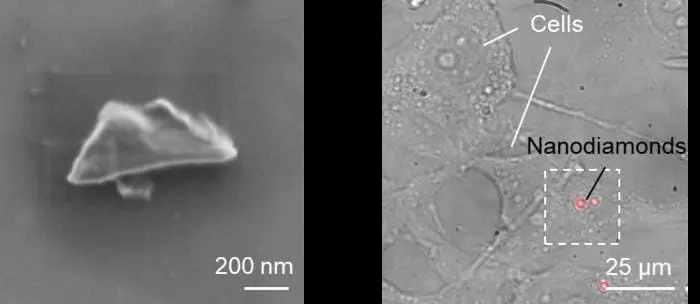
Researchers at Okayama University in Japan, led by Research Professor Masazumi Fujiwara, have developed high-quality nanodiamonds with nitrogen-vacancy centers that exhibit superior spin properties and fluorescence. These nanodiamonds have potential applications in bioimaging and quantum sensing, allowing for the detection of changes in physical, chemical, or biological systems.
The development results from collaboration between Okayama University, Sumitomo Electric Company, and the National Institutes for Quantum Science and Technology. Professor Fujiwara’s team has created biocompatible nanodiamonds that can interact with specific biological molecules, making them valuable tools for biological sensing.
The nanodiamonds can detect small temperature changes and have potential applications in diverse fields, including healthcare, technology, and environmental management. With their advanced sensing capabilities, these nanodiamonds may transform the way diseases are detected and treated and improve the performance of energy-efficient electronic devices.
Introduction to Nanodiamonds and Quantum Sensing
Nanodiamonds (NDs) with nitrogen-vacancy (NV) centers have emerged as promising quantum nanosensors due to their unique properties. These centers are created by replacing a carbon atom with nitrogen near a lattice vacancy in a diamond structure, allowing them to emit photons that maintain stable spin information and are sensitive to external influences like magnetic fields, electric fields, and temperature. Developing high-quality NDs with NV centers is crucial for advancing quantum sensing applications, particularly in biological systems.
The use of NDs in bioimaging and quantum sensing has been limited by their lower spin quality compared to bulk diamonds, resulting in reduced sensitivity and accuracy in measurements. However, recent advancements have led to the development of nanodiamond sensors with improved spin properties, making them suitable for bioimaging applications. Researchers from Okayama University in Japan have successfully developed NDs with exceptionally high-quality spins, which possess properties highly sought after for quantum biosensing and other advanced applications.
Producing high-quality diamonds with few impurities is essential for creating NDs with superior spin properties. Researchers can create NV centers with improved spin quality by growing single-crystal diamonds enriched with 99.99% 12C carbon atoms and introducing a controlled amount of nitrogen. The resulting NDs have shown strong fluorescence, achieving a photon count rate of 1500 kHz, making them suitable for bioimaging applications.
Properties and Applications of Nanodiamonds
The developed NDs have enhanced spin properties compared to larger commercially available NDs. They require 10-20 times less microwave power to achieve a 3% ODMR contrast, have reduced peak splitting, and demonstrate significantly longer spin relaxation times (T1 = 0.68 ms, T2 = 3.2 µs). These improvements indicate that the NDs possess stable quantum states that can be accurately detected and measured with low microwave radiation, minimizing the risk of microwave-induced cell toxicity.
The potential applications of these advanced NDs are diverse, ranging from biological sensing of cells for early disease detection to monitoring battery health and enhancing thermal management and performance for energy-efficient electronic devices. The ability to detect small temperature changes, with a temperature sensitivity of 0.28 K/√Hz, makes them suitable for various applications, including healthcare, technology, and environmental management.
Evaluation of Nanodiamonds in Biological Systems
Researchers introduced NDs into HeLa cells to evaluate their potential for biological sensing and measured the spin properties using ODMR experiments. The NDs were bright enough for clear visibility and produced narrow, reliable spectra despite some impact from Brownian motion (random ND movement within cells). Furthermore, the NDs could detect small temperature changes, demonstrating their potential for biological sensing applications.
The use of NDs in biological systems has the potential to transform healthcare by enabling early disease detection and providing sustainable solutions for future challenges. The advancements in ND development can potentially improve quality of life and provide innovative solutions for various industries.
Conclusion and Future Perspectives
In conclusion, developing high-quality nanodiamonds with nitrogen-vacancy centers has opened up new avenues for quantum sensing applications, particularly in biological systems. The improved spin properties of these NDs make them suitable for bioimaging and biological sensing applications, with potential uses in healthcare, technology, and environmental management.
Future research should focus on further improving the spin properties of NDs, exploring their potential applications in various fields, and developing innovative methods for their production and functionalization. The collaboration between researchers from different disciplines will be essential for advancing the quantum sensing field and realizing nanodiamonds’ full potential.
About Okayama University and Research Professor Masazumi Fujiwara
Okayama University is one of the leading universities in Japan, aiming to create and establish a new paradigm for sustainable development. The university offers a wide range of academic fields, providing an enriching educational experience and conducting advanced research.
Research Professor Masazumi Fujiwara from Okayama University has been at the forefront of nanodiamond research, focusing on the development of nanomaterials and their applications in biological studies and quantum nanophotonics. His team has been actively engaged in international collaborative research, with a particular focus on projects such as the JST-ASPIRE program (JPMJAP2339). Professor Fujiwara’s work has received multiple awards, including the 2015 Masao-Horiba Award, the 2020 Osaka City University Nambu Yoichiro Award, and the 2016 MEXT Fellowship for Excellent Young Researchers.
External Link: Click Here For More


