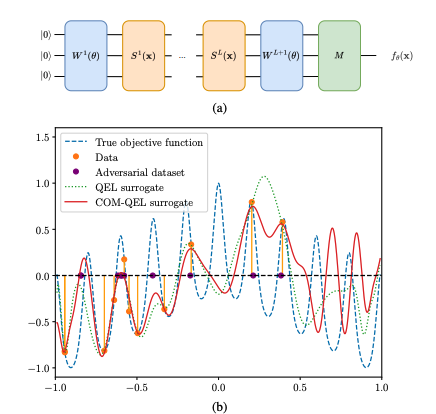
Researchers integrate conservative objective models with extremal learning, a circuit-based optimisation technique, to improve performance in offline model-based optimisation. This hybrid approach, termed COM-QEL, enhances predictive accuracy by mitigating overly optimistic extrapolations, consistently achieving higher objective values on benchmark tasks compared to standard QEL.
The challenge of optimising complex systems frequently arises when direct experimentation is costly or impractical, necessitating reliance on pre-existing data. Researchers are now investigating methods to enhance the reliability of predictive models used in such ‘offline’ optimisation scenarios, addressing the tendency of these models to overstate performance in unobserved regions. A new approach, detailed in a paper by Sotirov, Paine, Varsamopoulos, Gentile, and Simeone, integrates quantum-enhanced learning with conservative modelling techniques. Their work, titled ‘Conservative quantum offline model-based optimization’, demonstrates improved performance on benchmark tasks by combining the expressive power of quantum circuits with a regularisation method designed to produce cautious predictions when extrapolating beyond the initial dataset. This combination aims to identify solutions with demonstrably higher objective values in offline design problems, offering a more robust approach to optimisation when active experimentation is unavailable.
Offline model-based optimisation (MBO) addresses the challenge of optimising a function when only a static dataset of input-output pairs is available, precluding active experimentation. This limitation necessitates reliance on surrogate models, approximations of the true objective function built from the existing data. Recent work introduces a novel approach integrating Quantum Extremal Learning (QEL) with Conservative Objective Models (COM) to enhance the reliability of these surrogate models. QEL utilises the expressive power of quantum circuits, computational models leveraging quantum mechanical phenomena, to rapidly learn accurate approximations of the objective function, potentially offering advantages over classical machine learning methods.
Predictive models frequently exhibit over-optimistic extrapolations when applied
Predictive models frequently exhibit over-optimistic extrapolations when applied to unexplored regions of the input space, potentially leading to suboptimal solutions. This occurs because models, trained on limited data, can confidently predict high values in areas where they have no supporting evidence. To mitigate this, researchers incorporate COM, a regularisation technique designed to produce cautious predictions for out-of-distribution inputs. Regularisation introduces penalties to the model during training, discouraging it from making overly confident predictions in areas where data is sparse.
The resulting hybrid approach, termed COM-QEL, combines the benefits of QEL’s expressive power with the generalisation safeguards offered by conservative modelling, creating a robust optimisation framework. COM achieves cautious predictions by penalising predictions that deviate significantly from the observed data, effectively reducing the risk of selecting overly optimistic solutions in unexplored regions and improving the reliability of the optimisation process. The penalty is typically proportional to the distance between the predicted value and the range of values observed in the training data.
Empirical evaluations on standard benchmark optimisation tasks demonstrate the superiority of COM-QEL over the original QEL method. Specifically, COM-QEL consistently identifies solutions that yield higher true objective values, confirming its enhanced reliability for offline design problems. These benchmarks typically involve functions with known optima, allowing for a direct comparison of the performance of different optimisation algorithms.
This improvement stems from the model’s ability to avoid overly optimistic predictions, leading to more robust and accurate optimisation results. The findings validate the effectiveness of combining quantum machine learning techniques with established regularisation strategies, paving the way for more reliable and efficient optimisation algorithms. The success of COM-QEL highlights the importance of incorporating prior knowledge and constraints into the optimisation process, particularly in offline settings where data is limited.
Future work will focus on exploring the scalability
Future work will focus on exploring the scalability of COM-QEL to higher-dimensional problems, where the complexity of the optimisation landscape increases significantly. Researchers also plan to investigate the potential for combining it with other quantum machine learning techniques, such as quantum generative models, to further enhance its performance. Application to real-world optimisation problems in areas such as drug discovery and materials science is also planned, demonstrating its practical utility.
The research builds upon prior work in quantum machine learning, particularly in the area of variational quantum circuits, which are parameterised quantum circuits trained using classical optimisation algorithms. It also draws inspiration from classical model-based optimisation techniques, establishing a strong foundation for future research. By integrating conservative modelling principles, the authors address a critical limitation of predictive models in offline settings, enhancing their robustness and reliability.
🗞 Conservative quantum offline model-based optimization
🧠 DOI: https://doi.org/10.48550/arXiv.2506.19714