

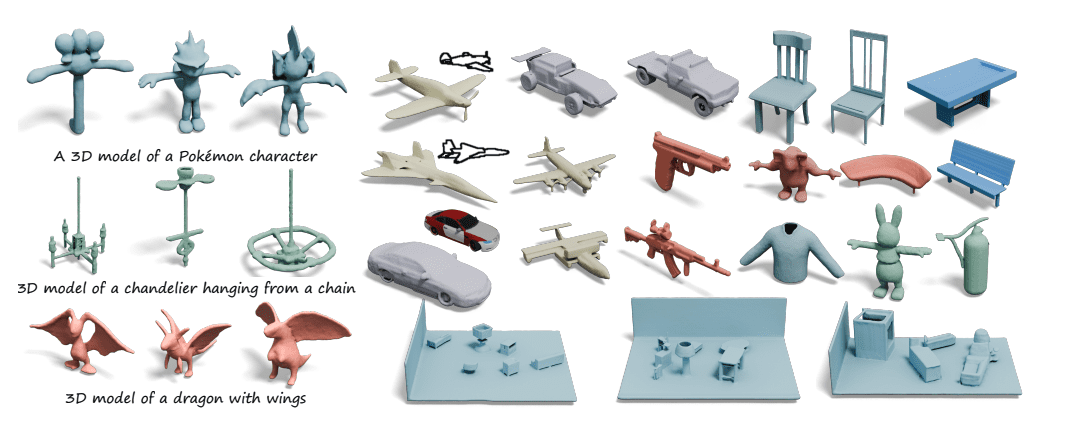
On April 14, 2025, researchers at NVIDIA introduced OctGPT: Octree-based Multiscale Autoregressive Models for 3D Shape Generation, a novel approach that enhances efficiency and performance in 3D shape generation through an octree-based model, achieving significant reductions in training and generation times while demonstrating versatility across various tasks.
OctGPT introduces a multiscale autoregressive model for efficient 3D shape generation, surpassing prior methods and rivaling diffusion models. Using octree structures and VQVAE, it captures hierarchical geometry and fine details as compact binary sequences. Enhanced transformers with 3D rotary encodings and parallel generation reduce training time by 13x and generation by 69x, enabling high-resolution shapes on four GPUs in days. OctGPT excels in text-, sketch-, image-conditioned tasks and scene synthesis, offering a scalable paradigm for high-quality 3D content creation.
In the evolving landscape of 3D shape generation, OctGPT emerges as a groundbreaking approach, utilizing octrees and autoregressive models to achieve high-quality results efficiently. This innovation represents a significant leap forward in the field, offering enhanced performance and streamlined design compared to existing methods.
OctGPT’s architecture begins with a Vector Quantized Variational
OctGPT’s architecture begins with a Vector Quantized Variational Autoencoder (VQVAE), which compresses intricate 3D models into compact representations. This process employs octrees—hierarchical data structures that partition space effectively, enabling efficient encoding of complex shapes. By converting these shapes into an octree format, the model manages details more effectively, setting a robust foundation for subsequent generation tasks.
Building on this base, OctGPT implements an autoregressive model to predict each node in the octree sequentially. This method ensures a coherent and efficient workflow, as each step depends on the previous one. Unlike traditional multi-stage methods that often require auxiliary models, OctGPT operates as an end-to-end solution, simplifying implementation and reducing potential errors.
OctGPT’s efficiency is demonstrated through its ability to handle longer sequences effortlessly. For example, processing 20K tokens takes just 0.4 seconds, outperforming competitors that either take significantly longer or encounter memory issues. This capability highlights the model’s scalability and adaptability across various tasks.
Rigorous testing on datasets such as ShapeNet and Objaverse revealed OctGPT’s superior performance. It achieved a shading-image-based FID score of 59.91, compared to OctFusion’s 81.25, indicating improved quality and diversity in generated shapes. Additionally, the CLIP-ViT score further validated these benefits, underscoring OctGPT’s effectiveness.
The implications of OctGPT are vast, with potential
The implications of OctGPT are vast, with potential applications in gaming, virtual reality, product design, and beyond. These fields stand to benefit from its efficient generation of high-quality 3D models. However, questions remain about scalability—specifically, how the model handles increasingly complex shapes or larger datasets beyond current tests.
While OctGPT showcases impressive capabilities, its training demands substantial resources, requiring multiple top-tier GPUs like NVIDIA 4090s. This barrier to entry suggests a need for future research into reducing resource requirements without compromising performance.
In conclusion, OctGPT represents a promising advancement in 3D shape generation, offering a cleaner, more efficient solution compared to previous methods. Its ability to handle complex tasks with superior metrics positions it as a valuable tool across various industries, paving the way for further innovations in this field.
🗞 OctGPT: Octree-based Multiscale Autoregressive Models for 3D Shape Generation
🧠 DOI: https://doi.org/10.48550/arXiv.2504.09975


