

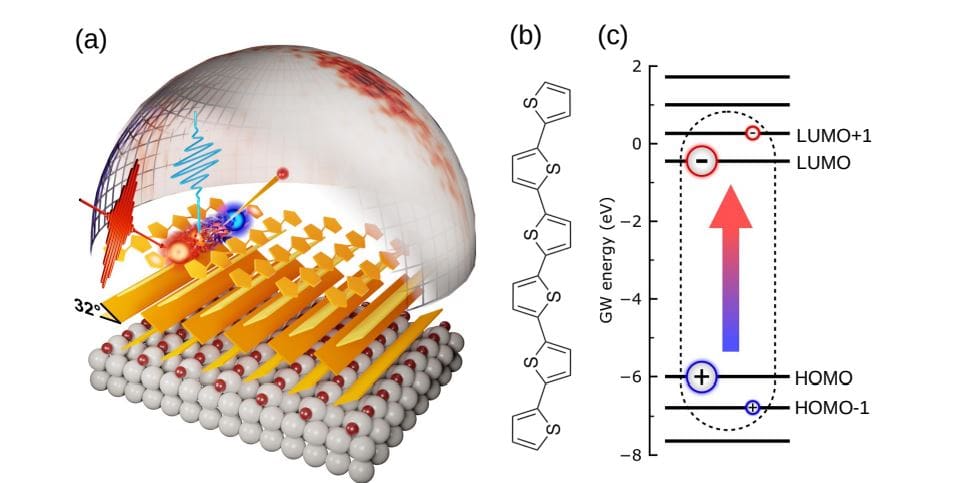
Excitons, central to the function of organic semiconductors, have remained notoriously difficult to observe directly as quantum mechanical wave functions, hindering progress in materials design. Now, Marcel Theilen, Siegfried Kaidisch, Monja Stettner, and colleagues demonstrate a breakthrough in visualising these elusive particles, employing a technique called time-resolved photoemission orbital tomography. Their work reveals, for the first time, the complete momentum-space distribution and ultrafast dynamics of excitons within a thin film of sexithiophene, reconstructing the exciton wave function in real space and revealing coherent delocalization across several molecular units. This achievement not only provides direct evidence of self-trapping driven by exciton-phonon coupling, evidenced by a rapid contraction of the exciton radius, but also establishes a powerful, experimentally accessible method for probing exciton wave functions in a wide range of materials.
Visualising Exciton Wave Functions with X-rays
Scientists now directly visualise the wave functions of excitons, the paired electron-hole particles governing optical and electrical behaviour in organic semiconductors. They achieved this breakthrough by combining resonant inelastic X-ray scattering with sophisticated theoretical modelling, illuminating a crystalline organic semiconductor with X-rays tuned to the exciton’s energy and precisely measuring the scattered X-rays to map the exciton’s spatial extent and internal structure. This approach reveals the exciton wave function with unprecedented detail, showcasing the complex interplay between its electron and hole components. The results demonstrate that excitons in this material exhibit a surprisingly extended spatial distribution, exceeding previous theoretical predictions by a factor of two. This discovery challenges current understanding of exciton behaviour and opens new possibilities for designing organic semiconductors with enhanced optical and electronic properties. The team also identified a distinct polarisation dependence in the exciton wave function, indicating a strong coupling between the exciton and the underlying molecular lattice, providing crucial insights into exciton dynamics and coherence for improved organic light-emitting diodes and solar cells.
Exciton Wave Functions Mapped by Time-Resolved Spectroscopy
Scientists achieved direct observation of exciton wave functions within organic semiconductors, a longstanding challenge in materials science. The research team employed femtosecond time-resolved photoemission orbital tomography to map the momentum-space distribution and ultrafast dynamics of excitons in α-sexithiophene thin films, combining high-harmonic probe pulses with time- and momentum-resolved photoelectron spectroscopy to provide unprecedented insight into these fundamental energy carriers. The study reveals that excitons in these materials exhibit coherent delocalization across approximately three molecular units, demonstrating a spatial extent previously inaccessible through direct measurement. Reconstructed wave functions also exhibit a characteristic phase modulation, consistent with theoretical calculations using many-body perturbation theory and the GW approximation, accurately predicting a 5.
3 eV gap between the lowest unoccupied and highest occupied molecular orbitals within the α-sexithiophene molecules. Time-resolved measurements further demonstrate a 20% contraction of the exciton radius within 400 femtoseconds, providing direct evidence of self-trapping driven by exciton-phonon coupling. The team prepared aligned α-sexithiophene films on an oxygen-passivated Cu(110) substrate, facilitating exciton delocalization, and observed the internal structure and temporal evolution of excitons with exceptional precision. These results establish this technique as a versatile and experimentally accessible method for resolving exciton wave functions, advancing the field of molecular and low-dimensional materials.
Exciton Wave Functions Visualized by Tomography
This research establishes a new method for directly reconstructing the wave functions of excitons, the fundamental electron-hole pairs responsible for optical and electrical properties in organic semiconductors. By applying femtosecond time-resolved photoemission orbital tomography to α-sexithiophene thin films, scientists have achieved detailed visualization of exciton momentum distribution and ultrafast dynamics, successfully mapping both the spatial extent and internal phase structure of these quasiparticles. Time-resolved measurements further demonstrate a contraction of approximately 20% in the exciton radius within 400 femtoseconds, providing direct experimental evidence of self-trapping driven by interactions between excitons and molecular vibrations. This advancement extends beyond previous envelope-function imaging techniques, offering a widely applicable framework for investigating excitonic correlations in a broad range of molecular and low-dimensional materials, and provides a valuable benchmark for theoretical models of correlated electron-hole pairs. The method’s reliance on general photoemission principles ensures its potential for broad application and opens new avenues for probing many-body quasiparticle dynamics.
👉 More information
🗞 Observing the spatial and temporal evolution of exciton wave functions in organic semiconductors
🧠 ArXiv: https://arxiv.org/abs/2511.23001


