
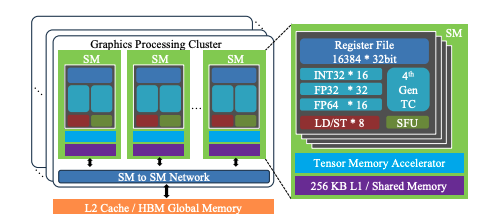
Researchers have conducted a comprehensive study on Nvidia’s Hopper GPU architecture, aiming to understand its microarchitectural intricacies and new features, including new tensor cores and distributed shared memory. The study involved benchmarking the three most recent GPU architectures: Hopper, Ada, and Ampere. The findings offer a deeper understanding of the novel GPU AI function units and programming features introduced by the Hopper architecture, which is expected to facilitate software optimization and modeling efforts for GPU architectures. This is the first study to demystify the tensor core performance and programming instruction sets unique to Hopper GPUs.
What is the Nvidia Hopper GPU Architecture?
The Nvidia Hopper GPU architecture is a continually evolving technology designed to cater to the computational demands of contemporary general-purpose workloads, particularly those driven by artificial intelligence (AI) utilizing deep learning techniques. A substantial body of studies have been dedicated to dissecting the microarchitectural metrics characterizing diverse GPU generations, which helps researchers understand the hardware details and leverage them to optimize the GPU programs. However, the latest Hopper GPUs present a set of novel attributes, including new tensor cores supporting FP8 DPX and distributed shared memory. Their details still remain mysterious in terms of performance and operational characteristics.
The objective of the research conducted by Weile Luo1 Ruibo Fan1 Zeyu Li1 Dayou Du1 Qiang Wang2 Xiaowen Chu13 was to unveil the microarchitectural intricacies of the Hopper GPU through an examination of the new instruction-set architecture (ISA) of Nvidia GPUs and the utilization of new CUDA APIs. The approach involved two main aspects. Firstly, conventional latency and throughput comparison benchmarks were conducted across the three most recent GPU architectures, namely Hopper, Ada, and Ampere. Secondly, a comprehensive discussion and benchmarking of the latest Hopper features were delved into.
The microbenchmarking results presented offer a deeper understanding of the novel GPU AI function units and programming features introduced by the Hopper architecture. This newfound understanding is expected to greatly facilitate software optimization and modeling efforts for GPU architectures. To the best of the researchers’ knowledge, this study makes the first attempt to demystify the tensor core performance and programming instruction sets unique to Hopper GPUs.
How Have GPUs Evolved?
Graphics Processing Units (GPUs) have experienced a significant leap in their capacity to accelerate a wide array of applications spanning from neural networks to scientific computing. This growth has been particularly propelled by the emergence of large language models (LLMs), where models like GPT-3 boasting over 150 billion parameters stand as prime examples. Modern GPU architectures such as Ampere, Ada, and Hopper embody cutting-edge features like tensor cores and high-bandwidth memory meticulously crafted to elevate artificial intelligence applications.
Nvidia consistently introduces new GPU architectures every two years, incorporating advanced features. However, detailed microarchitecture information about these features is often limited, making precise quantification challenging. In-depth studies are increasingly essential to understand the impact of these advancements on application performance. The tensor core (TC) unit was initially introduced with the Volta architecture, focusing on accelerating deep neural networks with FP16 and FP32 precision operations. Subsequent Ampere architectures expanded TC capabilities to include sparsity and a broader range of data precisions such as INT8, INT4, FP64, BF16, and TF32. The Hopper architecture extended this further, introducing support for FP8 precision, significantly enhancing LLM training and inference acceleration.
What are the Unique Features of the Hopper Architecture?
In addition to the new tensor core, Hopper introduces innovative features: Dynamic Programming X (DPX) instructions, distributed shared memory (DSM), and an enhanced asynchronous execution mechanism, Tensor Memory Accelerator for diverse scenarios. DPX instructions accelerate a wide range of dynamic programming algorithms, often involving numerous minimum/maximum operations for comparing previously computed solutions. DSM enables direct SM-to-SM communications, including loads, stores, and atomics across multiple SM shared memory blocks. Hopper supports asynchronous copies between thread blocks within a cluster, enhancing efficiency. However, detailed implementation and performance specifics remain undisclosed in existing literature. Unveiling these technical details is crucial for programmers to optimize AI applications effectively and leverage the new features of modern GPUs.
How was the Benchmarking Study Conducted?
In this study, a comprehensive benchmarking of the latest GPU architectures, Ampere, Ada, and Hopper, focusing on key features like tensor cores and asynchronous operations was conducted. To the best of the researchers’ knowledge, their research presents a pioneering analysis of the new programming interfaces specific to the Hopper architecture, offering a unique horizontal performance comparison among these cutting-edge GPU architectures. Many of their findings are novel and being published for the first time, providing valuable insights.
The researchers conducted detailed instruction-level testing and analysis on memory architecture and tensor cores across three GPU generations with different architectures. Their analysis highlights the unique advantages and potential of the Hopper architecture. They also compared AI performance across recent GPU generations, examining latency and throughput.
What are the Implications of the Study?
The study’s findings offer a deeper understanding of the novel GPU AI function units and programming features introduced by the Hopper architecture. This newfound understanding is expected to greatly facilitate software optimization and modeling efforts for GPU architectures. The study makes the first attempt to demystify the tensor core performance and programming instruction sets unique to Hopper GPUs. This information is crucial for programmers to optimize AI applications effectively and leverage the new features of modern GPUs. The research presents a pioneering analysis of the new programming interfaces specific to the Hopper architecture, offering a unique horizontal performance comparison among these cutting-edge GPU architectures.
Publication details: “Benchmarking and Dissecting the Nvidia Hopper GPU Architecture”
Publication Date: 2024-02-20
Authors: Wenzhe Luo, Ruilin Fan, Zeyu Li, Ding‐Zhu Du et al.
Source: arXiv (Cornell University)
DOI: https://doi.org/10.48550/arxiv.2402.13499