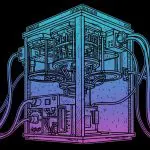
Jensen Huang, founder and CEO of NVIDIA, today announced NVIDIA NVQLink™, an open architecture designed to tightly couple the power of GPU computing with quantum processors, paving the way for accelerated quantum supercomputers. Developed with guidance from researchers at leading U.S. national laboratories, including Brookhaven, Fermi, and Los Alamos, NVQLink aims to bridge the gap between classical and quantum computing. This new interconnect provides the low-latency, high-throughput connection needed to manage qubit errors and unlock impactful quantum applications, uniting GPUs and quantum processors into a single, coherent system. U.S. Secretary of Energy Chris Wright emphasized that NVIDIA NVQLink is central to maintaining America’s leadership in high-performance computing and solving grand scientific challenges.
NVIDIA NVQLink: Uniting Quantum and Classical Computing Power
NVIDIA today announced NVQLink, an open system architecture designed to tightly couple the performance of GPU computing with quantum processors. This new approach aims to build accelerated quantum supercomputers, addressing a critical need for managing the complexities of quantum computation. According to the company, NVQLink facilitates an environment where qubits , the fundamental units of quantum information , can operate effectively despite their inherent fragility and error-proneness. The architecture is intended to support a broad ecosystem, currently including 17 QPU builders, five controller builders, and nine U.S. national laboratories.
The architecture provides a low-latency, high-throughput connection between quantum processors and conventional supercomputers, essential for running the demanding calibration and error correction algorithms required for stable quantum operations. Building on this, U.S. national laboratories, guided by the Department of Energy, will utilize NVIDIA NVQLink to drive breakthroughs in quantum computing research. According to Jensen Huang, founder and CEO of NVIDIA, NVQLink represents a “Rosetta Stone” connecting quantum and classical supercomputers, effectively uniting them into a single, coherent system. This integration marks the beginning of a new era in quantum-GPU computing.
“NVQLink is the Rosetta Stone connecting quantum and classical supercomputers — uniting them into a single, coherent system that marks the onset of the quantum-GPU computing era.”
founder and CEO Jensen Huang, NVIDIA
Maintaining American leadership in high-performance computing requires this bridge to accelerated quantum supercomputing, stated U.S. Secretary of Energy Chris Wright. The deep collaboration between national laboratories, startups, and industry partners like NVIDIA is central to this mission. NVQLink provides the critical technology to unite world-class GPU supercomputers with emerging quantum processors, promising to expand the possibilities of computing across numerous industries and research fields. The company anticipates that in the near future, every NVIDIA GPU scientific supercomputer will be hybrid, tightly coupled with quantum processors.
Accelerating Quantum Supercomputers with NVIDIA’s New Architecture
Building on this advancement, NVIDIA NVQLink is designed to address the critical need for low-latency, high-throughput communication between quantum processors and classical GPUs. According to the company, the architecture supports 17 QPU builders, five controller builders, and nine U.S. national laboratories, fostering a broad ecosystem for quantum computing development. This open approach is intended to accelerate the integration of diverse quantum technologies with NVIDIA’s GPU supercomputing platforms, enabling researchers to tackle increasingly complex problems. The system’s design prioritizes minimizing communication bottlenecks, a key challenge in hybrid quantum-classical systems.
The architecture’s performance is significantly enhanced by its ability to manage the delicate nature of qubits. Qubits require constant calibration and error correction, demanding substantial computational resources and rapid data transfer. Jensen Huang, founder and CEO of NVIDIA, emphasized that NVQLink is the essential connection, uniting quantum and classical systems into a single, coherent framework. The technology facilitates the environment necessary for transformative applications across various industries, allowing for the efficient execution of quantum algorithms and the real-time processing of quantum data.
U.S. national laboratories, guided by the Department of Energy, are poised to leverage NVIDIA NVQLink to achieve breakthroughs in quantum computing. Chris Wright, U.S. Secretary of Energy, stated that maintaining American leadership in high-performance computing necessitates building this bridge to accelerated quantum supercomputing. This collaboration between national labs, startups, and industry partners like NVIDIA is central to this mission, promising to unlock the full potential of quantum computation and solidify the nation’s position at the forefront of this rapidly evolving field.
NVQLink Ushers in Tightly-Coupled Quantum-GPU Era
According to the company announcement, NVIDIA NVQLink supports an expansive ecosystem of quantum processing unit (QPU) builders, controller builders, and U.S. national laboratories. Currently, the architecture integrates with seventeen QPU builders, five controller builders, and nine national labs, demonstrating a broad commitment to open collaboration. This widespread adoption is intended to accelerate the development and deployment of accelerated quantum supercomputers across diverse research areas. Jensen Huang emphasized that this interconnectedness is foundational to realizing the full potential of hybrid quantum-classical computing.
Building on this open approach, NVIDIA NVQLink addresses the critical challenge of maintaining qubit stability and correcting errors. Qubits, the fundamental units of quantum information, are inherently delicate and prone to errors, necessitating complex calibration and error correction algorithms. These algorithms require extremely low-latency, high-throughput connections to conventional supercomputers to function effectively, and NVQLink provides this crucial interconnect. The company reports this architecture is designed to manage the demanding computational load required for real-time qubit control and error mitigation.
U.S. national laboratories, guided by the Department of Energy, are poised to leverage NVIDIA NVQLink to achieve breakthroughs in quantum computing. Chris Wright stated that maintaining American leadership in high-performance computing hinges on building this bridge to the next era of computing. This collaboration between national labs, startups, and industry partners like NVIDIA is central to the mission of uniting world-class GPU supercomputers with emerging quantum processors, promising transformative applications across industries and scientific disciplines.
NVIDIA’s NVQLink architecture represents a pivotal step toward realizing the potential of accelerated quantum supercomputers. By tightly coupling quantum processors with GPU computing, researchers at institutions like Brookhaven National Laboratory and Fermi Laboratory gain a critical tool for managing qubit errors and developing impactful applications. This development could enable more complex quantum algorithms to run efficiently, accelerating progress in fields reliant on advanced computation.
The implications extend beyond quantum computing itself, potentially transforming industries that demand high-performance processing. For organizations like the Department of Energy’s Oak Ridge National Laboratory and Sandia National Laboratories, NVQLink provides an open and scalable platform. Ultimately, this interconnected approach promises to unlock new avenues for scientific discovery and innovation by bridging the gap between quantum and classical computing paradigms.