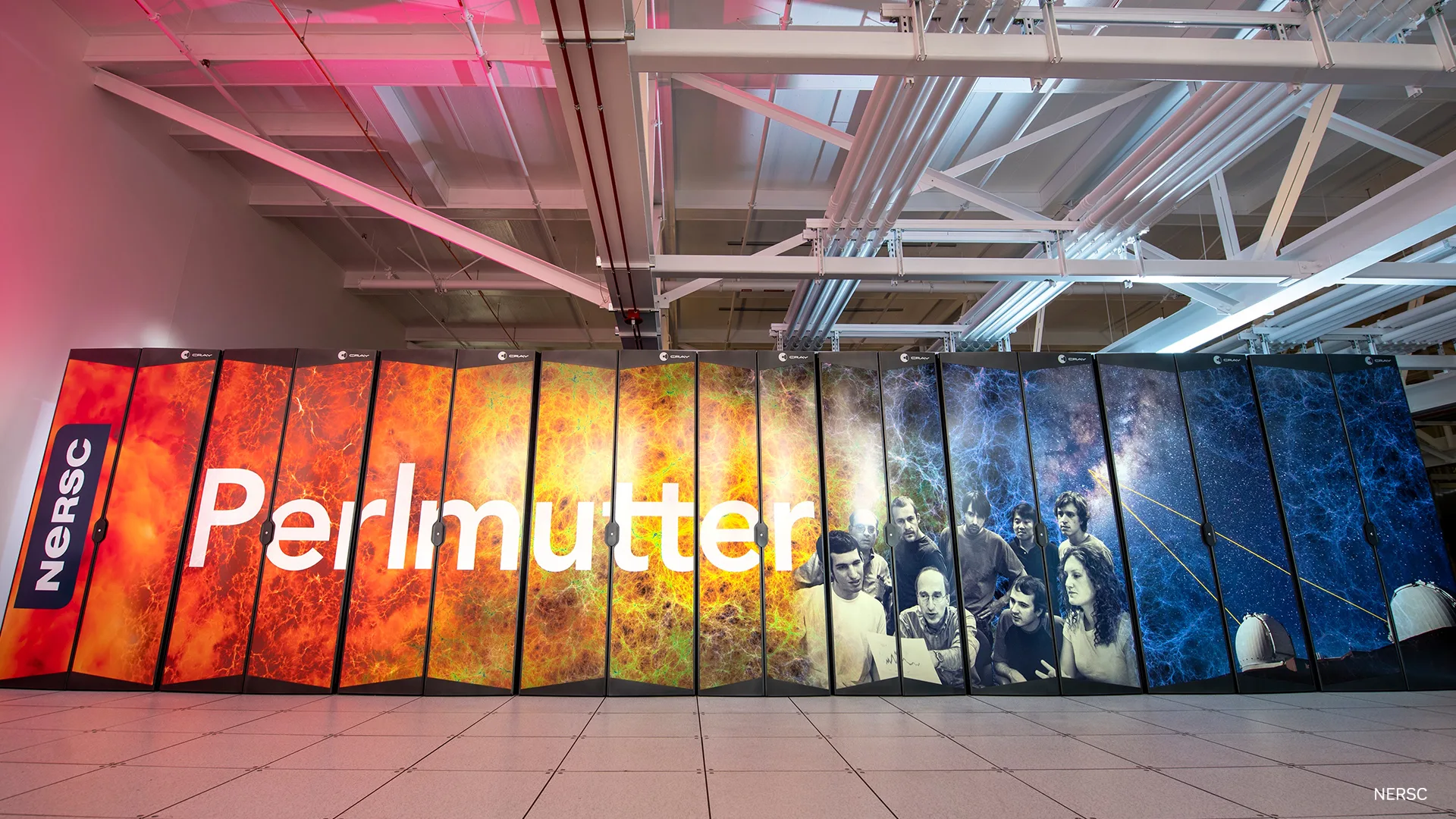
Researchers at Lawrence Berkeley National Laboratory have achieved the world’s largest full quantum chip simulation utilizing 6,724 NVIDIA GPUs on the Perlmutter supercomputer. This simulation, enabled by NVIDIA’s CUDA platform and the ARTEMIS simulation package, modeled a 1 cm quantum chip with over 10 billion grid points at micron resolution. The achievement allows for the capture of critical details such as cross-talk and signal distortion, addressing a significant engineering challenge in the development of large-scale quantum computers and benefiting from the application of Electronic Design Automation (EDA) tools to quantum chip design.
GPU-Accelerated Quantum Chip Simulation
Researchers at Berkeley Lab demonstrated the world’s largest full quantum chip simulation using 6,724 NVIDIA A100 Tensor Core GPUs on the Perlmutter supercomputer. This simulation modeled a 1 cm chip discretized into over 10 billion grid points at micron resolution. The team harnessed 95% of the Perlmutter system to achieve this, running the simulation for nearly eight hours to model 1.5 million time steps, reaching 1 nanosecond of physical time – critical for observing femtosecond-resolution propagation of control signals.
The simulation, utilizing the ARTEMIS package accelerated by the NVIDIA CUDA platform, enables a detailed, full-wave time-domain electromagnetic solver. This allows researchers to observe effects like cross-talk, mode coupling, and signal distortion – transient effects often missed by frequency-domain methods. ARTEMIS optimizes simulations for parallelization on NVIDIA GPUs, accurately modeling large, chip-scale systems while preserving fine spatial and temporal details across micrometer-scale qubit structures and centimeter-scale control lines.
GPU-accelerated simulations with ARTEMIS are 60x faster than CPU-only simulations on a node-by-node basis. This scalability allows for the observation of chip-level coupling dynamics and the testing of novel qubit architectures before fabrication. Researchers can now identify and reduce noise sources and cross-talk, accelerating the path towards building better, more robust quantum chips and shortening fabrication cycles.
Modeling Quantum Chip Spatial Scales
Researchers at Berkeley Lab demonstrated the largest full quantum chip simulation to date, modeling a 1 cm chip with over 10 billion grid points at micron resolution. This was achieved using 6,724 NVIDIA A100 Tensor Core GPUs on the Perlmutter supercomputer. The simulation, enabled by the ARTEMIS platform and NVIDIA’s CUDA platform, accurately resolves electromagnetic interactions from micrometer-scale qubit structures up to centimeter-scale control lines—critical for understanding chip-level coupling dynamics.
Accurate simulation of quantum chips requires resolving physics across multiple spatial scales, from micrometers to centimeters. Previous simulations were limited to either small, high-resolution regions or coarser-resolution, full-chip models lacking critical microscale detail. The ARTEMIS platform optimizes simulations for parallelization on NVIDIA GPUs, allowing researchers to achieve both large scale and fine detail, capturing transient effects like cross-talk and signal distortion often missed by other methods.
The simulation modeled the full-time dynamics of the chip for 1 nanosecond of physical time, requiring 1.5 million time steps. This allowed observation of control signal propagation at femtosecond resolution—critical for understanding crosstalk, a major hurdle in superconducting quantum chip design. GPU simulations were shown to be 60x faster than CPU-only simulations, accelerating the ability to test novel qubit architectures and reduce noise sources.
The team harnessed the full power of Perlmutter, running the simulation on 6,724 NVIDIA A100 Tensor Core GPUs, 95% of the entire system.
ARTEMIS Simulation Platform & Capabilities
The ARTEMIS simulation platform, developed by Berkeley Lab researchers, is an open-source package for full-wave simulation of novel chips. It utilizes the NVIDIA CUDA platform to accelerate simulations, recently achieving the world’s largest full quantum chip simulation on NVIDIA GPUs within the Perlmutter supercomputer. ARTEMIS optimizes comprehensive simulations for parallelization, enabling accurate modeling of large, chip-scale systems while preserving fine spatial and temporal details—resolving interactions from micrometer-scale qubit structures to centimeter-scale control lines.
ARTEMIS successfully modeled a 1 cm quantum chip discretized into over 10 billion grid points at micron resolution. This simulation, run on 6,724 NVIDIA A100 Tensor Core GPUs (95% of the Perlmutter system), took nearly eight hours to model 1.5 million time steps reaching 1 nanosecond of physical time. The platform’s ability to track control pulse propagation and interference in real-time reveals transient effects like cross-talk and signal distortion—details often missed by frequency-domain methods.
This GPU-accelerated approach provides significant speed improvements; GPU simulations are 60x faster than CPU-only simulations on a node-by-node basis. By providing a validated and scalable simulation framework, ARTEMIS allows physicists to test qubit architectures, reduce noise, and validate designs before fabrication. This capability is critical for building better, more robust quantum chips and accelerating the path toward useful quantum computing.
By drawing on the NVIDIA CUDA platform for a validated and scalable simulation framework, physicists can now test novel qubit architectures, identify and reduce noise sources and cross-talk, and validate quantum chip designs before entering the fabrication cycle.
NVIDIA CUDA Platform for Quantum Design
Researchers at Berkeley Lab have demonstrated the world’s largest full quantum chip simulation using 6,724 NVIDIA A100 Tensor Core GPUs on the Perlmutter supercomputer. This simulation modeled a 1 cm chip discretized into over 10 billion grid points at micron resolution. Utilizing the NVIDIA CUDA platform to accelerate the ARTEMIS simulation package, the team achieved a significant advancement in simulating complex quantum systems, allowing for detailed modeling of chip-level interactions and signal propagation.
The simulation focused on accurately capturing electromagnetic behavior across multiple spatial scales, from micrometer-scale qubit structures to centimeter-scale chip dimensions. This is crucial because traditional simulations often traded accuracy for scalability. By leveraging GPU-accelerated computing, researchers were able to model the full-time dynamics of the chip, observing signal propagation at femtosecond resolution, and identifying crucial details like crosstalk which impacts superconducting quantum chip design.
This work, enabled by the NVIDIA CUDA platform, provides a validated and scalable simulation framework for quantum chip design. The team demonstrated GPU simulations are 60x faster than CPU-only simulations. The ability to test qubit architectures, reduce noise, and validate designs before fabrication accelerates the path toward building more robust and useful quantum computers, addressing a significant hurdle in the field.
Simulating Chip Dynamics & Cross-Talk
Researchers at Berkeley Lab demonstrated the largest full quantum chip simulation to date, utilizing 6,724 NVIDIA A100 GPUs on the Perlmutter supercomputer. This simulation modeled a 1 cm chip with over 10 billion grid points at micron resolution. The goal was to accurately capture critical details like cross-talk and signal distortion, which are crucial for understanding quantum chip behavior and improving qubit design. This scale of simulation was previously unattainable due to computational demands.
The simulation employed the ARTEMIS platform, optimized for parallelization on NVIDIA GPUs using the CUDA platform, and allowed for a time-domain approach. This approach tracks how control pulses and microwave signals propagate, reflecting and interfering across the chip in real time—revealing transient effects like cross-talk that frequency-domain methods often miss. Observing these dynamics at femtosecond resolution is vital for identifying and mitigating noise sources.
This GPU-accelerated simulation framework enables physicists to test novel qubit architectures and validate designs before fabrication. The simulation revealed how fields couple through wires and seams, highlighting crosstalk paths. GPU simulations were shown to be 60x faster than CPU-only simulations, offering a powerful toolset to accelerate the development of robust quantum chips and shorten fabrication cycles.