
## NVIDIA Launches Full-Stack Autonomous Vehicle Software NVIDIA today announced the full production release of its DRIVE AV software platform at GTC Paris, part of VivaTech. This comprehensive system, combined with NVIDIA’s accelerated computing capabilities, provides automakers, truck manufacturers, robotaxi firms and start-ups globally with a foundation for developing and deploying AI-powered autonomous vehicles. The launch aims to accelerate the creation of safer, highly automated transport solutions and unlock a multitrillion-dollar market opportunity.
Full-Stack Software for Autonomous Vehicles
NVIDIA delivers a full-stack software platform, NVIDIA DRIVE AV, combining software and accelerated compute to facilitate the development of autonomous vehicles. Its modular architecture enables customers to implement features – such as surround perception and automated lane changes – scaling from level 2++ to level 3 automation, with a clear pathway to higher levels.
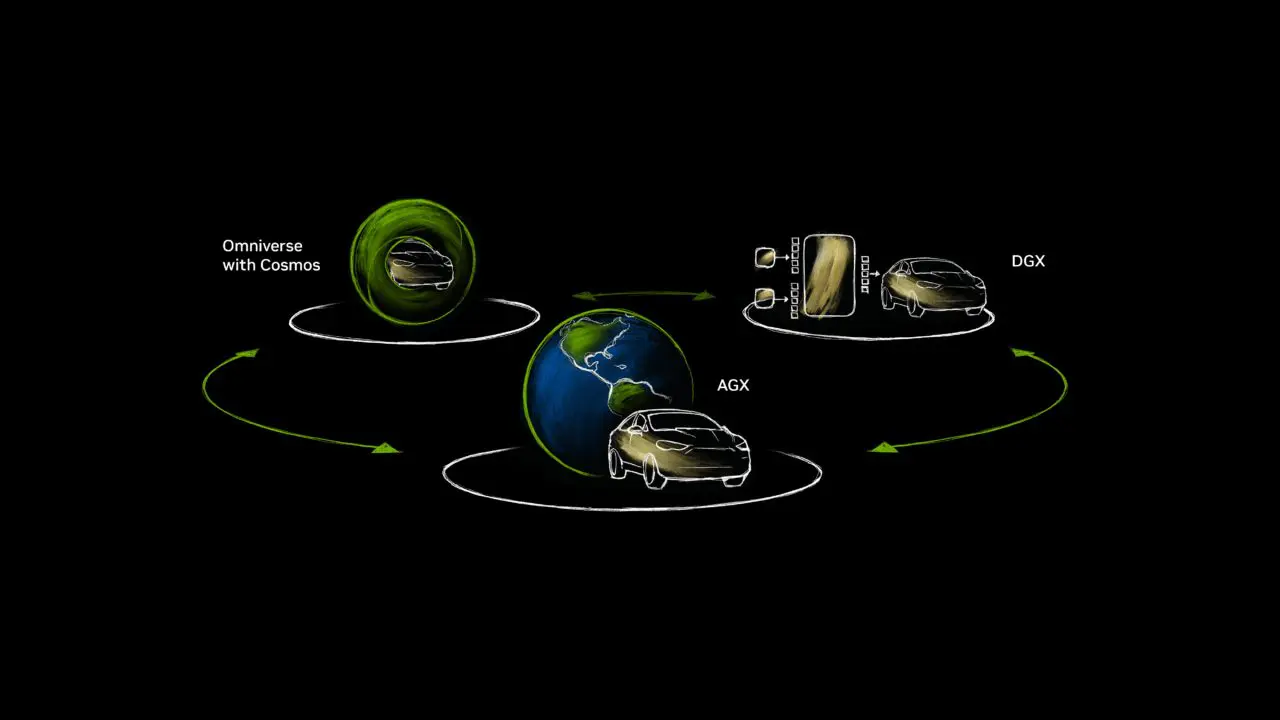
This development is supported by a three-computer solution. NVIDIA DGX systems and GPUs facilitate AI model training and software development. NVIDIA Omniverse and NVIDIA Cosmos platforms, running on NVIDIA OVX systems, enable large-scale simulation and synthetic data generation for testing and optimisation. Finally, the automotive-grade NVIDIA DRIVE AGX processes real-time sensor data within the vehicle.
NVIDIA DRIVE AV unifies perception, prediction, planning, and control using deep learning and foundation models trained on extensive driving data. This end-to-end approach eliminates the need for predefined rules, allowing vehicles to learn from both real and synthetic data, improving decision-making in complex environments. The NVIDIA Omniverse Blueprint for AV simulation converts limited human-driven miles into billions of virtually driven miles, enhancing data quality and scalability.
Safety is central to the system, bolstered by NVIDIA Halos, a comprehensive end-to-end safety system integrating hardware, software, AI models, and tools. This includes the NVIDIA DriveOS safety-certified operating system, compliant with ASIL B/D standards, providing a robust foundation for safe vehicle operation.
Unifying AI Functions with Deep Learning
NVIDIA DRIVE AV software unifies perception, prediction, planning, and control functions, employing deep learning and foundation models trained on extensive datasets of human driving behaviour. This approach processes sensor data and directly controls vehicle actions, obviating the need for predefined rules or traditional modular pipelines. Consequently, vehicles learn from both real and synthetic driving data, enabling safe navigation of complex environments with decision-making analogous to human drivers.
NVIDIA Omniverse Blueprint for AV simulation further refines the development process, providing physically accurate sensor simulation for training, testing, and validation. Combining this blueprint with NVIDIA’s three-computer solution allows developers to extrapolate from thousands of human-driven miles to billions of virtually driven miles, enhancing data quality and facilitating scalable, continuously improving autonomous systems.
Strengthening Safety with NVIDIA Halos
NVIDIA prioritises safety through the comprehensive NVIDIA Halos system, integrating hardware, software, AI models and tools to ensure safe autonomous vehicle (AV) development and deployment from cloud to car. Halos establishes safety guardrails across simulation, training and deployment, underpinned by 15,000 engineering years of expertise and incorporates the DriveOS safety-certified ASIL B/D operating system, meeting stringent automotive safety standards.
Industry Recognition and Future Applications
NVIDIA’s deployment of a full-stack autonomous vehicle (AV) software platform is gaining industry recognition, evidenced by its recent success in the End-to-End Autonomous Driving Grand Challenge at the Computer Vision and Pattern Recognition conference. This represents NVIDIA’s second consecutive win in the end-to-end category and its third consecutive Autonomous Grand Challenge award.
The platform’s scalability facilitates phased implementation; automakers can initially deploy subsets of advanced driver-assistance features – such as surround perception and automated lane changes – for level 2++ and level 3 vehicles. This provides a clear pathway towards higher levels of automation as technology matures and regulations evolve.
NVIDIA’s three-computer solution underpins this progression. DGX systems and GPUs facilitate AI model training and software development. Omniverse and Cosmos, running on OVX systems, enable large-scale simulation and synthetic data generation for validation and optimisation. Finally, the DRIVE AGX in-vehicle computer processes real-time sensor data for safe, highly automated driving.
These advancements are being leveraged by the European automotive industry, with NVIDIA partnering with manufacturers, suppliers and startups to transform vehicle design, engineering, manufacturing, and enable highly automated and self-driving vehicles.
More information
External Link: Click Here For More